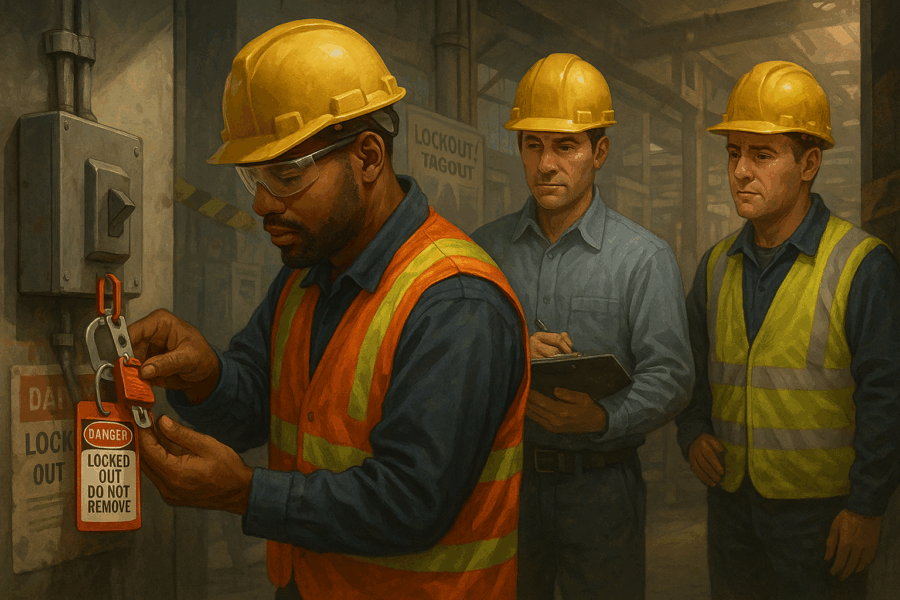
From Completion to Competence

Why Safety Training Fails When It Matters Most

By the second week of January, the training is already done.

Not all of it, of course—but enough of it. Enough to show progress bars inching toward green. Enough to feel that familiar sense of relief: We’re moving.

The LMS looks healthy. Completion rates are climbing. Calendars are full of refresher sessions and onboarding blocks. Somewhere, a spreadsheet is being quietly updated so that when someone eventually asks, “Are we covered?” the answer will be yes.

On paper, this is what a functioning safety program looks like.

In reality, most safety leaders know better.

Because they’ve seen what happens a few months from now—when the weather turns, production ramps up, schedules compress, and the first incident report lands in their inbox with a detail that stops them cold.

The employee involved? Fully trained.
The procedure? Covered.
The hazard? Addressed in the very course they completed six weeks earlier.

And yet, here they are.

That’s usually the moment when a question surfaces that doesn’t make it into meeting notes or dashboards.

What exactly are we accomplishing with all this training?

The Quiet Doubt No One Puts on the Agenda

Safety leaders rarely say this out loud, especially early in the year.

January is for optimism. For fresh starts. For plans and initiatives and renewed commitment. Questioning the effectiveness of training at that moment can feel almost disloyal—like undermining the very system you’re responsible for running.

So the doubt stays quiet.

It shows up in smaller ways. A longer pause before approving the next course. A subtle frustration when someone says, “Well, they were trained.” A sense that the organization is doing a lot of safety work without getting proportionate results.

This isn’t cynicism. It’s experience.

And experience teaches a hard truth: most safety training doesn’t fail in the classroom. It fails in the field.

Why Completion Feels Like Control

Completion metrics exist for a reason.

They’re clean. They’re defensible. They satisfy regulators, auditors, and legal teams. They allow leaders to demonstrate diligence in environments where diligence matters.

In a world full of uncertainty, completion creates certainty. Either the training was done or it wasn’t. Either the box is checked or it’s not.

That certainty is comforting.

It also happens to be misleading.

Because completion only proves that information was delivered. It says nothing about whether that information reshaped behavior, influenced decisions, or showed up when conditions were less than ideal.

Safety doesn’t break down during audits. It breaks down on a Tuesday afternoon when production slips and someone decides, quietly, to take a shortcut they’ve taken a hundred times before.

Completion metrics don’t see that moment.

The Gap Between Knowing and Doing

Most organizations operate under an assumption that feels reasonable but rarely holds up under pressure: if people know the rule, they’ll follow it.

The reality is more complicated.

Most incidents don’t happen because someone didn’t know what they were supposed to do. They happen because knowing wasn’t enough to overcome habit, urgency, or social expectation.

When people are rushed, distracted, or stressed, they don’t consult training materials. They rely on instinct. On muscle memory. On what feels normal in that environment.

If training hasn’t shaped those instincts, it hasn’t shaped safety.

This is where the idea of competence enters the conversation—and where things get uncomfortable.

The Brain That Gets Trained vs. the Brain That Shows Up

Most safety training is built for a calm, attentive audience. People sitting still, absorbing information, nodding along to slides that make perfect sense in isolation.

That brain exists.

It just doesn’t reliably show up at work.

The brain that shows up on the job is juggling competing priorities. It’s scanning for cues from coworkers. It’s balancing speed against risk. It’s influenced by what’s rewarded, tolerated, or quietly ignored.

In those conditions, behavior is driven less by knowledge than by norms.

Training that doesn’t account for that reality is training that looks good on paper and disappears in practice.

When Compliance Gets Mistaken for Readiness

Compliance training serves an important purpose. Regulations exist for a reason, and documentation matters.

The problem begins when compliance is mistaken for readiness.

Compliance asks, “Have we met the requirement?”
Readiness asks, “Are we prepared for what actually happens?”

Those questions are related—but they’re not the same.

An organization can be fully compliant and deeply unprepared. It can document every course, every signature, every certificate, and still find itself reacting to the same preventable issues year after year.

That’s not a failure of effort. It’s a failure of measurement.

The Risk of Saying “Everyone Is Trained”

Few phrases sound more reassuring—and carry more hidden risk—than “everyone is trained.”

It signals closure. Completion. Resolution.

It can also shut down curiosity.

When leaders believe training is complete, they stop asking whether systems are reinforcing the right behaviors. They stop examining how work actually gets done under pressure. They stop noticing the quiet adaptations employees make to keep things moving.

Training becomes a shield rather than a lens.

And when incidents happen, the focus shifts quickly to individual behavior instead of system design.

That’s when learning stops.

What Competence Looks Like in Real Life

Competence is not loud.

It doesn’t announce itself with certificates or dashboards. It shows up in moments that rarely make reports.

A worker pauses because something doesn’t feel right—even though no one is watching.
A near miss gets reported without hesitation or fear.
A supervisor steps in early, not because a rule was broken, but because a pattern is forming.

Competence is situational. Contextual. Often invisible until it’s missing.

And because it’s subtle, it requires leaders to pay attention in different ways.

Why the Best Organizations Watch Patterns, Not Percentages

Organizations that consistently outperform on safety don’t obsess over whether training was completed on time.

They watch patterns.

They notice whether near-miss reporting increases after training—not because incidents are rising, but because awareness is.
They notice whether corrective actions become more thoughtful, more specific, more durable.
They notice whether supervisors talk about risk differently six months later than they did at the start of the year.

They treat behavior as data.

Not data for punishment—but data for learning.

The Unavoidable Role of Managers

Training doesn’t live or die in the LMS. It lives or dies in leadership behavior.

Employees pay close attention to what supervisors reinforce, what they overlook, and how they react when safety slows things down.

If managers treat training as a formality, employees do the same. If managers treat training as a shared language for making decisions, employees use it that way.

No amount of content can compensate for inconsistent leadership.

Competence is built in conversation, not courses.

The Slow Erosion of One-Time Training

Annual training assumes a stable environment.

Most workplaces aren’t stable.

Teams change. Processes evolve. Risks shift. What made sense in January may be outdated by June.

When training doesn’t adapt, it quietly loses relevance. Employees stop connecting it to their daily reality. Safety becomes something that exists in a separate mental category—important, but abstract.

The organizations that avoid this trap don’t necessarily train more. They reinforce more often. They keep safety present in small, contextual ways. They shorten the distance between learning and application.

They understand that frequency beats intensity.

The Question That Actually Matters at the Start of the Year

January is when organizations decide how honest they’re willing to be about safety.

They can ask whether training was completed.

Or they can ask something harder:

If something goes wrong tomorrow, do we trust the decisions people will make when no one is watching?

One question produces documentation.

The other produces insight.

Completion is comforting because it feels definitive. Competence is uncomfortable because it exposes uncertainty.

But uncertainty is where improvement begins.

Redefining What “Trained” Really Means

Perhaps the most important shift organizations need to make this year is linguistic.

Being “trained” should not mean exposed to information.

It should mean capable. Confident. Adaptable.

It should mean that when conditions change, people know how to respond—not because a rule says so, but because it makes sense to them.

If training doesn’t create that outcome, it isn’t training. It’s distribution.

And distribution alone has never kept anyone safe.

Choosing the Harder Path

Every safety leader faces the same choice at the start of the year.

They can continue measuring what’s easy to count and hoping it correlates to real-world outcomes.

Or they can begin measuring what actually matters—even if it’s harder, messier, and less immediately comforting.

Completion keeps programs alive.

Competence keeps people safe.

And the organizations that understand the difference are the ones that quietly outperform, year after year, while everyone else wonders why the same problems keep coming back.

Want to know how ready you are:  https://secova.us/how_safe_are_you

From Volatility to Vigilance in 2026

When Market Stability Becomes a Chance to Reset Safety

When the Noise Gets Loud, Safety Gets Quiet

The last two years have been noisy.

For manufacturers, contractors, and industrial operators, 2024 and 2025 were defined less by a single crisis and more by a steady drumbeat of uncertainty. A new administration brought shifts in regulatory tone and policy direction. Tariffs were introduced or adjusted, altering cost structures, supplier relationships, and production planning almost overnight. Forecasts changed mid-quarter. Procurement strategies were rewritten. Margins tightened. Timelines compressed.

In many organizations, leaders weren’t managing growth—they were managing volatility.

When volatility enters an organization, it doesn’t arrive politely. It doesn’t stay contained in boardrooms or planning decks. It travels fast and wide, pushing its way into daily operations, into shift schedules, into overtime decisions, into conversations between supervisors and crews.

Volatility forces reaction.  And reaction, by definition, narrows focus.

During unstable periods, leadership attention gets consumed by the urgent:

  • Protecting throughput
  • Managing costs
  • Adjusting staffing
  • Responding to customer pressure
  • Navigating supplier disruptions
  • Reforecasting again and again

None of this is reckless. In fact, much of it is necessary. Organizations must survive before they can improve.

But there is a quieter, more dangerous side effect of sustained volatility—one that rarely shows up on financial statements.

Safety doesn’t disappear during volatile times. It drifts.

It drifts not because leaders stop caring, but because attention is finite. And when attention is taxed, the non-immediate, non-loud, non-crisis work begins to slide to the edges.

Safety becomes one more thing to manage instead of a discipline to lead.

  • Training gets postponed because production can’t pause right now.
  • Audits get rushed because the quarter has to close.
  • Corrective actions stay open a little longer than they should.
  • Near misses get noted but not always discussed.
  • Supervisors hesitate before stopping work because everything feels behind.

These decisions don’t happen in isolation. They happen incrementally, over months, under pressure. And because they feel temporary, they often go unchallenged.

Until they aren’t temporary anymore.

Firefighting Changes Behavior—At Every Level

Volatility doesn’t just reshape strategy; it reshapes behavior.

At the leadership level, firefighting compresses decision cycles. There’s less time for deliberation, more reliance on instinct, and a tendency to prioritize speed over structure. That urgency filters downward.

At the supervisory level, production pressure becomes personal. Supervisors are caught between expectations from above and realities on the floor. When every shift feels behind, stopping work—even for legitimate safety concerns—starts to feel like a risk in itself.

At the frontline level, the effects are physical and cognitive.

Workers feel it in:

  • Longer hours
  • Irregular schedules
  • More overtime
  • Fewer breaks between changes
  • Increased mental load
  • Constant adjustments to “how we do things now”

Fatigue creeps in quietly. Distraction follows. The margin for error narrows.

This is not a moral failing. It’s a human one.

Accidents don’t spike because people stop caring.
They spike because people are tired, distracted, and under pressure.

When organizations live in reaction mode long enough, deviation becomes normalized. Shortcuts feel justified. “Just this once” turns into “this is how we do it now.” The line between acceptable risk and unacceptable risk blurs—not deliberately, but gradually.

And this is where safety leaders often find themselves frustrated.

They see the drift.
They feel the tension.
They know the risks are rising.

But they’re operating inside the same volatile environment as everyone else.

The Entire Organization Feels Volatility—Not Just the Top

One of the most misunderstood aspects of market instability is how deeply it penetrates the organization.

Volatility is often discussed as a leadership problem—something executives and finance teams deal with. But its impact is profoundly human.

Frontline workers don’t read tariff policy memos.
They feel the results.

They feel it when materials arrive late.
When production schedules shift with little notice.
When staffing levels fluctuate.
When expectations tighten but resources don’t.
When yesterday’s process suddenly changes because “we had to adapt.”

Uncertainty creates cognitive load. Cognitive load increases risk.

In this environment, safety systems are either:

  • A stabilizing force
    or
  • Another source of friction

When safety feels disconnected from daily work—something separate, additional, or bureaucratic—it is the first thing to be deprioritized during instability.

When safety is embedded into how work actually gets done, it becomes a counterweight to volatility instead of a casualty of it.

This distinction matters, especially as we look ahead.

A Subtle Shift Is Beginning

As 2025 moves toward its close, many organizations are beginning to sense something different. Not certainty—but relative stability.

The noise hasn’t vanished. But it has softened.

Forecasts feel slightly less fragile.
Planning cycles feel marginally more predictable.
There is room, again, to think beyond the next fire.

And with that space comes a rare opportunity.

Periods of stability don’t just enable growth—they enable discipline.

They create room to ask questions that couldn’t be asked during crisis:

  • What drifted while we were reacting?
  • Which “temporary” practices became permanent?
  • Where did safety become less consistent than we intended?
  • What signals did we miss because we were focused elsewhere?

This moment—this transition from volatility to relative calm—is one of the most important inflection points a safety organization can experience.

Because it’s here that leaders can choose to reset.

Not by adding more rules.
Not by issuing new slogans.
But by re-establishing structure, consistency, and shared responsibility.

Sammy’s Thoughts:
“Volatility forces reaction. Stability gives you back choice. What you do with that choice defines your safety culture for the next cycle.”

As markets stabilize and organizations prepare for growth in 2026, the question is no longer how to survive disruption.

The question is how to rebuild vigilance.

What Comes Next

The temptation, as stability returns, is to rush forward—to capitalize on momentum, to accelerate output, to regain what was lost.

But safety leaders understand something deeper:

Growth without structure simply recreates risk at scale.

The coming year isn’t just an opportunity to grow—it’s an opportunity to re-anchor safety as a proactive discipline, not a reactive one.

In the next section, we’ll explore exactly how safety drifts during periods of instability—and why vigilance must be intentionally rebuilt, not assumed, as conditions improve.

How Volatility Drives Safety Drift (Without Anyone Noticing)

Safety drift rarely announces itself.

There is no meeting where someone says, “Let’s care a little less about safety this quarter.” No memo goes out declaring that standards are now optional. No leader wakes up intending to compromise the well-being of their workforce.

And yet, over time, drift happens.

It happens precisely because it doesn’t feel like failure in the moment. It feels like adaptation.

During volatile periods—like those many organizations experienced across 2024 and 2025—adaptation becomes the dominant survival skill. Leaders adapt plans. Supervisors adapt schedules. Crews adapt workflows. Everyone adapts to moving targets.

The danger is not adaptation itself. The danger is what adaptation quietly displaces.

When volatility persists, safety doesn’t collapse. It erodes—one reasonable decision at a time.

The Subtle Trade-Offs That Create Risk

Safety drift is built from decisions that make sense in isolation.

A training session is postponed because a shipment arrived late and production has to catch up.
A corrective action is marked “in progress” for another month because the right part isn’t available yet.
A near miss is logged but not discussed because the shift is already running long.
A supervisor hesitates before stopping work because the line is already behind and tensions are high.

Each choice is defensible. Each one is temporary. Each one feels like an exception.

But drift isn’t caused by any single exception.
It’s caused by the accumulation of them.

Over time, those exceptions start to form a pattern—and patterns reshape norms.

What was once unacceptable becomes tolerated.
What was once questioned becomes assumed.
What was once escalated becomes absorbed.

This is how organizations end up surprised by incidents that, in hindsight, were entirely predictable.

Why Drift Feels Invisible to Leadership

One of the hardest truths for senior leaders to accept is that safety drift often happens below the surface of traditional reporting.

Lagging indicators may look fine.
Recordable rates may stay flat.
Audits may still pass.

On paper, everything appears stable.

But paper rarely captures:

  • Fatigue
  • Frustration
  • Cognitive overload
  • Informal workarounds
  • Unreported near misses
  • Quiet normalization of deviation

In volatile environments, the workforce often absorbs pressure rather than escalating it. People adapt because they feel they have to. And adaptation, when unexamined, masks risk.

This is where leadership intent and frontline reality begin to diverge.

Leaders believe standards are being upheld. Workers believe they’re doing what’s necessary to keep things moving.

Both believe they’re acting responsibly.

And yet, the system drifts.

The Frontline Reality: Pressure, Fatigue, and Attention Debt

At the frontline, volatility is not abstract. It’s physical and mental.

It shows up as:

  • Overtime that stretches from occasional to routine
  • Rotating schedules that disrupt recovery
  • Production changes that require constant adjustment
  • Procedures that lag behind reality
  • Conflicting priorities between speed and safety

Fatigue isn’t just about hours worked. It’s about attention.

Every time a worker has to reinterpret a process, compensate for a missing resource, or adjust to a last-minute change, they spend cognitive energy. Over weeks and months, that energy depletes.

This creates what many safety professionals quietly recognize but rarely name: attention debt.

Attention debt increases the likelihood of:

  • Missed steps
  • Slower reaction times
  • Reduced situational awareness
  • Poorer risk assessment
  • Overconfidence in familiar tasks

None of this shows up in incident logs until something goes wrong.

And when it does, the question is often framed incorrectly:
“What did the worker do wrong?”

A better question is:
“What conditions made error more likely?”

Volatility creates those conditions.

How Systems Can Either Contain Drift—or Accelerate It

During stable periods, even weak systems can appear functional. People compensate. Institutional memory fills gaps. Informal communication smooths rough edges.

Volatility removes those buffers.

When systems are unclear, inconsistent, or overly manual, they become liabilities under pressure.

Consider what happens when:

  • Hazard reporting feels slow or complicated
  • Follow-up is inconsistent
  • Feedback loops are unclear
  • Ownership of actions is ambiguous
  • Visibility into trends is limited

In these conditions, drift accelerates.

Workers stop reporting issues they don’t believe will be addressed quickly. Supervisors deprioritize documentation that feels disconnected from action. Leaders lose sight of early warning signals buried in fragmented data.

The system doesn’t fail dramatically. It simply stops guiding behavior.

This is why safety systems matter most during instability—not as control mechanisms, but as anchors.

Anchors provide:

  • Consistency when conditions change
  • Clarity when priorities compete
  • Memory when turnover increases
  • Structure when improvisation rises

Sammy’s Thoughts:
“When everything around you is changing, the safest systems are the ones that don’t. They give people something steady to rely on.”

This isn’t about technology for technology’s sake. It’s about reducing cognitive load, preserving attention, and making the safest choice the easiest one—even when pressure is high.

Drift Is Not a Failure—It’s a Signal

It’s important to say this clearly: Safety drift is not proof of bad leadership.

It is a signal.

  • A signal that the organization has been under sustained stress.
  • A signal that people have been compensating.
  • A signal that systems may not be keeping pace with reality.

Drift tells leaders where structure needs reinforcement—not where blame should be assigned.

And as volatility begins to ease, that signal becomes an invitation.

An invitation to reset expectations. To re-establish consistency. To move from reaction back to intention.

The organizations that seize this moment don’t just return to baseline—they strengthen it.

Why the Transition Period Matters More Than the Crisis Itself

Crises demand reaction. Transitions demand judgment.

As markets stabilize and planning horizons lengthen, leaders regain the ability to choose how work gets done—not just whether it gets done.

This transition is where safety can either:

  • Remain in a reactive posture, carried forward by habit
    or
  • Be intentionally repositioned as a proactive, foundational discipline

The difference lies in whether leaders recognize drift for what it is—and act on it.

The next section explores exactly what that action looks like: how vigilance is rebuilt when volatility subsides, and how safety leaders can use this moment to re-anchor structure across the organization.

From Firefighting to Foundation: Rebuilding Vigilance as Stability Returns

Firefighting has a strange effect on organizations.

At first, it sharpens focus. People move quickly. Decisions get made. Teams rally. But over time, firefighting becomes a posture rather than a response. Everything is urgent. Everything feels temporary. Everything is justified by the pressure of the moment.

And then, almost imperceptibly, the moment passes.

Stability doesn’t arrive with an announcement. It arrives quietly—through fewer emergency meetings, longer planning horizons, and a subtle shift in the kinds of questions leaders start asking.

Instead of:
“How do we get through this week?”

The questions become:
“How do we do this better next quarter?”
“What needs to be more consistent?”
“What drifted while we were reacting?”

This is the most dangerous—and most valuable—phase for safety leaders.

Because when volatility fades, habits remain.

The Risk of Carrying Crisis Behavior Into Calm Conditions

One of the most common mistakes organizations make after periods of instability is assuming that improvement happens automatically once pressure eases.

It doesn’t.

The behaviors that helped organizations survive volatility often become liabilities in calmer conditions:

  • Informal decision-making replaces defined process
  • Speed-first thinking overrides consistency
  • Exceptions linger without review
  • Temporary workarounds quietly harden into “how we do things now”

When leaders don’t intentionally reset expectations, the organization carries crisis behavior forward into a period that actually demands discipline.

This is how companies find themselves six months into “stable” conditions with:

  • Inconsistent training practices
  • Uneven enforcement of standards
  • Fragmented reporting
  • Conflicting safety norms across sites

Stability doesn’t fix drift. Intentional leadership does.

Vigilance Is Not Intensity—It’s Consistency

Vigilance is often misunderstood as heightened alertness or constant scrutiny. In reality, vigilance is far less dramatic.

Vigilance is rhythm.

  • It’s knowing that inspections happen the same way every time.
  • That reports get reviewed promptly.
  • That corrective actions are followed through.
  • That training is refreshed intentionally, not reactively.
  • That leaders show up predictably around safety expectations.

Vigilance isn’t about watching harder. It’s about building systems that don’t rely on heroics.

During volatile periods, vigilance gets replaced by intensity. People work harder, faster, longer. But intensity burns out. Vigilance sustains.

As conditions stabilize, safety leaders have a chance to shift from intensity back to structure.

Re-Establishing Baselines Without Creating Whiplash

One of the hardest leadership challenges during a transition period is avoiding overcorrection.

After drift, the instinct is often to clamp down:

  • New rules
  • Tighter enforcement
  • Stronger language
  • Sudden zero-tolerance messaging

While well-intentioned, this approach can backfire. Workers who spent months adapting under pressure may experience this shift as punitive or disconnected from reality.

The more effective approach is quieter—and more durable.

It starts with re-establishing baselines:

  • What does “good” look like again?
  • What behaviors are non-negotiable?
  • What processes must be consistent across sites?
  • What decisions should no longer be left to improvisation?

This is not about rewriting everything. It’s about restoring clarity.

When people know what “normal” is supposed to be, they can align to it. When normal is ambiguous, drift fills the gap.

The Role of Systems in Rebuilding Vigilance

As organizations move from volatility toward stability, systems matter more—not less.

In crisis mode, people compensate for weak systems through effort and attention. In stable conditions, that compensation disappears. If systems aren’t strong, gaps re-emerge.

Effective safety systems during this phase serve three critical functions:

They restore consistency.
Clear workflows, defined ownership, and predictable follow-up reduce variation across teams and locations.

They reduce cognitive load.
When processes are clear and accessible, people spend less energy figuring out “how” and more energy focusing on “what matters.”

They surface drift early.
Visibility into trends, engagement, and follow-through helps leaders intervene before drift becomes normalized again.

This is where modern, well-designed safety systems quietly earn their keep—not by controlling behavior, but by supporting it.

Sammy’s Thoughts:
“When stability returns, systems shouldn’t tighten the reins. They should steady the ground. That’s how vigilance becomes part of daily work again.”

Notice what’s missing here: enforcement-heavy language, fear-based messaging, or top-down mandates.

Vigilance built on trust and structure lasts longer than vigilance built on pressure.

Re-Engaging the Frontline Without Re-Igniting Fatigue

Frontline workers carry the longest memory of volatile periods. They remember the overtime. The shifting priorities. The moments when safety felt secondary, even if leadership didn’t intend it that way.

As stability returns, asking frontline teams to “re-engage” with safety requires credibility.

That credibility comes from:

  • Closing the loop on reports
  • Acknowledging what was hard during volatile periods
  • Reinforcing that safety expectations are stabilizing—not escalating
  • Making it easier to do the right thing, not harder

Rebuilding vigilance is not about asking people to care more.
It’s about removing friction so care can translate into action.

When workers see that systems are reliable again—that reports are addressed, that processes make sense, that expectations are consistent—they re-engage naturally.

Trust rebuilds faster than leaders often expect, when structure returns.

Why This Moment Is Rare—and Valuable

Most organizations don’t get a clean reset.

They move from one crisis to the next, carrying unresolved drift forward indefinitely. But periods of relative stability create a window—brief, but powerful.

A window to:

  • Review what changed during volatility
  • Decide what stays and what goes
  • Reinforce standards before growth accelerates
  • Embed safety into the next cycle intentionally

Safety leaders who recognize this moment don’t just protect their workforce—they shape the organization’s operating model for years to come.

The next section will explore what this reset looks like in practice: how proactive safety replaces reactive habits, and how engaging the entire organization—not just the safety team—becomes the cornerstone of sustained vigilance.

Re-Engaging the Organization: Making Safety Proactive Again

One of the most persistent myths in safety is that engagement starts with enthusiasm.

It doesn’t.

It starts with belief.

After long periods of volatility, people don’t disengage because they don’t care. They disengage because they’ve learned—sometimes subconsciously—that their effort doesn’t always change outcomes. Reports weren’t always acted on. Follow-ups weren’t always visible. Standards felt flexible depending on the week.

So when leaders say, “Now that things are stabilizing, we need everyone to re-engage around safety,” the workforce doesn’t respond with resistance. They respond with quiet skepticism.

Is this real?
Is this consistent?
Will this last?

Re-engaging an organization around safety is not about reigniting passion. It’s about restoring credibility.

Proactive Safety Isn’t Louder—It’s Earlier

Reactive safety responds to events.
Proactive safety responds to signals.

During volatile periods, organizations become very good at reacting:

  • Investigating incidents
  • Addressing failures after the fact
  • Responding to regulatory pressure

What often gets lost is the muscle of early intervention—the ability to notice, act, and adjust before something becomes an event.

Proactive safety lives upstream:

  • In near misses
  • In small deviations
  • In recurring minor hazards
  • In fatigue patterns
  • In informal workarounds

These are the places where vigilance pays dividends.

But proactive safety only works when people believe:

  1. It’s worth speaking up early
  2. Their input won’t be ignored
  3. The system can respond without drama

Without that belief, signals stay buried.

Why Engagement Can’t Be Delegated to the Safety Team

Another common mistake during reset periods is assuming that safety engagement is the responsibility of the safety department alone.

It isn’t.

Safety teams can design processes, manage systems, and analyze trends—but culture lives everywhere else.

Real engagement happens when:

  • Supervisors treat safety conversations as part of daily work
  • Operators see safety as something they own, not something done to them
  • Leaders reinforce expectations through behavior, not slogans

When safety remains siloed, it feels optional.
When safety is embedded, it feels fundamental.

Re-engagement requires leaders across the organization to model consistency—not intensity.

Consistency Is the Signal Everyone Is Watching

After volatility, people don’t listen to what leaders say first. They watch what leaders do repeatedly.

Do safety meetings happen consistently again—or only when there’s an incident?
Are corrective actions closed on time—or quietly deprioritized?
Is training scheduled predictably—or squeezed in when convenient?
Are near misses discussed openly—or logged and forgotten?

Consistency is the loudest message leadership sends.

And consistency doesn’t require perfection. It requires reliability.

When people see the same expectations applied week after week, shift after shift, site after site, they begin to trust that safety is no longer negotiable—or situational.

That trust is what reactivates engagement.

The Power of Making Safety Visible Again

During volatile periods, much of safety work becomes invisible. People assume things are happening somewhere else, handled by someone else, or delayed until “things calm down.”

Re-engagement accelerates when safety becomes visible again—not theatrically, but practically.

Visibility looks like:

  • Sharing closed corrective actions
  • Communicating lessons learned from near misses
  • Highlighting small improvements that came from frontline input
  • Showing progress, not just plans

When people see that safety activity leads to tangible outcomes, participation rises naturally.

Sammy’s Thoughts:
“People don’t need more reminders to care about safety. They need to see that caring actually changes something.”

Visibility turns effort into evidence.

Democratizing Safety Without Diluting Accountability

One of the most important shifts organizations can make as they move into a more stable phase is broadening ownership—without losing clarity.

Democratizing safety does not mean everyone is responsible for everything. It means everyone has a role—and that role is clear.

Frontline workers identify hazards and speak up early.
Supervisors reinforce standards and remove obstacles.
Safety professionals design systems and analyze trends.
Leaders model priorities and ensure follow-through.

When safety is framed this way, it becomes part of daily work instead of an overlay.

Systems that support this model don’t centralize control—they distribute capability. They make it easier for people to contribute without needing permission, escalation, or extra effort.

This is where safety stops being reactive and starts becoming resilient.

Why Proactive Safety Feels Different When Stability Returns

There’s a reason proactive safety often feels more achievable during stable periods: people have the mental bandwidth to participate.

When cognitive load decreases—when schedules are more predictable, expectations clearer, and priorities steadier—people are better able to notice, think, and act.

This is the moment to:

  • Reintroduce consistent rhythms
  • Reinforce early reporting
  • Normalize discussion of minor issues
  • Reset expectations without urgency

Not because safety was ignored during volatility—but because this is when it can truly take root again.

The final section will pull these threads together, looking ahead to 2026 and exploring how leaders can carry vigilance forward—not as a reaction to instability, but as a foundation for growth.

Carrying Vigilance Forward: Making Safety a Foundation for Growth in 2026

As organizations look ahead to 2026, the conversation inevitably turns to growth.

Growth in output.

Growth in capacity.

Growth in headcount.

Growth in opportunity.

After years of volatility, growth feels earned—and for many leaders, overdue. But growth has a habit of exposing whatever an organization has failed to stabilize. Processes that were “good enough” under pressure start to strain. Cultural inconsistencies that were masked by urgency become visible. Systems that were tolerated during firefighting begin to show their limits.

This is where safety leadership matters most.

Because the question heading into a growth cycle is not simply how fast an organization can move—but how consistently it can operate while doing so.

Why Vigilance Must Become Structural, Not Situational

Reactive safety is situational. It responds to spikes, incidents, audits, or external pressure. It intensifies when something goes wrong and relaxes when things appear calm.

Vigilance, by contrast, is structural.

It doesn’t fluctuate with headlines or quarterly forecasts.
It doesn’t depend on individual heroics.
It doesn’t disappear when attention shifts elsewhere.

Structural vigilance is built into:

  • How work is planned
  • How issues are surfaced
  • How follow-up happens
  • How accountability is shared
  • How learning is captured and reused

This distinction becomes critical as organizations accelerate.

Growth multiplies everything:

  • More people
  • More tasks
  • More handoffs
  • More variability

Without structure, growth amplifies risk. 

With structure, growth amplifies capability.

The Hidden Cost of Re-Entering Growth Without Resetting Safety

Organizations that move into growth mode without resetting safety often do so with the best intentions. They assume that what carried them through volatility will carry them forward.

But the habits formed during instability—shortcuts, informal workarounds, uneven enforcement—don’t scale well.

They create:

  • Inconsistent expectations across teams
  • Uneven onboarding for new hires
  • Confusion about what “good” looks like
  • Increased reliance on tribal knowledge
  • Greater exposure when experienced workers leave

The cost isn’t immediate. It shows up months later, often framed as:

  • “We’re struggling to keep new people aligned.”
  • “Incidents seem to be creeping up.”
  • “We’re seeing more variability between sites.”

By then, the opportunity to reset proactively has passed.

That’s why this moment—between volatility and acceleration—is so valuable.

What a Proactive Reset Actually Looks Like

Resetting safety doesn’t require a grand initiative. It requires clarity.

Clarity about:

  • Which standards are non-negotiable
  • Which processes must be consistent
  • Which signals demand immediate attention
  • Which roles own which parts of the system

A proactive reset focuses on fundamentals:

  • Re-establishing reporting expectations
  • Closing open loops
  • Reinforcing consistent training rhythms
  • Making safety activity visible again
  • Ensuring systems support—not hinder—daily work

It’s less about adding and more about aligning.

When people understand the structure and trust its consistency, vigilance becomes habitual rather than forced.

Where Systems Quietly Enable Culture

At this stage, systems play a subtle but essential role. Not as the centerpiece of the conversation—but as the scaffolding that holds it together.

Well-designed systems:

  • Reduce ambiguity
  • Preserve institutional memory
  • Distribute responsibility without confusion
  • Make engagement easier than avoidance
  • Support people when attention is stretched

They don’t replace leadership. They reinforce it.

This is where tools like sam® fit naturally—not as a selling point, but as an example of how modern safety systems can democratize participation and make vigilance part of everyday work.

Sammy’s Thoughts:
“Growth works best when safety doesn’t have to shout to be heard. My job is to help keep the structure steady, so people can focus on doing great work—safely.”

sam® Base System – secova.us

That’s the essence of soft enablement: letting systems do the quiet work of consistency so culture can do the visible work of care.

Vigilance as a Leadership Posture

Ultimately, vigilance is not a checklist or a program. It’s a posture.

It’s the posture of leaders who:

  • Ask early questions instead of late explanations
  • Treat near misses as assets, not annoyances
  • Reinforce consistency even when pressure rise
  • See safety as infrastructure, not overhead

As markets stabilize and growth returns, leaders will be judged less by how quickly they move—and more by how well they sustain.

Safety will be part of that judgment, whether explicitly or implicitly.

Organizations that carry vigilance forward intentionally will find that growth feels steadier, onboarding smoother, and performance more predictable.

Organizations that don’t will spend the next cycle relearning lessons they already paid for.

A Final Thought Heading Into 2026

Stability is not the end of uncertainty.  It’s the pause between waves.

What leaders do with that pause matters.

They can rush ahead and hope the drift doesn’t follow. Or they can reset, re-anchor, and rebuild vigilance with intention. Safety, when treated as a foundation rather than a reaction, doesn’t slow growth. It makes growth survivable.

As 2026 approaches, the opportunity is clear:

  • To move from volatility to vigilance.
  • From reaction to structure.
  • From firefighting to foresight.

And to build workplaces where safety isn’t something people remember to do—but something the organization never forgets.


The Software Scaries: How to Choose, Deploy, and Actually Succeed with EHS Technology

Why picking the right safety software feels daunting—and how the right rollout plan makes all the difference.


The Fear Is Real: Why EHS Software Feels So Daunting

If you’ve ever been tasked with selecting new EHS software, you know the feeling in your gut. It’s part excitement, part anxiety—and part déjà vu. You’ve been here before, perhaps with another vendor promising a seamless solution that ended up delivering something… well, less than seamless.

EHS leaders don’t go into their careers to become IT project managers. They care about safety, people, and compliance—not configuration tables, data migration, and onboarding workflows. Yet when organizations decide to modernize, safety professionals often find themselves leading massive software transitions with limited time, resources, and internal tech support.

And let’s be honest: software purchasing is intimidating. Between endless demos, slick dashboards, and AI-powered promises, it can be difficult to tell what’s real. Choosing wrong can mean years of frustration, lost time, and sunk costs.

“Selecting new safety software feels a bit like changing engines mid-flight. You know it needs to happen—but one bad move, and everything can stall.”

The fear isn’t irrational—it’s earned. Over the past decade, organizations have seen countless technology deployments fail, not because the software was bad, but because the deployment plan was nonexistent. Vendors complete the sale, provide the login credentials, and direct customers to a help desk when challenges arise.

That’s not partnership—that’s abandonment.


Why Software Deployments Go Wrong (and It’s Not the Buyer’s Fault)


Let’s start with the truth: most software rollouts don’t fail because of the customer. They fail because vendors treat implementation as an afterthought.

Across industries, analysts have been tracking a troubling pattern:

According to Gartner (2024), 67% of enterprise software deployments fail to meet ROI expectations within the first 18 months.

Forrester (2023) found that only 14% of organizations felt their software vendors provided meaningful support post-purchase.

A 2023 McKinsey study indicated that companies that lacked structured onboarding were 3x more likely to abandon software within the first year.

In other words, most organizations don’t have a software problem—they have a support problem.


💻 The “Buy-and-Bye” Model

Here’s how it typically goes: you sit through several demos. Every vendor promises intuitive design, AI automation, and “white-glove” support. You narrow down the options, negotiate the pricing, finalize the contract, and… that’s the conclusion.

Now it’s on you.

Support tickets replace human contact. The “account manager” becomes a shared inbox. When adoption lags or new users get frustrated, you’re told to “submit a ticket.” You don’t have a partner—you have a platform.

The industry calls this SaaS enablement. EHS professionals refer to this situation as being left alone to deal with the mess.


🧩 Complexity Masquerading as Customization

Another trap: systems built for every possible use case are often too complex for any single company’s actual needs. Flexibility becomes a liability.

“You can configure anything,” the vendor says. But what they don’t mention is that you will be the one configuring it.

This is where great intentions turn into burnout. The safety manager now has to translate safety procedures into logic tables, field names, and permissions. What should be empowering becomes overwhelming.


⏳ The Contract Trap

Then there’s the pressure of commitment. Multi-year contracts are common in software sales, and vendors use them to ensure revenue predictability—not client success. Once you’ve signed, you’re locked in, whether or not the software fits your needs.

That’s the opposite of partnership. It’s a gamble on blind faith.

Real-world example: A mid-sized construction firm purchased an enterprise-grade EHS suite at $150K annually. They were promised easy setup. In reality, implementation required six months of IT involvement, ten administrative licenses, and an additional “consulting package” just to configure workflows. They never made it past the second month. The contract, unfortunately, lasted three years.

The result? The safety team went back to Excel by month four—and the software became an expensive ghost on the company’s balance sheet.


What You Should Be Asking Before You Buy


So how do you protect yourself—and your organization—from software regret? You ask better questions.

Software demos are designed to impress, but the best buyers are the ones who look past the polish and dig into the process. Here’s what you should ask before signing any contract:


1️⃣ “What does success look like by Day 30, Day 60, and Day 90?”

If the vendor can’t articulate clear milestones for implementation and adoption, that’s a red flag. Good partners have roadmaps. They know how long it should take to see traction and what “success” actually looks like.


2️⃣ “Who will I talk to after we sign?”

This one’s critical. You’re not just buying software—you’re buying a relationship. Ask if there’s a dedicated customer success manager or if you’ll be routed to a generic support queue. If it’s the latter, prepare for frustration.


3️⃣ “How do you measure adoption and engagement?”

Don’t just ask about uptime or server speed. Ask how they’ll help you know if the system is being used effectively. Will they show you who’s logging in? Completing training? Submitting reports? Visibility drives improvement.


4️⃣ “What happens if it doesn’t work for us?”

Flexibility is the mark of a confident vendor. Beware of anyone pushing long-term commitments without proving value first. Pilots, phased rollouts, and modular contracts are signs of a partner who’s confident you’ll stay because it works—not because you’re trapped.


5️⃣ “What’s the total cost of ownership?”

Hidden costs sink more projects than software bugs. Ask about configuration, integration, admin licenses, and training fees. A cheap system that demands 200 hours of setup time isn’t cheap at all.


⚠️ Red Flags to Watch For:

  • They focus on features, not outcomes.
  • They use “AI” as a selling point but can’t explain its impact.
  • They talk more about dashboards than about your daily reality.
  • They avoid questions about what happens after go-live.

“The best vendors don’t sell you software—they teach you how to succeed with it.”


Section IV – Deployment: The Most Overlooked Risk in EHS Software


Software implementation isn’t a switch—it’s a process. The best systems can still fail if the rollout is rushed, unclear, or unsupported.


⚙️ The Two Ingredients of Success: Clarity and Cadence

Clarity means every stakeholder knows what’s expected in the first 90 days. Who’s responsible for data import? Who owns training? Who’s testing workflows?

Cadence means there’s a rhythm—regular check-ins, progress reviews, and updates. Software success isn’t a one-time event; it’s a series of small, well-managed wins.

According to McKinsey (2023), projects with defined 90-day deployment plans are 2.8x more likely to achieve ROI than those without structured onboarding.


🧠 Change Management Is a Human Problem

Even the best tools will fail if people don’t understand or believe in them. When software changes daily habits—like how incidents are logged or training is tracked—it’s not a technical shift; it’s a cultural one.

Real-world example: A manufacturing plant launched an inspection app but didn’t train supervisors on data interpretation. Inspections went up 40%, but corrective actions dropped 60%. The system worked—the rollout didn’t.


Measuring Success: Turning Optimization Into ROI

The moment software goes live, measurement begins. But too many organizations stop after installation. Optimization is where value is proven.


Key early indicators of success:

  • Increase in engagement metrics (logins, form submissions, completion rates)
  • Reduction in manual reporting or redundant spreadsheets
  • Faster response and corrective action times

Key long-term indicators:

  • Audit readiness (retrieving data instantly, not manually)
  • Lower incident frequency and higher near-miss reporting
  • Tangible time savings for safety managers


Organizations that hold structured optimization reviews every 30 days see a 35% improvement in data accuracy and 4x faster ROI realization compared to those that don’t. (Aberdeen Group, 2024)


Optimization is the multiplier—it’s where insights become efficiency and efficiency becomes culture.

Why a 90-Day Pilot Changes Everything

For many EHS teams, the idea of a pilot program feels like a luxury. But in reality, it’s the most practical risk-reduction tool you have.


A 90-day pilot lets you:

Test real-world workflows with your actual data

Assess ease of use for field and admin staff

Identify configuration gaps before full deployment

Build user trust through early success


 “A pilot doesn’t just test software—it tests the partnership.”


A structured 90-day pilot gives both sides a chance to learn, adapt, and optimize. It’s a trial run for the relationship as much as the tool.

The White-Glove Difference: Real Support vs. Help Desks

Many vendors promise “support.” Few deliver real partnership.

In traditional models, you log a ticket and wait for a response. In reality, you’re not looking for troubleshooting—you’re looking for guidance.

True white-glove service means:

  • A dedicated implementation specialist
  • Regular onboarding calls and milestone reviews
  • Live configuration support—not just email threads
  • A shared goal: helping you succeed, not survive

When onboarding feels supported, adoption follows. When adoption follows, ROI becomes inevitable.

“White-glove support isn’t about fixing bugs—it’s about building confidence.”


Section VIII – Fear Less, Deploy Better

Choosing and deploying software will always feel like a big leap. But it doesn’t have to be a blind one.

When you ask the right questions, demand transparency, and choose a partner who’s willing to learn with you, the risk becomes manageable—and the payoff enormous.

The right technology doesn’t just digitize safety—it humanizes it. It helps people stay organized, informed, and empowered.

“Software should make safety simpler, not scarier. And the best way to prove that is one pilot, one plan, and one partnership at a time.”

Fixing the Feedback Loop in Safety

Why incident reporting is broken—and how to restore trust, action, and culture at the front line

The Problem Isn’t the Form—It’s What Happens After

You’ve seen the signs.

A near miss is logged. A tripping hazard is flagged. A piece of faulty PPE is reported for the third time. The form is submitted—maybe even entered into a digital system. And then? Silence. There was no follow-up, and no visible fix was implemented. There was no acknowledgment that the report held any significance.

Eventually, the message becomes clear—not in what is said, but in what is not:
“Don’t bother filling it out. Nothing’s going to change.”

And so the forms stop coming.

This is the quiet crisis at the heart of safety culture:
We’ve built reporting systems. But we’ve failed to build feedback systems.

It’s not that workers don’t care. It’s that they see risk. The loop between reporting and response is so unreliable that disengagement serves as a form of self-protection. Why speak up if your voice doesn’t echo?

In an era where digital tools promise real-time incident capture, automated workflows, and CAPA tracking, the real question isn’t whether the form gets filled out. The real question is: what happens next?

Why Incident Reporting Isn’t Just a Process—It’s a Social Contract

Every time a worker reports a hazard, an injury, or a close call, they are doing something quietly heroic. They are trusting the system. They have faith in the individuals in charge of the system. It is important to trust that safety is more than just a slogan.

“Filling out a report is like throwing a bottle in the ocean,” one site supervisor said. “Maybe someone sees it. Maybe they don’t. Either way, you probably never hear back.”

This isn’t a workflow issue—it’s a cultural one.
It’s not about forms. It’s about follow-through. 

At its best, incident reporting is a feedback-rich loop:

  1. A worker identifies risk
  2. That risk is documented and shared
  3. Leaders review and act on it
  4. The reporter is acknowledged
  5. The change is visible and reinforced

When that loop functions, a culture of psychological safety takes root. Workers report more. Hazards surface sooner. Preventable injuries are avoided.

When this loop breaks down due to inaction, bureaucracy, or silence, the process of reporting deteriorates. And what decays next is belief.

A Slow Death by Disengagement

The decline of reporting doesn’t happen overnight. It dies by a thousand small signals:

  • A worker files the same report twice. No response.
  • A hazard is “closed” in the system but never fixed on the floor.
  • A near miss sparks an email chain but no root cause review.
  • A safety meeting references metrics—but never the people behind them.

Soon, reporting becomes transactional at best. Worse, it becomes adversarial:

“I’m not going to rat out my crew.”
“It’s just going to fall on deaf ears.”
“That’s for HR to deal with.”

In too many organizations, safety reporting is treated as an act of compliance.
In outstanding ones, it’s treated as an act of courage.

The Anatomy of a Broken Feedback Loop

If incident reporting is the engine of continuous improvement, then the feedback loop is its fuel system. Without it, the engine might rev briefly—but it won’t sustain. And if the fuel line is broken or clogged, it’s not long before the engine stalls out entirely.

In many workplaces, the reporting process itself has evolved. Paper forms gave way to PDFs. PDFs gave way to cloud-based submissions. Portals. Apps. Voice-to-text dictation.

And yet—nothing changed.

Because digitizing the form isn’t the same as closing the loop.

The Five-Stage Breakdown

Let’s examine what happens between the moment a worker submits a report and the moment they feel something has been done.

We’ll walk through the stages—form, route, review, resolve, reflect—and expose where and why so many organizations fail. resolve, and

1. Observation Logged

“There’s an oil leak under the hydraulic lift in Bay 2.”

✅ Good: The form is completed—accurately and timely, with a supporting photo.
⚠️ Risk: No prompt appears confirming receipt. The worker isn’t sure if it even went through.

🧠 Cognitive Moment:This stages is where emotional investment is high. A worker has taken initiative. If there’s no confirmation or acknowledgment here, the trust dip begins immediately.

2. Routed to the Responsible Party

The form should go to the area manager or safety supervisor.

⚠️ Common breakdowns:

  • It’s unclear who owns the issue.
  • The email notification is buried.
    There’s no time-bound SLA (Service Level Agreement).
  • Routing rules haven’t been updated since the last reorganization.

“I got it a week later,” said one safety manager. “At that point, the shift had moved on, the issue was forgotten, and I looked as if I didn’t care.”

3. Reviewed for Action

Does this require an immediate response? Investigation? Root cause analysis? Preventive action?

❌ Common failures:

  • No triage system = everything looks equally urgent… or not urgent at all.
  • “Reviewed” turns into a routine task that can be checked off, with no further action required.
  • No one assigns CAPA (Corrective/Preventive Action) ownership.

And worse? CAPAs are created in a different system entirely.

A report may be logged in your EHS tool, while the action lives in:

  • A Microsoft Teams chat
  • A spreadsheet
  • Someone’s email
  • A separate maintenance app

🧠 This disconnect isn’t just inconvenient—it’s culturally corrosive. If the system doesn’t handle resolution elegantly, it sends the message: “Fixes are optional.”

4. Resolved (or not)

Maybe the hydraulic line gets replaced. Maybe it doesn’t.

✅ Ideal: Photos attached, resolution logged, CAPA completed, timeline visible
⚠️ Typical: “Closed” status marked without field validation
❌ Common: Nothing happens—and no one knows it didn’t

One company boasted of a 98% “closeout rate” in their incident dashboard.
When we dug deeper, “closed” just meant a supervisor clicked a button.

“The line’s still leaking,” the original worker said. “But the form says it’s resolved.”

5. Reflected Back to the Reporter

Is the worker informed about the outcome?

This final step is where the loop either closes—or collapses.

✅ Best practice: The reporter receives a personal note or notification.

“Thanks for flagging this. We replaced the faulty component and added a PM to catch it sooner next time.”

⚠️ Common practice: Nothing. No message. No visibility. There is no human connection.

❌ The worst version? They’re told they filled the form out wrong or “should have spoken up sooner.” That’s how you kill participation for good.

The Data Trap: False Metrics, Hollow Dashboards

Here’s the kicker: most organizations are measuring incident reporting success by volume.

  • Number of reports submitted
  • Number of reports closed
  • Number of near-misses logged

But those metrics are deceiving. You can have:

  • High submission and low trust
  • High closeout and low resolution
  • High visibility + low action

If your workers are reporting more but believing less, the loop is broken.

What a Functioning Feedback Loop Actually Looks Like

Let’s contrast the broken loop with one that works—not just technically, but emotionally, socially, and operationally.

Stage What Success Looks Like
Observation Clear, simple submission process—on mobile, with photo/audio options
Routing Assigned automatically based on area, type, and severity—with escalation
Review Timely triage with criteria: severity, recurrence, potential impact
Resolution CAPA assigned, tracked, and verified in the same system as report
Reflection The reporter receives outcome—personally or via automated message
Culture Safety meetings include reporting highlights and stories of action taken

🧠 What matters most: The perception of the system is just as important as the actual workflow. If workers believe the loop works, they’ll use it.

Why Reporting Culture Is Behavior-Driven, Not Process-Driven

“We don’t have a reporting problem—we have a behavior problem.”
— EHS Director, Midwestern manufacturing site

It’s a line you’ve probably heard before.
Or say it yourself.
You may have even muttered this phrase after reviewing a blank incident report log for the fourth week in a row.

But here’s the thing: it’s not just a clever quip—it’s a diagnosis.
At its core, incident reporting is fundamentally a human behavior, not merely a process.

And like all behaviors, it’s shaped by:

  • Perception
  • Incentive
  • Risk
  • Reward
  • Environment
  • Leadership

You can roll out the best software on the market.
Train everyone on how to use it.
Even mandate its use.
But if the people behind it don’t feel safe, seen, or supported, the behavior won’t follow.

The Myth of the Rational Reporter

Let’s start with the flawed assumption baked into most reporting systems:
“If we present people the tools, they’ll use them.”

That’s not how human psychology works.
Workers operate not in a vacuum of logic, but under pressure:

  • Production targets

  • Peer dynamics
  • Supervisor expectations
  • Fatigue
  • Fear
  • A dozen “you should’ve known better” moments from their past

“If I report this, I might slow down the job.”
“If I report this, I’ll be the person who always complains.”
“If I report this, my boss will think I’m blaming them.”
“If I report this, I could get someone fired.”
“If I report this, I’ll have to explain it in a meeting.”

Even the most confident, safety-conscious worker performs a silent risk-benefit analysis before submitting that form.

Behavioral Safety Isn’t Just for Hardhats

We talk a lot about behavior-based safety in physical terms:

  • Lifting techniques
  • PPE usage
  • Line of fire awareness
  • Ergonomics

But reporting behavior is just as much a frontline safety behavior—and arguably more foundational.

Because reporting is the trigger that drives improvement:

  • It uncovers latent hazards
  • It tracks close calls before they become incidents
  • It exposes breakdowns in training or procedures

If your workers aren’t reporting, your system isn’t seeing.
And if your system isn’t detecting issues, it can’t take preventive measures.

The Social Physics of Safety Reporting

Safety isn’t just an individual act—it’s a social signal.

When a worker reports a hazard, they’re not just reacting to the hazard itself—they’re responding to:

  • Whether others around them report
  • Whether those reports were respected
  • Whether action followed
  • Whether they were thanked or blamed

This creates a feedback loop of its own. A cultural current.

In cultures where reporting is praised, it grows.
In cultures where reporting is punished, near misses disappear.

We’ve seen crews go months without a single near miss logged. This was not due to a lack of near misses, but rather because the last reported incident resulted in:

  • A chew-out
  • A shift-wide email blast
  • A disciplinary action
  • Or worse, nothing at all

Fear-Based Silence: The Hidden Barrier

Here’s what rarely gets talked about in official safety protocols:
Fear.

Even in companies that pride themselves on “open door” policies, fear is often alive and well:

  • Fear of retaliation
  • Fear of being labeled a snitch
  • Fear of slowing production
  • Fear of being questioned or shamed

This fear doesn’t always show up loudly. Sometimes, it just looks like

  • A delay in reporting
  • An incomplete form
  • A verbal mention instead of a formal entry
  • A teammate covering for another

And most insidiously? Fear becomes normalized.

“We just handle that stuff ourselves.”
“That’s not worth a report.”
“We don’t want to get anyone in trouble.”
“I’ve been doing this 20 years—I know what to watch for.”

Designing for Behavior: What Actually Works

So how do you move from system-centric to human-centric?

It starts by designing not for processing but for psychological safety.

✅ Make It Easy

  • Use mobile tools (or even QR codes) that allow fast capture
  • Let workers report via photo, voice note, or text
  • Allow anonymous reporting—but also reward named reports

✅ Make It Expected

  • Normalize reporting in daily safety meetings
  • Celebrate volume—not just severity
  • Avoid saying “We had no incidents this week” like it’s a good thing—it may just mean no one’s talking

✅ Make It Safe

  • Train supervisors on non-punitive responses
  • Protect anonymity when needed
  • Follow up gently—even when a report isn’t acted on
  • Separate “what happened” from “who’s to ”blame.”

✅ Make It Valued

  • Recognize individuals or crews that consistently report
  • Share examples of actions taken because of worker input
  • Involve frontline employees in investigation or closeout conversations

✅ Make It Visible

  • Show reporting trends, resolutions, and themes over time
  • Use dashboards or visual boards at the site level
  • Let workers see that reports don’t vanish into a void

“When I saw my photo on the hazard board with a thank you,” one operator said, “I realized someone was paying attention.”

You Can’t Mandate Engagement—You Have to Earn It

If there’s one truth in reporting culture, it’s this:

Behavior follows belief.
Faith follows experience.
And experience follows leadership.

You can build the perfect form. The cleanest flowchart.
But if your people don’t believe their voice matters, they won’t speak.

This is where EHS professionals must evolve from system builders to behavioral architects.
From enforcers of compliance to designers of trust.

Visibility, Velocity, Validation—The Three V’s of Real-Time Safety Response

You’ve done the hard part: built a culture where people are willing to speak up. You’ve reduced fear. You’ve made reporting normal. But what if that report goes into a system that’s slow, invisible, or non-responsive?

Trust collapses.

At this stage, it’s not about compliance—it’s about infrastructure. The system needs to function at the speed of trust. That’s where the Three V’s come in:

Visibility. Velocity. Validation.

These aren’t features of software. They’re principles of effective safety systems that actually close the loop between reporting and response.

Visibility: Everyone Sees What’s Going On

Too many organizations mistake digitization for transparency. Just because you logged it in a system doesn’t mean the right people saw it—or that the person who reported it ever knew what came of it.

Real visibility means:

  • Every open report is viewable by those responsible for resolution.
  • Hazard reports are visible not just to safety teams but also to operations, site leads, and even workers in the affected area.
  • Leaders have access to a live, real-time picture of what’s open, pending, and resolved—not buried in static monthly summaries.

On the shop floor, visibility also looks like:

  • Safety boards that share “top hazards of the week” or lessons learned
  • Toolbox talks that reference real recent reports (anonymized if needed)
  • Daily huddles that surface in-progress CAPAs and timelines

It’s simple: people engage more with systems they can see. Systems that feel alive. Systems where their contribution doesn’t disappear into the dark.

Velocity: Time Is a Trust Metric

This one’s easy to measure. It’s how long it takes between “I reported it” and “something was done.”

If a worker logs a report Monday and sees no action by Friday, you’ve lost them—maybe for good. The longer the delay, the more likely they are to believe the system is performative, not real. a response

You can start small. Define timeframes based on the type of report:

  • Immediate injuries or high-severity risks should trigger response within hours.
  • Moderate hazards like faulty equipment or worn PPE might require triage within 24–48 hours. a response
  • Although near misses may be reviewed weekly, they should still receive prompt acknowledgment.

And here’s the kicker: even if the fix will take time, acknowledging the report doesn’t have to. A swift “we saw this and we’re on it” buys you goodwill. Silence kills it.

Velocity also means:

  • Streamlined workflows (no approvals just to assign an action)
  • Clear ownership (no “who’s supposed to handle this?”)
  • Escalation paths when deadlines slip
  • Integration with maintenance or operations, so fixes don’t stall in other systems

Don’t confuse speed with sloppiness. This isn’t about rushing. It’s about respecting the urgency of trust.

Validation: Close the Loop with the Person Who Opened It

This is where most organizations fail. The issue gets fixed—but the worker never hears about it. The report is marked “closed” in the system—but not in the mind of the person who raised it.

Validation is the act of saying, “You were heard, and your report mattered.”

This can be as simple as

  • A direct message from a supervisor: “Thanks for flagging that. We repaired the hydraulic line and added a daily examination to prevent recurrence.”
  • A mention in a shift meeting: “Shout-out to Maria for catching that trip hazard before it turned into something worse.”
  • A note in the EHS bulletin or weekly summary about actions taken that week in response to worker input

Here’s the magic: validation doesn’t just reinforce the person who reported. It signals to everyone else that this is a system that responds. A system worth using.

Don’t just log the outcome. Deliver it back to the human who created the input.

How to Operationalize All Three

If you’re thinking, “This sounds like a lot,” you’re right. But it’s doable—and transformative—when built into your existing safety rhythms.

Here’s what it looks like in action:

  • A mobile-first reporting process that’s accessible and fast
  • Clearly defined ownership: someone is always responsible for next steps
  • Triage meetings with EHS and operations every 48 hours to assign actions
  • CAPAs tracked in the same environment as the original report
  • Weekly updates or dashboards that show what’s been resolved—and by whom
  • Personal feedback delivered to the reporter, ideally within 3–5 business days

You don’t need more technology. You need more intentionality.

When you consistently show people that their reports are visible, responded to quickly, and that they made a difference—you don’t need to beg people to speak up. They just will.

The Real-World Costs of a Broken Loop — When Silence Becomes a Safety Hazard

When safety professionals talk about metrics, they often talk in terms of lagging indicators—injury rates, lost time, OSHA citations.

But behind every charted incident is usually a story of silence.

A report that wasn’t taken seriously.
A hazard that was noticed—but never escalated.
A feedback loop that collapsed somewhere between submission and resolution.

These aren’t theoretical failures. They’re real. And they carry costs: human, financial, cultural.

Case 1: The Leaking Valve That Led to a Burn

“He told them about it. Two weeks in a row. Wrote it on the inspection form and everything.”

This came from a veteran shift lead at a chemical processing facility in the Midwest.

The incident in question? A maintenance technician suffered second-degree burns on his forearm after a steam valve failed during a routine line flush. It wasn’t a catastrophic failure—but it was entirely preventable.

The leak had been reported—twice—during weekly inspections. Each time, the report was logged in their safety software and routed to the general maintenance inbox. But no one “owned” the valve issue. It wasn’t prioritized because the leak was small, and the maintenance backlog was large.

No one closed the loop. No one followed up. No one validated the original report.

Total cost:

  • Emergency room visit and restricted duty
  • OSHA recordable
  • Strained relationship between operations and safety
  • Permanent erosion of trust in the reporting system

“After that, I instructed my team to inform me directly if they notice anything unusual.” Forget the system.”

Which sounds proactive… until you realize the digital safety system is now just window dressing. The real system had gone underground.

Case 2: The Forklift Near Miss That Became a Fatality (Elsewhere)

“It wasn’t our site that had the incident. But it could have been.”

A safety director at a logistics warehouse in the Southeast told us this story with grim clarity.

Two months earlier, a forklift nearly struck a worker during a shift change. The incident was minor—no contact, no injury. But it exposed a serious risk: a blind corner near the break room where foot traffic and forklifts converged.

The near miss was logged. Management reviewed it in their monthly EHS meeting. They agreed it was a concern but didn’t install mirrors or signage. Budget constraints. Competing priorities.

Eight weeks later, the same scenario played out—at a sister facility in another region. This time, the forklift made contact.

The worker didn’t survive.

“We had the warning. But we didn’t act on it. Not in time.”

The company did everything right after the fatality: site-wide audits, equipment reviews, new controls, and retraining. However, the safety leader and the crew on the original site had already suffered the consequences.

The near miss had been a gift. The feedback loop failed to deliver it.

Case 3: The Anonymous Report That Wasn’t Anonymous

“After that, I’ll never submit another one.”

This is from a production line worker who had submitted a report about improper PPE use by a supervisor—using the system’s anonymous reporting option.

The report was detailed. Too detailed. It narrowed the scenario down to a specific time and crew. Within 48 hours, the supervisor had confronted the crew, demanding to know “who turned him in.”

Everyone knew who had submitted it. Nothing was formally done. But the reporter was reassigned to a less favorable shift. Subtle. Deliberate.

“It was like the system marked me. Like I made trouble by doing the right thing.”

The loop didn’t just fail—it backfired.

Instead of reinforcing the behavior, it punished it.  And in doing so, it sent a message to the entire crew: “Stay quiet.”

Cultural Costs Are the Hardest to Quantify—and the Most Expensive

When incident reports fall into black holes—or worse, when they lead to retaliation or inaction—the cost isn’t just injuries or fines.

It’s cultural decay.

  • Reporting dries up
  • Peer-to-peer accountability disappears
  • Supervisors become gatekeepers instead of advocates
  • Workers rely on workarounds instead of protocols
  • Near misses get buried until they resurface as injuries—or fatalities

And here’s the most dangerous part:
The metrics don’t immediately reflect the breakdown.

Your dashboard might still show:

  • “High closeout rates”
  • “Low injury frequency”
  • “Consistent toolbox talk participation”

But beneath the surface, the signals are different:

  • Fewer reports from newer employees
  • Fewer near misses logged during high-output shifts
  • Reports clustering only around inspection periods
  • Reports disappearing after a change in leadership

These are all symptoms of a system that people no longer believe in.

It’s Not About Blame—It’s About Breakdowns

Every story shared here could’ve been prevented—not through more training, but through more follow-through.

In each case, the worker did their part. They spoke up. They noticed something. They took the time to report it. What failed was the structure around them—the loop that should have turned voice into action.

The fix isn’t technology alone. 

It’s culture.

It’s consistency.

It’s building a system that treats every report like a trust deposit—and delivers something back in return.

Building a Safety Culture That Scales—Systems, Stories, and Signals That Stick

If you’ve made it this far, you already know the truth:

  • Safety culture isn’t built by having the right forms, the right software, or even the right rules.
  • It’s built when people believe that speaking up leads to something better.
    And that belief is earned—over and over again—through a system that sees, responds, and reflects.

So how do you build that kind of culture not just at one jobsite, but across dozens? Across shifts? Regions? Countries?

How do you build a feedback ecosystem that’s big enough to scale but human enough to feel local?

It starts with three things:
Systems, Stories, and Signals.

1. Systems: The Invisible Framework

Every strong culture is underpinned by structure. That doesn’t mean bureaucracy—it means predictability. Consistency. Clarity.

In the context of safety, your organizational structure serves as your feedback loop:

  • Clear workflows for who handles what, when
  • Defined expectations for how quickly reports are reviewed and resolved
  • Real-time visibility for all levels—worker, supervisor, and leadership
  • Feedback mechanisms to inform the original reporter

These aren’t add-ons—they’re part of the process.
A safety system without structure is just a suggestion. A well-built one becomes a reflex.

But here’s the nuance: systems should support behavior, not suppress it.

This means:

  • Avoiding process overkill
  • Making tools mobile and accessible
  • Building for the way people actually work (not the way you wish they worked)
  • Designing every element with the reporter in mind—not just the safety team

If your system makes it easier to remain silent rather than speak up, it may need to be reevaluated.

2. Stories: The Cultural Glue

Data drives insight.
Stories drive behavior.

If you want to scale a reporting culture, you have to move beyond charts and dashboards. You need narratives.

Tell the story of:

  • The worker who reported a loose guardrail—and prevented a fall
  • The line team that spotted a defective harness and saved a contractor’s life
  • The anonymous report that led to a full procedural overhaul

Make it real. Make it personal.
Make it clear that this system works because people use it—and because leaders listen.

When you embed these stories in:

  • Toolbox talks
  • Onboarding sessions
  • Safety newsletters
  • Leadership town halls

…you begin to create shared memory. A belief that this is how we do things here.

And when people start repeating those stories—on their own—you’ve crossed from system into culture.

3. Signals: What Gets Reinforced Gets Repeated

Culture is a game of repetition.

If workers report a hazard and nothing happens, that’s a signal.
If they report one and it’s addressed quickly, that’s a signal too.
If they’re praised, celebrated, or thanked? Even stronger signal.

These micro-signals accumulate. Over time, they create the behavioral norms that define your culture.

So ask yourself:

  • Do we signal that reporting is safe and expected—or risky and bureaucratic?
  • Do we spotlight those who report—or just those who perform?
  • Do we talk about open hazards during meetings—or just completed ones?
  • Do our leaders model transparency—or hide behind metrics?

Even inaction is a signal. When silence follows a report, the message is clear:
“Don’t expect anything to change.”

Leaders must treat every report—every submission, every follow-up, every acknowledgment—as an opportunity to send a signal about what matters here.

The Scaling Formula: Decentralized Behavior, Centralized Accountability

The companies that obtain this right understand a paradox:

  • Reporting behavior must be decentralized.
    Every worker, at every site, must feel empowered to speak up.

  • Accountability must be centralized.
    Leadership must own the consistency of the system.

You can’t delegate trust-building to individual supervisors and hope it scales.
You build the system. You reinforce the norms. You share the stories.
And you let the behavior take root locally, because the structure supports it globally.

Final Thought: Culture Isn’t What You Say. It’s What You Reinforce.

You can print posters. You can run training. You can hold town halls.

But culture is built in the micro-moments:

  • The speed of a follow-up
  • The tone of a thank-you
  • The visibility of a fix
  • The ownership of a mistake
  • The action that follows the form

If you want a culture where people speak up, you need more than a platform.

You need a system that listens—and proves it.

When this is achieved, a significant shift occurs.
Reporting goes from a task… to a habit.
From a form… to a reflex.
The process transforms into a promise.

And that’s when safety culture scales.

No Bars, No Safety

Why Connectivity is the Invisible Backbone of Safe Remote Work

A Practical Guide to Enabling Safety and Compliance in Remote, Industrial, and Field Environments

Section 1: The New Frontier of Safety is Connectivity

Out on a wind farm in West Texas. Deep in the corridors of a wastewater treatment plant. High atop scaffolding in a rural tower install. In these places, safety can’t rely on laminated checklists or workers’ memory. Today’s safety demands real-time access, digital documentation, and immediate visibility—even hundreds of miles from the corporate office.

And yet, most organizations still treat digital connectivity as a “nice-to-have” instead of what it actually is: a frontline safety requirement.

If your workforce can’t get a signal, they can’t:

  • Complete digital pre-job safety briefings
  • Submit near-miss or incident reports in real time
  • Access critical documents like SDSs or site-specific safety plans
  • Confirm training compliance or verify contractor qualifications
  • Receive hazard alerts or severe weather warnings
  • Sync inspections, audits, or observations with the broader EHS team

Connectivity is no longer just an IT issue. It’s a safety imperative.

Section 2: Safety Software Doesn’t Work Without Signal

You’ve invested in an EHS platform—perhaps sam® by secova, or others like SafetyCulture, Cority, or Benchmark Gensuite. But if your foreman on a trench crew can’t submit a stop work notice until they return to the trailer—then you’re not operating in real time. And if real-time isn’t possible, responsiveness and accountability break down.

Common failure points from the field:

  • Apps freezing or crashing due to poor signal
  • Training verification or qualifications inaccessible on-site
  • Safety observations captured—but not transmitted for days
  • Supervisors blind to in-progress jobs and exposure risks
  • SDS retrieval delayed during chemical exposure or leaks

This isn’t theoretical. These are the real limitations organizations face every day. And they expose your teams to greater risk—not because your safety program is weak, but because your connectivity infrastructure wasn’t built with field realities in mind.

Section 3: Building the Digital Infrastructure for Safety

Implementation Ideas & Vendor Playbook

To ensure your safety program functions at remote and rugged job sites, you need a layered, resilient connectivity strategy. Below are the four primary infrastructure components safety leaders should consider, along with practical steps and vendor references.

1. Cellular Hotspots & Mobile Gateways

Best for: Mobile crews, vehicle-based teams, utility and telecom operations

How to implement:

  • Install LTE/5G routers in crew trucks, trailers, or site office.
  • Pair with rugged tablets or smartphones that auto-connect
  • Choose dual-SIM devices for automatic network switching
  • Conduct site signal mapping before deployment

🔧 Vendors to consider:

  • Cradlepoint IBR Series (rugged, built for industrial fleets)
  • Peplink MAX Transit Duo (dual LTE modems with failover)
  • Verizon Jetpack, AT&T Nighthawk, T-Mobile Inseego (for fast, small-scale deployment)

💡 Best Practice: Choose hardware that supports multi-SIM redundancy, so if AT&T coverage fails, Verizon or T-Mobile picks up automatically.

2. Private Mesh Wi-Fi Networks

Best for: Fixed infrastructure sites like oil & gas terminals, power plants, fabrication yards, shipbuilding, or mining zones

How to implement:

  • Deploy outdoor access points on poles, rooftops, or jobsite trailers
  • Use mesh-enabled hardware to cover wide areas with consistent signal
  • Segment access by zone (Zone A, B, C) or user role (admin vs. contractor)
  • Provide site-specific SSIDs with password management for security

🔧 Vendors to consider:

  • Cisco Meraki MR Series (cloud-managed, enterprise-ready)
  • Ubiquiti UniFi Mesh Pro (cost-effective and scalable)
  • Rajant Kinetic Mesh (highly dynamic, used in mining and defense)

💡 Best Practice: For remote zones, pair mesh units with solar + battery power systems to maintain uptime without relying on grid access.

3. Satellite Internet for Ultra-Remote or Rural Sites

Best for: Wilderness projects, oil & gas drilling, emergency response, offshore work

How to implement:

  • Set up satellite terminals at mobile trailers or command tents
  • Connect a Wi-Fi router to distribute access across field teams
  • Prioritize bandwidth for critical safety systems and documentation
  • Use scheduling to conserve data bandwidth (e.g., auto-sync every hour)

🔧 Vendors to consider:

  • Starlink for Business (broad coverage, high-speed, increasingly affordable)
  • HughesNet Enterprise
  • Viasat Mobility Services

💡 Best Practice: Don’t rely solely on satellite—use it in combination with LTE when possible for redundancy and lower latency in populated areas.

4. Mobile Device Management (MDM)

Best for: Ensuring devices stay secure, connected, and configured correctly

How to implement:

  • Provision rugged tablets or smartphones with pre-loaded EHS tools
  • Lock down devices to approved apps (kiosk mode)
  • Push software and content updates automatically
  • Remotely disable or wipe devices if lost or compromised

🔧 Vendors to consider:

  • SOTI MobiControl (strong reputation in field environments)
  • Microsoft Intune (if you use Microsoft 365 or Azure)
  • IBM MaaS360 (cross-platform and policy-flexible)

💡 Best Practice: Use MDM dashboards to flag devices that haven’t synced or accessed the network recently—these may indicate risks in your data pipeline.

Section 4: Connectivity is a Safety Investment—Not an IT Line Item

Let’s talk cost. Leaders often hesitate when they hear about deploying cellular gateways or satellite systems. But what is the real cost of doing nothing?

If we consider PPE mandatory, then connectivity is digital PPE. It allows us to access the system. To get trained. To report danger. To react fast.

Section 5: Real-World Scenarios Where Connectivity Drives Safety

Here’s what safety looks like when your job site is digitally connected:


Section 6: Questions to Guide Your Connectivity Strategy

Use these prompts to self-assess your readiness:

  • Do all our critical safety apps work reliably in the field?
  • Have we mapped cellular coverage at each job site?
  • Are supervisors trained to troubleshoot hotspot or tablet connectivity?
  • Who owns our connectivity rollout—Safety? Ops? IT?
  • Do we review sync failures, access delays, or offline issues as part of our incident reviews?

Final Thought: Connectivity Is the Next Layer of Protection

This isn’t about bandwidth. This is about equity of safety. About making sure that every worker—whether 10 feet from the office or 10 miles from cell service—has the tools, visibility, and protection they need to stay safe.

If your EHS system doesn’t function in the field, it doesn’t function at all.

Start treating connectivity like what it is: the invisible infrastructure that holds your safety culture together.

The Power of Training

The Illusion of Speed — Why Companies Skip Training in the First Place

In fast-paced industries like manufacturing, logistics, construction, and energy, the pressure to produce, ship, build, or complete is constant. Margins are tight. Schedules are even tighter. And in that kind of environment, training often becomes the first thing to go—not because it isn’t valued, but because it’s perceived as a drag on output.

A new hire shows up on Monday. By Tuesday, they’re shadowing someone on the line. By Friday, they’re expected to work independently. Maybe they got a few binders to flip through. Maybe they watched a couple of safety videos or filled out a checklist. But was that training? Or was it just exposure?

The Misguided Logic of “Time is Money”

Many employers adopt a “just-in-time” approach to workforce development—believing that the sooner someone is physically working, the better. But that logic is short-sighted. It equates movement with productivity and ignores the steep, slow-burning costs of putting an untrained employee into a complex or hazardous environment.

Consider this: according to the National Safety Council, the average cost of a single workplace injury in the U.S. is more than $42,000 in direct costs alone. That doesn’t account for the time spent investigating incidents, the morale impact on teams, or the potential reputational damage. Suddenly, saving a few hours on onboarding doesn’t look like such a smart move.

What’s more, research published in the Journal of Occupational and Environmental Medicine shows that new employees are three times more likely to be injured on the job within their first month. Not because they’re reckless—but because they’re unprepared.

Culture of Expediency

This pressure to rush can stem from several sources:

  • Short-term productivity pressures: If orders are backlogged, the instinct is to get hands on deck immediately.
  • High turnover environments: “Why train them? They’re going to leave in six months anyway.” It’s a common refrain in warehouses and seasonal workforces.
  • Poorly defined onboarding: Some companies don’t skip training intentionally—they simply never built a system for it in the first place.
  • Supervisor culture: Even when policies require training, floor-level leadership often pressures new hires to skip steps to “learn by doing.”

This culture of expediency sends a subtle but powerful message to workers: Speed matters more than safety. And that message, once internalized, is hard to undo.

Training as a “Soft” Priority

Another key reason training is skipped or shortened is perception. Training is often seen as a “soft” task—less measurable, less critical than hitting a production number. Leadership talks about it in HR or compliance terms, not as a driver of business outcomes.

But that thinking misses the bigger picture. Companies that invest in structured training report better retention, higher employee engagement, and stronger safety records. According to a 2023 Gallup Workplace study, employees who receive consistent training and development opportunities are 2.9 times more likely to say they are engaged at work.

Engaged employees don’t just stay—they perform better, communicate more openly, and take safety more seriously.

False Sense of Competence

There’s also a tendency—especially among experienced workers and supervisors—to assume that “common sense” will fill the gaps. If someone has used a forklift before, they don’t need to be retrained. If they’ve worked in a warehouse, they must know what PPE is required.

But common sense isn’t a compliance strategy. It’s an assumption. And in environments where tools, materials, and hazards change frequently, assumptions get people hurt.

Without standardized, job-specific training, companies aren’t building knowledge—they’re relying on chance. On tribal wisdom. On “doing it like the last guy did.” And that’s not good enough.

The Hidden Message Behind Skipped Training

When training is treated as optional, it tells workers something deeper: You’re on your own here. That message erodes psychological safety before a single shift begins. It discourages questions. It discourages pause. And it encourages workers to fake it until they make it.

But “faking it” in a high-risk environment has consequences. It’s not just about the new employee. It’s about the ripple effects—on teammates, supervisors, production lines, and company liability.

Training isn’t a cost. It’s an investment. And skipping it doesn’t save money—it transfers risk.


The False Economy of Speed

There’s an all-too-familiar phrase uttered across factories, warehouses, and job sites: “We don’t have time for training.” It usually comes from a place of urgency, when production deadlines are looming and labor is stretched thin. The pressure to get new hires “on the floor” and “up to speed” quickly feels justified—because after all, idle hands don’t move product. But beneath this logic lies a dangerous misconception: that skipping or minimizing training somehow saves time and money.

In reality, this shortcut is anything but efficient. It’s the equivalent of flooring the gas pedal with bald tires—sooner or later, you’ll skid out, crash, or break down entirely. What appears to be a gain in speed is actually a trade-off in safety, quality, retention, and long-term productivity.

The Productivity Mirage

At first glance, dropping a new hire directly into operations may feel like the fastest way to recoup recruiting costs. You need bodies to hit targets. And in industries like logistics and manufacturing, where turnover can exceed 30% annually, getting people moving quickly feels like common sense.

But research paints a different picture. According to a study by the Association for Talent Development (ATD), organizations that invest in structured onboarding and training see 60% higher productivity among new hires and stronger retention within the first 12 months. Why? Because people perform better when they know what’s expected, how to do it safely, and why it matters.

The so-called “lost time” in training is actually recovered many times over in reduced rework, fewer accidents, and stronger performance consistency. Speed doesn’t come from skipping steps—it comes from mastering them.

The Cost of Chaos

When workers are rushed into tasks without adequate training, two things happen:

  1. They improvise based on what others are doing, often replicating bad habits.

  2. They make mistakes—some minor, some catastrophic.

A new forklift operator who doesn’t know the proper turning radius in a tight warehouse aisle could damage inventory or equipment. A line worker unsure of a lockout/tagout procedure may expose themselves—or a teammate—to fatal energy release. These aren’t hypothetical scenarios. OSHA logs and news reports are filled with real-world examples of preventable incidents that stemmed from rushed or incomplete onboarding.

One notable case occurred in a Midwestern meatpacking facility where a newly hired maintenance worker—on the job for less than a week—was tasked with repairing a piece of machinery still energized. The LOTO training had been “covered” verbally during a chaotic first-day orientation but never practiced. Within hours, he suffered a severe electrocution. OSHA later cited the company for lack of formalized training and inadequate supervision.

Was that hour saved on training worth a life-altering injury and a six-figure fine?

Short-Term Thinking, Long-Term Losses

Here’s the hidden irony: When companies under-train to save time, they often end up spending more time cleaning up the fallout.

Consider these ripple effects:

  • Supervisors spend more time correcting errors.
  • Production teams slow down to accommodate injured or inexperienced coworkers.
  • HR and Safety teams scramble to fill out incident reports, file claims, or manage disciplinary action.
  • Legal and compliance departments jump in when OSHA gets involved.

The initial “shortcut” is now a detour full of potholes. And it doesn’t end there. Workers who feel unsupported or unsafe in their roles are significantly more likely to quit. The Work Institute’s 2023 Retention Report found that lack of career development and poor onboarding were among the top reasons employees left jobs—particularly in frontline roles.

In industries where labor shortages are the norm, can you really afford that?

Training as a Strategic Investment

Smart organizations flip the script. They treat training not as a time sink but as a time multiplier—an investment in capability, stability, and resilience.

They understand that:

  • A well-trained worker completes tasks faster and more accurately.
  • Trained teams are more adaptable when conditions change or new systems are introduced.
  • Training reduces risk, which reduces cost, downtime, and liability.

Training isn’t overhead. It’s insurance. It’s infrastructure. And just like you wouldn’t skimp on welding gear, scaffolding, or truck brakes—you shouldn’t skimp on the thing that keeps your people safe and effective.

The Cultural Message

There’s also a subtler, more powerful message embedded in good training: We value you enough to prepare you.

That message builds trust. It creates a sense of professionalism and shared responsibility. And it lays the foundation for something that can’t be bought—a culture of safety.

When training is rushed or skipped, the message received is very different: “You’re on your own.”

One cultivates engagement. The other breeds detachment.

Training Delays ≠ Productivity Gains

Let’s bust a myth.

The idea that skipping safety training gets workers “productive” faster is simply false. According to a National Safety Council report, 70% of companies that experienced a serious workplace injury said it could have been prevented with better training. And yet, in environments driven by output—manufacturing lines, construction crews, warehouse teams—training is often treated as a luxury. Something to get to “when there’s time.”

But time is never there. And so the loop continues: undertrained workers make mistakes, accidents happen, experienced team members are pulled from work to patch gaps or respond to incidents, and productivity stalls. Again.

When onboarding is rushed and safety training is sidelined, the damage isn’t always immediate—but it’s cumulative. It shows up in:

  • Higher incident rates
  • Greater equipment misuse
  • Slower ramp-up time
  • Increased worker stress and turnover
  • Risk of fines or regulatory violations

It’s not that these outcomes are surprising—it’s that we see them again and again, yet continue to prioritize speed over preparation.

Real-World Ripple Effects

Let’s break it down with a familiar example.

In a mid-sized logistics facility in the Midwest, a new hire was brought in during peak season. Instead of completing the full three-hour hazard communication and equipment safety training, they were sent to shadow a seasoned forklift operator for just 30 minutes. Within a week, the new employee accidentally reversed into a pallet stack, damaging $15,000 worth of inventory and knocking a coworker off balance, leading to a workers’ comp claim.

The company didn’t just face repair and insurance costs—they lost productivity as internal safety investigations were conducted, employee morale dipped, and the entire team was pulled into retraining. Ironically, the “saved time” of skipping training cost them more than two full weeks of normal operations.

This isn’t rare—it’s representative. Undertraining creates unseen drag across operations that grows until it becomes visible through loss.

“We’ll Train Later” Is a Lie We Tell Ourselves

Let’s call it what it is.

When companies say, “We’ll get them trained later,” it’s not a strategy—it’s procrastination disguised as pragmatism.

Why? Because “later” rarely comes. Or if it does, it’s too late—after a close call, or worse, an actual injury. The reason often boils down to short-termism: leadership or line supervisors are under pressure to meet demand, and training is seen as an inconvenience.

But this mindset is not only dangerous—it’s expensive.

In 2023, the U.S. Bureau of Labor Statistics reported an average direct cost of $42,000 per medically consulted workplace injury. That number doesn’t account for indirect costs like lost time, morale erosion, or the reputational damage from OSHA citations.

Now ask: would that same company have balked at spending $300 on proactive digital training and 3 hours of structured time?

It’s not a matter of affordability—it’s a matter of mindset.

Shifting the Paradigm: Training as Enablement, Not Expense

Safety training must be reframed—not as a regulatory requirement or sunk cost, but as a performance enabler.

Here’s the truth: trained workers are confident workers. Confident workers are faster, more precise, and less likely to make dangerous mistakes.

And when people feel the company has invested in their development—not just thrown them to the wolves—they’re more likely to stick around. They’re more likely to ask questions. They’re more likely to speak up when something seems off.

This creates a cycle of shared vigilance and accountability—what safety culture should be in the first place.


The Right Way to Train: Structuring Safety Programs for Retention, Readiness, and Regulatory Compliance

If we accept that skipping safety training is costly—and that half-hearted training is equally dangerous—the next logical question is: What should good safety training look like?

The answer isn’t as simple as “more hours” or “better content.” Effective safety training is built on three pillars: retention, readiness, and regulatory alignment. These three dimensions are mutually reinforcing: training that sticks improves on-the-job readiness, which in turn reduces compliance gaps and drives a safer, more efficient workplace.

But let’s be clear: you can’t YouTube your way to safety. Nor can you drop a 50-slide PowerPoint into someone’s inbox and call it a day. Structuring safety training requires intention, relevance, and, increasingly, digital tools that support how people actually learn and apply knowledge.

1. Training for Retention: Making Safety Stick

The human brain is wired to forget. Studies show that within just one week, people forget 90% of what they learn in a traditional lecture-style setting. In high-risk workplaces, that forgetting curve isn’t just inefficient—it’s dangerous.

So how do you overcome it?

  • Repetition and Reinforcement: Learning science tells us that spaced repetition dramatically improves retention. This means safety content shouldn’t be delivered once a year—it should be revisited regularly in bite-sized, engaging formats. Think microlearning modules, weekly toolbox talks, quick video refreshers.

  • Contextual Learning: Adults learn best when they understand why the training matters to their job. A new forklift operator doesn’t need a generic “safety in the workplace” course—they need hands-on guidance for their role, in their language, on their equipment.

  • Mixed Modalities: Not every learner thrives on the same format. Some need visuals, others benefit from hands-on demos, others want checklists. Great training combines visual, auditory, and kinesthetic learning—especially in blue-collar environments.

  • Real-Time Feedback: The best way to know if someone has learned something? Ask them to do it. Quizzes, spot checks, simulations, and peer demos are far more effective than a signature on a sign-in sheet.

2. Training for Readiness: From Knowledge to Action

Too often, companies stop at knowing. But safety isn’t just about what you know—it’s about what you do in a split-second moment.

That’s why we must shift our goal from “training completion” to operational readiness.

What does readiness look like?

  • A new employee correctly donning PPE without prompting
  • A contractor identifying a hazard and stopping work before escalation
  • A line worker knowing when and how to initiate a Lockout/Tagout
  • A supervisor confidently coaching a team on confined space entry protocols

These behaviors only happen when training is integrated into real work. In practice, this means:

  • Shadowing and mentorship during the first weeks of work
  • Scenario-based exercises that mirror actual hazards
  • Daily safety huddles that revisit key themes
  • Simulations and drills for rare but high-risk situations

It also means tracking readiness—not just training hours. Does your new hire feel ready to enter the field? Can they walk through the emergency shutdown procedure without coaching? These are far better indicators than a checkbox that says “training complete.”

3. Training for Regulatory Compliance: Covering Your Bases Without Losing the Plot

Let’s not ignore the elephant in the room: OSHA, MSHA, DOT, and other regulatory bodies require certain trainings. Annual refreshers, orientation modules, site-specific briefings—they all matter, and they all carry legal weight.

But here’s the trap: when compliance is the only lens, training becomes a paperwork game. The purpose of training isn’t to protect the company from fines—it’s to protect the people doing the work.

That said, you still need to cover your bases. The best safety programs:

  • Map every role to required trainings by regulation, exposure, and task
  • Track completion in real time, with timestamps and records to prove it
  • Auto-renew and re-assign required courses at regular intervals
  • Log all attendance and completions for audits or inspections

Smart systems make this easy. But smart leadership ensures that even mandatory training doesn’t feel like a burden. By tying each module to real-world consequences—and reinforcing it on the floor—compliance becomes a byproduct of good culture, not a stand-alone box to check.

The Bottom Line: Intentionality Beats Volume

Too often, companies mistake volume for value when it comes to training. Just because someone sits through 40 hours of modules doesn’t mean they’re safer. In fact, poorly structured training can create complacency, resentment, or confusion.

The best safety training programs are:

  • Strategic
  • Adaptive
  • Human-centered
  • Tied to real tasks and risks
  • Measured by behavior change, not completion rates

You want your people to walk into a situation and know what to do. That’s the real return on training—not a certificate on a wall, but a decision in the moment that saves a life, prevents an injury, or keeps production running safely.

World Consequences of Skipping or Rushing Safety Training

When companies choose to shortcut training—whether by skipping it altogether or rushing workers through a condensed version—they’re not just taking a risk. They are rolling a loaded die. The consequences of these choices are not theoretical. They are real, measurable, and—tragically—often preventable. From catastrophic injuries to legal penalties and cultural damage, the fallout from undertraining ripples far beyond the immediate incident.

The Human Toll: Preventable Accidents and Lifelong Impact

Take the case of a 19-year-old temporary worker in a metal stamping plant in Ohio. On his first day, with only a brief safety orientation and no hands-on walkthrough, he was tasked with operating a hydraulic press. Less than two hours into his shift, he lost three fingers. The press had a known malfunction, and proper lockout/tagout (LOTO) training could have prevented the incident. But the company had prioritized keeping the line moving over taking the time to onboard new staff safely.

This is not an isolated case. According to OSHA, over 60% of workplace injuries occur within the first year of employment—and the lack of effective safety training is consistently listed as a root cause. In sectors like construction, warehousing, and manufacturing, the risks are amplified. Heavy machinery, hazardous materials, and fast-paced environments demand precision and awareness—skills that can’t be built in a 10-minute video or a forgotten PowerPoint deck.

Regulatory Exposure: When Shortcuts Backfire

Beyond the human impact, there’s the regulatory cost. In 2023, a major U.S. food processing company was fined $1.8 million by OSHA after a chemical exposure incident hospitalized multiple employees. The investigation found that several workers hadn’t been properly trained on PPE protocols or chemical handling procedures. The required HAZCOM (Hazard Communication Standard) training was outdated, and refresher sessions hadn’t been documented.

This lack of compliance opened the door not just to OSHA fines, but also to lawsuits, insurance hikes, and reputational damage. When regulators find gaps in training documentation or inconsistencies in how workers understand safety protocols, companies can quickly find themselves under scrutiny—not just for the incident, but for their entire training and compliance system.

Cultural Degradation: When the Message Doesn’t Match the Mission

The silent cost of poor training is cultural erosion. Imagine you’re a new hire at a logistics warehouse. You’re excited about the job, eager to learn, and a supervisor hands you a laminated checklist and says, “Just sign this and get started—we don’t have time for the whole orientation today.” What message does that send?

Over time, workers internalize what’s important based on what gets prioritized. If training is rushed or skipped, safety quickly becomes a side note rather than a shared value. Even the most beautifully worded safety mission statement can’t survive this type of lived contradiction.

Teams begin to see training as a formality—something you “get through” instead of something you grow from. The ripple effect? Increased shortcuts, normalization of risk, and disengaged employees who no longer feel protected or invested.

Cost of Turnover: Undertrained Workers Don’t Stay

Studies by the Bureau of Labor Statistics show that workplaces with high injury rates also tend to have high employee turnover. The connection isn’t hard to see. If workers feel unsafe, ill-prepared, or unsupported, they are less likely to stay—and when they leave, they take institutional knowledge with them.

Moreover, replacing an hourly worker in industrial roles can cost employers anywhere from $3,000 to $10,000 per employee, depending on the role and required certifications. That number doesn’t include the productivity lag that occurs while onboarding new staff, nor the morale dip that often accompanies the departure of a team member due to injury or frustration.

Undertraining isn’t just a safety issue. It’s a financial liability.

Real Examples, Real Lessons

  • In a 2022 NIOSH study, one transportation firm found that after implementing a comprehensive, interactive training program that included scenario-based learning and multilingual access, its injury rate dropped 43% over 18 months—and employee retention improved by 27%.
  • Conversely, a mid-sized construction company that skipped scaffold safety refreshers saw two workers fall from improperly assembled scaffolds within six weeks. OSHA investigations revealed neither worker had taken the required annual retraining, and documentation was incomplete. Fines, delays, and reputational loss followed.

The data is clear: skipping training or phoning it in is not a time-saver. It is a risk multiplier.

How to Build Training That Actually Sticks

By now, it’s clear: safety training isn’t a one-time task. It’s not something you check off a list and hope for the best. And yet, that’s exactly how many companies still treat it. Slide deck? Check. Sign-in sheet? Check. Everyone understands and retains what they learned? Not even close.

In this section, we shift from the “why” to the “how.” Specifically, how can organizations create safety training programs that truly stick—training that transforms behavior, builds competency, and becomes part of the culture rather than a compliance ritual?

Understand the Psychology of Learning

To build sticky training, we need to think like psychologists as much as educators. Adult learners—especially those in high-risk environments—don’t absorb information the same way as students in a classroom. They’re skeptical, experienced, and most importantly, time-starved.

According to Malcolm Knowles’ Adult Learning Theory, adults learn best when training is:

  • Relevant to their immediate work
  • Problem-centered rather than content-centered
  • Self-directed, allowing some autonomy
  • Experience-based, connecting new ideas to existing knowledge

In practice, this means safety training must be timely, contextual, and directly applicable. Workers don’t want theory—they want to know how not to get hurt today.

Make It Multi-Modal

Relying on a single format—whether that’s classroom lectures, PowerPoint decks, or eLearning videos—is a recipe for disengagement.

To boost retention, companies should adopt a multi-modal training strategy, including:

  • Hands-on simulations (lockout/tagout drills, spill response demos)
  • Microlearning modules (short, mobile-friendly refresher courses)
  • Peer-led toolbox talks (where workers discuss real-world issues)
  • Scenario-based learning (decision-making under pressure)

A construction firm in Illinois, for example, reduced musculoskeletal injuries by 43% in one year after shifting from annual slide-deck training to weekly 15-minute stretch-and-learn sessions led by field supervisors. It wasn’t just about information—it was about routine, culture, and real-world practice.

Use Spaced Repetition and Just-in-Time Learning

Research from the Ebbinghaus Forgetting Curve shows that people forget up to 90% of what they learn within a week—unless the information is reinforced.

To counter this, high-performing companies use spaced repetition: short bursts of content revisited regularly over time. This is especially powerful when paired with just-in-time learning—providing the right training right before it’s needed.

Example: Before entering a confined space, workers might be required to complete a quick 3-minute refresher via tablet or mobile device—reinforcing the key hazards and controls. It’s short, it’s relevant, and it’s contextual.

This approach not only increases retention but also boosts compliance because workers understand why it matters in the moment they need it.

Make Training Social and Self-Directed

The most effective safety cultures are those where people feel like they own safety—not that it’s being done to them.

Encourage peer-led training, mentorships, or cross-department safety huddles. When workers teach each other, they reinforce their own understanding—and trust builds between teams.

Also, empower workers to track their own progress. Many digital systems allow for individual learning dashboards where employees can see their completed modules, upcoming certifications, and skill gaps. This creates accountability and pride—not just obligation.

Close the Loop: Assess, Certify, and Follow Up

Training that isn’t assessed isn’t retained. But assessment doesn’t mean a generic multiple-choice test. High-quality programs include:

  • Knowledge checks embedded into the material
  • Performance assessments in the field
  • Supervisor observations post-training

Follow-up is equally critical. Did the worker apply the training? Were they coached when they made a mistake? Was the feedback loop closed?

In one manufacturing company, a near miss involving improper use of a hoist prompted a review of lifting safety training. The solution wasn’t just retraining—it was adding a field verification step where supervisors observed and signed off on the proper procedure weekly for a month. Incident rates dropped, but more importantly, trust in the system increased.

Build Safety Habits, Not Just Knowledge

In the end, knowledge without action is useless. The goal of any safety training should be to create habits—automatic, reflexive behaviors that prevent incidents even when people are tired, distracted, or under pressure.

This is why consistency and frequency matter more than volume. A five-minute daily safety moment might have more lasting impact than an hour-long quarterly seminar.

To build those habits:

  • Integrate training into daily workflows
  • Reinforce behaviors with recognition (not just penalties)
  • Create visible cues in the environment (like checklist stations, signage, and peer reminders)

When workers see safety not as an interruption but as part of how the job gets done—it sticks.

Training Isn’t Overhead, It’s Infrastructure

Let’s end where we began: safety training isn’t optional, and it isn’t overhead. It’s infrastructure—every bit as critical to your operation as a conveyor belt, a forklift, or a functioning emergency shut-off valve. Without it, everything else in your system is at risk.

And yet, so many organizations still treat training as a burden. A line item. A once-a-year checkbox.

This mindset is not only dangerous—it’s expensive.

Training is the only investment that protects every other investment. It reduces accidents, safeguards lives, improves morale, and boosts retention. It makes your people smarter, your operations smoother, and your liability lower.

But only if it’s done right.

Let’s recap what that means.

First, you need to shift the mindset. Safety training isn’t a bureaucratic obligation. It’s a cultural commitment. You’re not training to pass an audit. You’re training to save someone’s hand, someone’s back, someone’s life.

Second, recognize that bad training costs more than no training. Confusing procedures, outdated materials, and inconsistent delivery create a false sense of preparedness. The only thing worse than an untrained worker is one who thinks they’re trained—but isn’t.

Third, embrace systems that scale. Whether that’s a digital LMS like sam® by secova or a structured peer-led onboarding process, what matters most is consistency, accessibility, and real-world applicability.

Fourth, listen to your people. Not just in exit interviews or post-incident reviews—but every day. Your workers know where the gaps are. They know which trainings feel real and which ones feel like boxes. They know who needs help and who’s quietly struggling. Training that doesn’t reflect their voice will never stick.

Finally, keep it human. Training is not content—it’s care. Every time you take the time to train someone well, you’re saying: “You matter. Your life matters. Your safety matters.”

That’s not overhead. That’s leadership.

So here’s your call to action:

  • Audit your current training program—not just on paper, but in the field.
  • Ask your frontline employees what works and what doesn’t.
  • Reinforce safety habits daily, not quarterly.
  • Make training part of your culture—not just your compliance.

And remember: The job of a safety leader isn’t just to create a safe environment.

It’s to create a place where everyone knows how to stay safe—and believes it’s worth doing.

That belief is built through training. Real training. The kind that sticks.

And that’s how the job gets done—safely, smartly, and together.

Why Safety Doesn’t Come Naturally

There’s a hard truth every safety leader eventually comes to grips with: humans are not naturally wired for safety. Not at work. Not at home. Not on the factory floor or at the job site. And certainly not when we’re stressed, tired, or distracted.

We’re wired to survive—but not to anticipate.

We’re wired for efficiency—not caution.

We’re wired to take shortcuts—not follow procedures.

So when an organization says they want to build a culture of safety, they’re not just setting policy—they’re asking people to rewire instinct.


The Science Behind Unsafe Behavior

Neuroscience gives us powerful insights into why safety is so hard to sustain. The prefrontal cortex—responsible for judgment, decision-making, and impulse control—isn’t always in charge when we’re working under pressure. Instead, the limbic system, which governs emotion and habit, often takes over.

That’s why experienced workers sometimes make dangerous mistakes: they’re running on autopilot. The brain favors repetition. If you’ve walked across the shop floor without a hard hat 200 times and nothing happened, your brain stores that as “safe”—even if it’s not.

And that’s just the beginning.

  • Risk normalization kicks in when hazards are frequent and uneventful.
  • Cognitive overload from multitasking reduces attention to detail.
  • Social dynamics like peer pressure, time pressure, or supervisor indifference shape whether people speak up.

Our biology, our psychology, and our workplace cultures all conspire to make safety harder than it should be.

So what can we do?


A Culture of Safety Must Override Instinct

Safety culture isn’t about rules. It’s about overrides.

It’s the behavioral architecture we build to guide people toward safer actions even when their instincts pull the other way. And it takes more than posters, policies, and PPE.

To create a culture that rewires behavior, organizations must blend science, systems, and story. Here’s how.

1. Make Safety Social, Not Just Procedural

Humans are social animals. We do what our peers do, not necessarily what’s written in the manual.

  • Micro-behaviors matter. When a supervisor wears hearing protection consistently, others follow. When they don’t, no sign on the wall will fix it.
  • Mentorship works. Pairing experienced, safety-conscious workers with new hires helps transfer not just skills, but mindsets.
  • Recognition shifts norms. Instead of only flagging violations, organizations should spotlight positive safety behaviors—like speaking up, stopping work, or reporting a near miss.

Culture isn’t what you say. It’s what you celebrate.


2. Create Space for the Brain to Work

Cognitive overload is a real and measurable hazard. When workers are juggling production goals, shifting procedures, and personal distractions, their brains are too taxed to prioritize safety.

  • Simplify decision points. Clear checklists reduce cognitive friction.
  • Design intuitive environments. Color-coded zones, visual cues, and automated reminders help anchor attention.
  • Avoid information dumping. Safety training shouldn’t be a firehose. Spread it out. Make it relevant. Reinforce it over time.

Give the brain room to do the right thing—and it will.


3. Shift from Fear to Trust

Fear-based safety cultures don’t work. They breed silence. They hide problems. And they guarantee that the next incident will be worse than the last.

Instead, high-performing safety cultures cultivate psychological safety:

  • People feel safe to speak up.
  • Supervisors listen, not lecture.
  • Employees can admit mistakes without being punished.

Trust allows information to flow. And information is the fuel of prevention.


4. Turn Near Misses into Gold

A near miss is a gift. It’s your organization’s nervous system firing in time.

But most go unreported—not because people don’t care, but because they don’t believe it matters, or worse, they fear retaliation.

Organizations should:

  • Celebrate near-miss reporting.
  • Treat near misses as learning opportunities—not liabilities.
  • Close the loop. Show what was done with the report. Prove it wasn’t wasted effort.

Near misses are the smoke. Treat them seriously, and you’ll rarely see fire.


5. Train for Behavior, Not Just Knowledge

Too much safety training is passive, generic, and forgettable. But learning science shows we retain more when we:

  • Practice skills in context.
  • Receive feedback immediately.
  • Repeat learning over time.

Effective safety training is:

  • Job-specific
  • Scenario-based
  • Culturally relevant
  • Engaging and interactive

And above all, it respects the worker’s intelligence and experience.


6. Use Tech to Amplify, Not Replace, Human Judgment

Digital tools can help—but they don’t replace culture.

Technology should:

  • Reduce friction in reporting
  • Automate reminders
  • Track trends across sites
  • Provide real-time data to inform decision-making

But the goal is not to “tech away” the human part of safety. The goal is to equip people—to make safety the easy choice, not the hard one.


7. Build Rituals, Not Just Systems

The brain loves ritual. It helps form habits. It provides cues and consistency. The best safety cultures embed ritual into daily operations:

  • Start every meeting with a safety moment
  • End every shift with a quick check-in
  • Ask “What could go wrong?” before beginning a task

These micro-moments stack. They send a signal: safety is always on.


What Gets in the Way? (And What to Do About It)

Even the best safety plans falter without the right conditions. Here are common blockers—and how to move through them.

Resistance from leadership: Frame safety as a performance and liability issue. Show the cost of inaction, not just the moral imperative.

Fatigue and distraction: Rotate shifts. Build in recovery. Don’t punish people for slowing down to stay safe.

Contractor chaos: Standardize onboarding. Share your safety values upfront. Monitor without micromanaging.

Complacency: Refresh training. Change up the message. Rotate roles so people see the risks from new angles.

Safety is a journey. Not a checkbox.


Final Thought: You’re Not Fighting People. You’re Fighting Biology.

The enemy of safety isn’t the worker. It’s the wiring.

It’s the instinct to hurry.

It’s the pressure to please.

It’s the brain’s lazy love for shortcuts.

Your job as a leader is to build a culture that helps people override those instincts—not once, but daily. That’s the only way it becomes habit. That’s the only way it becomes culture.

Safety isn’t about perfection. It’s about persistence. It’s about design. And it’s about believing that everyone—from the CEO to the temp hire—deserves to go home whole.

Let’s build systems that make that belief real.

Every day. Every shift. Every person.

#SafetyCulture #WorkplaceSafety #EHS #HumanFactors #SafetyLeadership #RiskPrevention #IndustrialSafety #ConstructionSafety #BehavioralSafety #SafetyMindset #InjuryPrevention #NearMiss


EHS Doesn’t Have to Be Hard

Why Simplicity Is the Future of Safety — and How Our New Website Proves It

Let’s be honest: managing Environmental Health and Safety (EHS) across any organization—whether you have 50 employees or 5,000—is complicated. There’s training to deliver, incidents to log, actions to track, audits to conduct, hazards to assess, equipment to inspect, and compliance to maintain. And that’s just Tuesday.

So when we say “EHS doesn’t have to be hard,” we don’t mean the responsibility is small. We mean the systems supporting it don’t need to make it harder.

That’s why we’ve redesigned the entire way you experience sam® by secova—starting with our new website: www.secova.us

This isn’t just a facelift. It’s a functional hub built to help safety professionals, operations leaders, and compliance managers quickly understand what sam® does, how it works, and why it might just be the easiest EHS platform you’ll ever use.


In this article, we’ll show you exactly what you’ll find on the new site—and how each piece connects to your everyday safety challenges.

The Homepage: Clarity Starts Here

Our homepage is your orientation to simplicity. Right away, you’ll see how we’ve structured sam® into a base system and functional modules that support your real-world workflows.

From here, you can:

  • Navigate to training, incidents, inspections, SDS management, and CAPA workflows
  • Watch brief visual overviews that simplify what each module does
  • Access our Readiness Assessment Tool to get a quick snapshot of your own EHS strengths and gaps

Everything is visual, easy to understand, and built for how EHS professionals think.

Our Solutions Pages: Each Module, Explained Simply

Our Solutions section breaks down sam®’s capabilities by function:

  • LMS – Manage learning across roles, sites, and languages with over 100+ OSHA-aligned training courses
  • Incident Management—Capture, investigate, and close the loop on accidents and near misses
  • CAPA – Create corrective and preventive actions directly from incidents, inspections, or audits
  • JHAs/JSAs & Risk Assessment—Create task-specific hazard assessments with scoring and sign-off workflows
  • SDS Management—Eliminate paper binders and enable search, version control, and QR access
  • Equipment Inspections—Schedule and track inspections for PPE, tools, vehicles, and safety gear
  • Audits & Surveys—Go beyond checklists and understand perception, culture, and compliance across your org

Each page includes not just what the tool does, but how it gets used—real workflows, real value, plain language.

Base System

Functional Modules

Culture of Safety


See It. Don’t Just Read About It.

We know not everyone wants to scroll through feature lists.

That’s why we’ve built a Videos Page that includes short, animated explainers that visually illustrate each module’s core functionality. These are not tutorials. They’re quick, easy-to-follow previews designed to give you and your leadership team a feel for the platform’s structure and simplicity.

Think of it as a self-serve preview, perfect for:

  • Introducing stakeholders to sam®
  • Aligning teams before a demo
  • Understanding what “easy to use” really looks like

When you’re ready to go deeper, our embedded LMS includes in-system tutorials and role-based onboarding.


Our Blog: Practical Insight from the Field

We’ve expanded our Blog Page to cover the human side of EHS. Here, you’ll find:

  • Weekly insights on safety culture, training best practices, and regulatory changes
  • Real stories from the field
  • Thought leadership on how to modernize outdated workflows

The tone? Informal, practical, and always grounded in what safety professionals are really facing.

Why We Built a Readiness Assessment (and Why You Should Take It)

If everything we’ve mentioned so far feels like a lot—it’s because it is.

The work of managing safety is massive. And you’re not expected to do it all perfectly.

That’s why we created the Safety Readiness Assessment: a short, accessible questionnaire that helps you:

  • See where you’re doing well
  • Identify areas that might need more support or structure
  • Get immediate feedback and recommendations

It’s free, fast, and designed to give you clarity—not judgment.

Why It’s All on the Website

  • We built our new site with one purpose in mind: to reflect how sam® actually makes safety easier.
  • It’s not sales-heavy. It’s not tech jargon. It’s not overloaded.
  • It’s clear. Configurable. Familiar.
  • Just like the system itself.
  • So if anything in this article felt familiar—
  • If you’ve struggled to track training
  • If your incidents don’t get followed through
  • If audits and inspections live in Excel
  • If SDS binders still collect dust in your breakroom
  • If your team can’t easily show they’re ready to work safely…

Then it’s time to explore sam®.

Ready to See What sam® Can Do?

Here’s where to start:

  • Explore the platform at www.secova.us
  • Take the Safety Readiness Assessment
  • Share the site with your EHS, Operations, or HR teams
  • Or just browse the videos and blog for practical value, even if you’re not ready to switch platforms


We built this site for you.

Because safety is complicated.

But your system doesn’t have to be.

sam® by secova — simple, powerful, and ready when you are.


From Gates to Highways: The 360-Degree Roadway-Safety Playbook for EHS & OHS

Why the Last 50 Feet Matter

Picture the final approach to a busy warehouse dock at 07:58 on a Monday. A line-haul tractor backs into Bay 12 while two forklifts race to clear weekend backlog. A pedestrian steps outside the break-room door—phone in hand—to answer a supervisor’s call. She rounds the corner just as a pallet jack swings wide. No one is hurt, yet the “near miss” evaporates; two hours later nobody remembers the almost-collision.

Occupational roadway safety is often framed as long-haul truck crashes on public highways, but Bureau of Labor Statistics injury census data show nearly one-third of transportation-related worker deaths now occur on private or semi-private property such as yards, quarry haul roads, and distribution centers. (bls.gov) These spaces are deceptively familiar; complacency grows while visibility shrinks. The National Institute for Occupational Safety and Health (NIOSH) calls it the “Last Fifty Feet” problem—hazards spike exactly where operators believe they’ve left the high-risk world of open traffic.

Why the shift?

  • E-commerce velocity has doubled average dock turns in a decade, squeezing margins for error.
  • Multi-modal hubs mix yard tractors, vendor box trucks, forklifts, pedestrians, and robotics—collision-avoidance rules written for single-mode operations collapse.
  • Decentralized responsibility: Fleet managers own the highway, facilities own the yard, and EHS owns audits—hazards fall between silos.

National Safety Month’s Week-3 theme invites EHS/OHS professionals to confront this messy interface and treat every paved surface—from guard shack to public road—as a single, integrated risk environment.

The Risk Landscape—Facts, Figures & Trend Lines

Key takeaway: Transportation remains the No. 1 killer at work, but the distribution of fatalities is shifting inward toward employer-controlled space.

Macro Numbers (U.S.)

Metric

2023 Count

Five-Year Trend

Source

Total occupational fatalities 5,283 –3.7 % vs 2022 BLS CFOI 2023 (bls.gov)
Transportation incidents (all settings) 1 989 Flat since 2018 BLS CFOI tables
Share occurring off public roadways 28% +4 pp since 2014 CFOI micro-analysis (bls.gov)
Forklift injuries (all severities) ≈34 900 / yr Stable McCue Safety Stats (mccue.com)
Percent forklift incidents OSHA deems preventable via standard training ≈70% OSHA Technical Memo (osha.com, osha.gov)
Workers killed inside work zones (pedestrians) 176 Slight ↓ (−7 %) vs 2021 FHWA 2023 update (ops.fhwa.dot.gov)
Fatally injured drivers/passengers not wearing seat belts 62% No significant change NIOSH motor-vehicle alert (cdc.gov)

Costs That Hide in Plain Sight

  • Direct claim cost per serious vehicle incident: USD 73,000 median (National Council on Compensation Insurance 2024).
  • Indirect cost multiplier: 2.7–4.5 × direct cost once downtime, retraining, equipment damage, and brand impact are included (Liberty Mutual 2023).
  • Insurance impact: Auto liability premiums rose 11% YoY in 2024 for companies with >1 DOT-reportable crash per million miles (Marsh Commercial Auto Benchmark).

Back-of-napkin math: A warehouse experiencing one injury-producing forklift collision per quarter can bleed USD 1 M+ annually once hidden costs surface.

Global Snapshots

  • European Union: Road transport causes 39% of workplace fatalities; EU Directive 2022/2380 pushes employer duty of care beyond public roads to “logistical premises.”
    Australia: Heavy-vehicle crashes represent 46% of worker deaths in transport, postal & warehousing; SafeWork NSW launched a Yard Management Guideline in 2023.
  • Latin America: Chilean mines report haul-truck vs. light-vehicle collisions as the second-largest contributor to fatality risk; ISO 21815 proximity-detection compliance emerges as a procurement requirement.

The message is universal: on-site roadway risk is no longer a “nice to have” topic for boardrooms—it is an ESG, continuity, and brand imperative.

Anatomy of Risk: Four High-Exposure Scenarios

Blind-Corner Crossings (Warehousing/Manufacturing)

Physics meets psychology: At 5 mph, a laden forklift needs ~10 feet to stop, but operators often drive with the forks raised, obscuring 25% of the forward view. Add pallet stacks blocking line-of-sight, and a pedestrian has <0.7 seconds to react.

Mitigations:

  • “STOP • LOOK • POINT” pedestrian mirrors at every cross-aisle.
  • Fork-down alarms are audible.
  • Traffic-light projectors cast a 2-foot red bar onto the floor to indicate when forklifts are approaching.

Yard-Shuttle Interface (Distribution & Retail)

Semi-trailers, vendors’ box trucks, and personal vehicles share a cramped lot. Hostlers are familiar with the process, while visiting drivers are not. After-hours deliveries eliminate human spotters, which increases the risk of forklifts striking pedestrians while transporting pallets across the lanes.

Mitigations:

  • One-way circulation with zebra-striped walkways.
  • Hands-free intercom kiosks will replace the need for paperwork runs.
  • 10-lux minimum yard lighting, verified quarterly.

Temporary Traffic Patterns (Construction & Utilities)

Pop-up work zones move daily; line markings lag realities; flaggers double as equipment operators. Pedestrians (inspectors, subcontractors) walk unpredictable routes.

Mitigations:

  • Intelligent cone or beacon systems that geo-fence the zone and broadcast speed limits to vehicle dash units.
  • End-of-shift mobile audit checklist: signage, sight distance, and lighting.

Mixed-Fleet Micro-Routes (Mining & Aggregates)

The ton-class differential between haul trucks and pickups amplifies kinetic energy: a 200-ton truck at 25 mph carries the kinetic punch of a 4,000-lb car at 350 mph. Visibility gaps exceed 30 ft in the front blind zone.

Mitigations:

  • There are dedicated lanes for light-vehicle escape.
  • Proximity alarms, which are set to 50 meters, trigger automatic logging of events for trend review.
  • “Stand clear” radio channels with scripted interaction.

Regulatory & Consensus-Standard Cheat-Sheet

Standard/Reg

Scope

2025 Watch-List Point

OSHA  Operator training, eval. every 3 years Region IV Local Emphasis Program adds random forklift blitzes—$16 million in fines in FY 2024.
OSH Act §5(a)(1) (General Duty) “Free29 CFR 1910.178 (PIT)

 from recognized hazards.”

This regulation has been cited in 42% of pedestrian-vehicle death cases since 2019.
FMCSA 49 CFR Part 380 (Entry-Level Driver Training) CDL operators crossing public roads Yard-to-street transitions count as “public highway operations.”
ANSI Z15.1-2022 Safety standard for employer-controlled motor-vehicle operations New Section 8.3 mandates near-miss data review in quarterly safety meetings.
ISO 45001:2018 OH&S management systems; risk elimination at source Surveillance audits increasingly demand leading indicators (walk-around compliance, near-miss capture).
EU Road Safety Directive 2022/2380 Heavy-vehicle direct-vision requirements 2028 compliance triggers retrofit of blind-spot camera

s on many U.S. imports.

CSA Z1000-2024 (Canada) OH&S includes the Fleet Ops appendix Requires a fatigue-risk-management system for >20-vehicle fleets.

Action step: Map each line item above to your current risk inventory—gaps feed directly into your improvement roadmap.

Building a Data-Driven Improvement Loop

The classic Plan-Do-Check-Act (PDCA) cycle still works, but roadway risk demands granularity and speed. Below, each phase is unpacked with modern tactics.

PLAN—Hazard Intelligence & Prioritization

  1. Map the Flow: Physically walk every vehicle path with color-coded chalk (red = bidirectional, yellow = one-way, blue = pedestrian). Photograph blind spots from driver and walker perspectives.
  2. Mine Lagging Data: Pull three years of OSHA 300 logs, incident claims, and first-aid entries. Classify by “Vehicle Type × Victim Role × Location.”
  3. Add Informal Voices: Operators, spotters, and shipping clerks—solicit stories of “close calls.” Research shows storytelling uncovers 3–5 × more hazards than forms alone.
  4. Prioritize with a risk matrix: Likelihood × Severity ranks hazards, but weight exposure heavily—the forklift cross-aisle happens 600 times a shift, the tank truck entry twice a month.

DO—Control Implementation

Engineering controls trump administrative controls.

  •   or bollards at high-frequency pedestrian cut-throughs.
  • Convex mirrors and LED floor arrows where line-of-sight <50 ft.
  • Deadman speed governors on forklifts (8 mph inside, 12 mph outside).

Administrative & Behavioral:

  • One-way traffic re-lays—pilot for a single week; track cycle-time impact.
  • Seatbelt enforcement blitz with peer observers (non-supervisory).
  • Dedicated yard traffic coordinator during shift change (15-minute overlap).

CHECKMetrics that Matter

Indicator Type

Example KPI

Collection Method

Frequency

Leading % vehicle walk-arounds completed Digital checklist timestamp Daily
Lagging Vehicle-pedestrian recordables per 200k hours OSHA log Monthly
Learning % workforce who passed “Safe Pedestrian” quiz LMS export Weekly
System CAPA closure days (D-date → verified) Task tracker Weekly

Metrics that Move Visualization tip: The heat map shows near misses by hour of the day, with shift changes and lunch periods often highlighted.

ACT—Continuous Improvement

  • Kaizen Events (1-day rapid workshops) empower frontline crews to co-design fixes.
  • The Quarterly Steering Group adds Finance & HR and ties safety data to cost and well-being metrics.
  • Annual “Moon-Shot” Goal: e.g., reduce off-public-road strikes by 50% in three years—aligns vendors, logistics, and capital planners.

Technology Enablers (and Cautions)

Digital Inspection & Near-Miss Apps

QR code entry, photo proof, and auto-routing CAPA. Upside: frictionless. Downside: data avalanche—without triage algorithms, safety teams drown.

Success keys:

  1. A mandatory drop-down taxonomy for “Vehicle Type” is necessary to enable trend slicing.
  2. CAPA workflow that integrates with CMMS—parts orders auto-populate work orders.

Telematics & On-board Cameras

The system provides alerts for speed, hard-brake, lane-departure, and in-cab distraction. Upside: objective behavior data. Downside: privacy backlash.

Mitigation:

  • Write a transparent data charter—who sees data, retention period.
  • Reward “clean shift” streaks to balance enforcement with positive feedback.

Vision-AI Pedestrian Detection

Camera-based systems identify hi-vis vests and trigger audible alarms. The system is effective in open yards, but it can generate false positives in cluttered warehouses, leading to “alarm fatigue.”

Proximity Wearables (UWB, BLE, LIDAR tags)

Early adopters note a 40% incident reduction in mines but struggle with battery management and PPE integration. Evaluate total cost: tags + readers + maintenance.

Simulation & Digital Twins

Logistics firms now build micro-simulation models of yard traffic, testing new routing virtually. The entry cost has fallen to less than USD 10,000 per site, compared to USD 250,000 five years ago.

Watch-Outs

Risk

Example

Mitigation

Tech Silos Inspection app ≠ Training LMS API-first procurement language
Data Poverty Fancy dashboards, no inputs Frontline UX testing pre-rollout
Human Displacement Fear “Robot replacing me” Link automation to upskilling budget

Case Studies & Micro-Lessons

Warehousing—The Red-Aisle Project

Company: Fortune-100 retailer, 1.2 M ft² DC.
Hazard: 31 pedestrian near-misses per month.
Action: Deployed AI-vision cameras + LED floor “stop lines.”
Outcome: 74% reduction in near misses; forklift productivity neutral (cycle time +0.8%). Lesson: Visual aids work best when operator and pedestrian cues match.

Construction—Pop-Up Work-Zone Control

Company: Regional highway contractor.
Hazard: One back-over fatality last season.
Action: Introduced a daily 5-point Speak-Up for Safety brief delivered by rotating crew crewmembers; added proximity vest buzzers.
Outcome: Zero struck-by incidents in 210k hours. Lesson: Peer-led messaging beats top-down lectures.

Utilities—Bucket-Truck Blind-Spot Drill

Company: Electric cooperative.
Hazard: Two vehicle × lineman collisions in three years.
Action: Drone footage of actual blind spots shown in VR headsets during refresher.
Outcome: Seatbelt compliance rose from 72% to 97%; live-line repair productivity was unchanged. Lesson: Immersive visuals create “aha!” moments conventional slides miss.

Mining—Haul-Truck/Light-Vehicle Separation

Company: Copper mine, Andes.
Hazard: High-energy collisions at ramp merge.
Action: Dedicated light-vehicle corridor, geofence speed governors, monthly fatigue screening.
Outcome: Lost-time injury frequency cut 46%; insurance premium saved USD 1.7 M over two years. Lesson: Infrastructure + policy + bio-risk management yields compounding gains.

Public Safety—Fire-Rescue Apparatus on Highways

Agency: Mid-Atlantic city fire department.
Hazard: Secondary collisions at incident scenes.
Action: Adopted Traffic Incident Management Systems (TIMS) playbook; used rear chevron lighting and autonomous arrow boards.
Outcome: Zero secondary struck-bys in the first winter season. Lesson: Interagency protocols multiply protection.

Eight Tactical Plays You Can Run Immediately

  1. 72-Hour Near-Miss Blitz
    Goal: Capture 60+ near misses to seed the heat map.
    Metric: Reports per 100 employees.
  2. Seat-Belt “Listen & Clip” Challenge
    Supervisors carry clipboards; each audible buckle click earns a tally. Share compliance percentages publicly.
  3. Night-Shift Visibility Audit
    Use a smartphone lux meter; flag zones <10 lux. Missing bulbs become a work order for the next day.
  4. One-Way Aisle Pilot:
    Convert the highest-traffic cross-aisle to one-direction; measure travel-time delta with RFID.
  5. Phone-Free Perimeter Zone
    Paint a 6-in. orange stripe; phones prohibited inside. Patrol with positive reinforcement tokens.
  6. Storm-Ready Drill
    Trigger the audible alert to indicate that it is time to shelter and muster. Debrief gaps.
  7. Photo Friday—Load-Securement Edition
    Operators submit their best load photo; the top five are shown at all-hands, driving pride.
  8. The Leadership Ride-Along
    Director spends one hour as a spotter or hitching a trailer; empathy unlocks the budget.

Each play includes setup (<1 hr), execution (<1 day), and a measure and reflect step—a mini-PDCA you can rinse & repeat.

The Long Game—Culture, Contracts & Continuous Learning

Culture: Story > Statistic

Cognitive-psychology research finds narrative memories stick 22× × better than numbers. Host monthly “Near-Miss Story Circles” where employees recount what almost happened and how a safe act prevented catastrophe.

Contracts & Procurement

Insert “Safety Data Interface” clauses requiring 3PLs and yard-hostler vendors to share near-miss and telematics feeds in real time. Without shared data, you inherit blind spots.

Continuous Learning Ecosystem

  • Micro-modules: 3–7 min.; spaced learning quadruples retention.
  • Knowledge Graphs: Link each CAPA to relevant SOP, training, and inspection item—searchable on mobile.
  • Competence Currency: Operators accrue digital “safety credits” redeemable for professional upskilling courses—ties safety to career trajectory.

Resource Shelf & Toolkit

Category

Resource

Access

Regulatory OSHA Powered Industrial Trucks e-Tool osha.gov/etools/pit
Guidance ANSI Z15.1-2022 free summary ansi.org
Data BLS CFOI public microdata bls.gov/iif
Training NIOSH CMVS Library—driver health modules niosh.org/mv
Checklists FHWA Work-Zone Inspection template ops.fhwa.dot.gov
Calculators NSC Incident Cost Estimator injuryfacts.nsc.org
Research “Last Fifty Feet” white paper niosh.gov (search phrase)
Community Campbell Institute Road to Zero Coalition thecampbellinstitute.org

Closing Thought—From Awareness to Mastery

The focus on road safety during National Safety Month can feel daunting: thousands of moving parts, regulatory overlap, and cultural inertia. Yet the data show most on-site vehicle injuries are preventable when organizations treat the yard, dock, and haul road with the same rigor they apply to high-hazard process safety.

Whether you start with a 72-hour near-miss blitz, a seat-belt observation drive, or a full digital twin of your yard, the critical step is to close the loop—collect, analyze, act, and learn in a rhythm the workforce can feel.

Roadway safety mastery isn’t a milepost on the highway; it’s the habit of walking the last fifty feet with eyes wide open and data in hand.

Maintain safety and steer towards the correct path.

#NationalSafetyMonth #RoadwaySafety #WorkplaceSafety #SafetyFirst #EHS #OHS #SafetyCulture #ContinuousImprovement #IncidentPrevention #NearMissReporting #ForkliftSafety #PITSafety #YardSafety #FleetSafety #PedestrianSafety #TransportationSafety #WarehouseSafety #ConstructionSafety #UtilitySafety #MiningSafety #RiskManagement #ISO45001 #OSHACompliance #ANSIStandards #VisionZero #ZeroHarm #SafetyLeadership #SafetyManagement #Kaizen #sam

Beyond The Tags

How to Strengthen Your Lockout/Tagout (LOTO) Program Through Process, Training, and Technology

Lockout/Tagout (LOTO) violations have consistently ranked among OSHA’s top 10 most cited violations year after year. And yet, the tragedy is not in the fines—it’s in the real-world injuries and fatalities that occur when energy isn’t properly controlled. Behind every citation is a life forever altered.

For many organizations, LOTO exists as a laminated policy in a binder. But safe work doesn’t come from paperwork. It comes from understanding, from repetition, from systems that make safety real at every step: planning, training, doing, and tracking.

This article explores how companies can build a more robust LOTO program by focusing on four foundational pillars:

1. Evaluating and updating your written procedures

2. Delivering timely, relevant, and practical training

3. Tracking compliance and competency through technology

4. Embedding LOTO into your broader safety culture and everyday workflow

Because when it comes to energy control, assumptions aren’t just risky—they’re deadly.

Evaluating and Updating Lockout/Tagout Procedures

Before you train or track anything, your written procedures must reflect reality—not wishful thinking. That starts with a comprehensive equipment review:

  • Has anything changed since your last LOTO review? New machines, maintenance protocols, or control panels?
  • Are specific steps clearly outlined for each piece of equipment—especially for complex systems?
  • Are procedures written in plain language with diagrams or photos for clarity?

OSHA requires that employers develop and maintain equipment-specific LOTO procedures that identify all energy sources—electrical, mechanical, hydraulic, pneumatic, chemical, and thermal—and the steps needed to isolate and lock out those energies.

Too often, organizations rely on generic procedures or “tribal knowledge.” That works—until it doesn’t. A review every 12 months is not just smart—it’s required under OSHA 1910.147(c)(6)(i).

A strong evaluation process includes frontline involvement. Bring in operators and maintenance technicians to walk through real shutdowns. Capture steps, barriers, and potential shortcuts.

Example in Action: In one automotive parts facility, a procedural walkthrough revealed that contractors were routinely bypassing LOTO because procedures were overly complex and not easily accessible. A revised version, co-authored with maintenance techs, reduced confusion and increased compliance rates.

Real-World Consequence: In another case, a technician was seriously injured while servicing a machine because the LOTO instructions were outdated and failed to mention a secondary pneumatic energy source. No one on the shift had updated the procedure or verified whether the line had changed. The investigation concluded that generic documentation and infrequent reviews were to blame.

LOTO procedures should be treated as living documents, evolving with your operations. Set a recurring schedule—not just for annual reviews but for post-incident or near-miss updates. Each incident can be an insight.

Training That Goes Beyond Check-the-Box

Training is where many LOTO programs break down—not because it’s not delivered, but because it’s not retained.

OSHA mandates LOTO training for three groups:

  • Authorized employees (those who perform lockout)
  • Affected employees (those who work around locked-out equipment)
  • Other employees (everyone else who may encounter a lockout situation)

But too often, this training is:

  • Delivered once and forgotten
  • Generic and not site-specific
  • Not accompanied by practical demos
  • Presented with minimal assessment or feedback

To be effective, LOTO training must include:

  • Visual walkthroughs of actual equipment shutdowns
  • Hands-on demonstrations of locking out energy sources
  • Quizzes or check-ins to validate comprehension
  • Regular refresher training, especially after near misses or updates to procedures

Practical Example: A food packaging plant introduced a “LOTO rodeo” as a competitive, hands-on quarterly refresher. Teams earned points for speed, accuracy, and completion of procedural steps. Engagement soared, and incident rates fell by 25% in one year.

Training in Action: Another manufacturer of aerospace components developed a mobile cart outfitted with sample valves, switches, and lockout points to simulate common machinery. Trainers used the cart in break rooms and tool cribs to facilitate short, rotating sessions throughout the workday. The result? Increased retention and a 40% jump in worker confidence scores during quarterly safety surveys.

Training must reflect the environments workers actually encounter. Use video tutorials, photo-based quizzes, and real-world examples. Teach to understanding—not just completion.

Tracking Competency and Compliance

Even with the best procedures and training, if you’re not tracking compliance—you’re flying blind.

This means more than logging completion dates. It means capturing:

  • Who has completed training and when
  • Who has demonstrated practical competency
  • Where gaps exist in refresher cycles
  • Which equipment has had LOTO audits or observations
  • Which procedures have been recently reviewed and by whom

Too often, audits only happen post-incident. But a strong LOTO program includes random spot checks, peer-to-peer reviews, and behavioral observations.

Common Pitfall: A manufacturing site relied solely on paper training logs. During an OSHA inspection, the site couldn’t produce evidence that temporary contractors had received proper LOTO instruction. The result? A $92,000 fine and reputational damage.

Best Practice: Digitally track and flag when employees are overdue for refresher training or have not demonstrated hands-on proficiency. Integrate training milestones into onboarding and advancement.

Embedding LOTO into Safety Culture and Workflow

LOTO isn’t just a compliance item—it’s a mindset. That mindset needs to be visible in the culture:

  • Supervisory Modeling: Leaders must visibly participate in safety walks, question procedural shortcuts, and reward proper LOTO behavior.
  • Peer Accountability: Encourage workers to challenge each other respectfully. Normalize correction as a safety commitment—not a call-out.
  • Storytelling: Share examples of “LOTO saves” or near misses during meetings. Create a culture where reporting is a source of pride.

Cultural Insight: At a distribution hub, safety teams started asking employees to share one thing they learned during 22 updates availabletheir last LOTO use. It opened honest conversations, uncovered gaps, and built collective ownership.

Build LOTO into your visual management. Use signage, floor markings, and QR codes linking to digital procedures at equipment sites. Make safety visible and accessible.

How sam® by secova Supports a Smarter LOTO Program

sam® isn’t just a place to store procedures or training logs. It’s a platform that helps you embed LOTO into your daily safety culture.

Here’s how:

  • Procedure Management: Upload and assign equipment-specific LOTO procedures. Ensure only the latest version is visible. Add diagrams, videos, or SOP attachments.
  • Role-Based Training: Assign training based on employee classification (authorized, affected, other) and automate reminders for annual refresher requirements.
  • Competency Tracking: Track completion of hands-on assessments—not just eLearning modules. Log who’s been observed successfully locking out.
  • Audit-Ready Logs: Maintain documentation that’s ready for inspection at any moment—timestamped, verified, and accessible by leadership.

For distributed teams, sam® standardizes expectations across sites. It brings visibility, accountability, and empowerment into every step of the LOTO process.

Lockout/Tagout Isn’t Optional—It’s Foundational

Energy control is one of the most critical, complex, and consequential aspects of workplace safety. It’s also one of the easiest to take for granted.

LOTO isn’t about tags or paperwork. It’s about lives. It’s about giving every technician, every operator, every temp worker the tools, knowledge, and confidence to prevent the unthinkable.

Reinforce your procedures. Reinvent your training. Reimagine your tracking.

At sam® by secova, we make it easier to manage—and harder to overlook.

Because safety doesn’t start with a citation. It starts with accountability.

And it begins right here.

Your LOTO Program Self-Check

If you’re looking to strengthen your Lockout/Tagout efforts, use this checklist to assess your current state:

  • Are all equipment-specific LOTO procedures reviewed at least annually?
  • Do your procedures reflect the most current equipment and energy sources?
  • Are LOTO steps written in plain, visual language?
  • Do authorized employees receive hands-on, role-specific training?
  • Are affected and other employees trained on recognition and response?
  • Are refresher trainings triggered by near misses, equipment changes, or annually?
  • Is training tracked digitally with practical competency records?
  • Do supervisors model proper LOTO practices consistently?
  • Are LOTO audits or peer reviews conducted regularly?
  • Is your team empowered to question and report safety gaps?

The more boxes you check, the stronger your foundation.

If there are gaps, now’s the time to close them. We’re here to help.

#LockoutTagout #LOTO #WorkplaceSafety #EHS #SafetyCulture #InjuryPrevention #EmployeeTraining #AuthorizedPersonnel #HazardControl #SafetyCompliance #OSHAStandards #IndustrialSafety #ManufacturingSafety #ConstructionSafety #SafetyAwareness #MaintenanceSafety #OperationalExcellence #WorkforceProtection #RiskReduction #SafetyLeadership #SamBySecova #ComplianceTracking #EnergyControl #DigitalSafetySolutions #SafetyPrograms #TechInSafety #PreventInjury #SafetyAccountability #SafetyMindset #SmartSafety