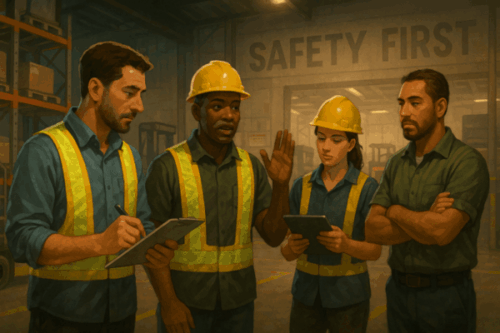
Fixing the Feedback Loop in Safety

Why incident reporting is broken—and how to restore trust, action, and culture at the front line

The Problem Isn’t the Form—It’s What Happens After

You’ve seen the signs.

A near miss is logged. A tripping hazard is flagged. A piece of faulty PPE is reported for the third time. The form is submitted—maybe even entered into a digital system. And then? Silence. There was no follow-up, and no visible fix was implemented. There was no acknowledgment that the report held any significance.

Eventually, the message becomes clear—not in what is said, but in what is not:
“Don’t bother filling it out. Nothing’s going to change.”

And so the forms stop coming.

This is the quiet crisis at the heart of safety culture:
We’ve built reporting systems. But we’ve failed to build feedback systems.

It’s not that workers don’t care. It’s that they see risk. The loop between reporting and response is so unreliable that disengagement serves as a form of self-protection. Why speak up if your voice doesn’t echo?

In an era where digital tools promise real-time incident capture, automated workflows, and CAPA tracking, the real question isn’t whether the form gets filled out. The real question is: what happens next?

Why Incident Reporting Isn’t Just a Process—It’s a Social Contract

Every time a worker reports a hazard, an injury, or a close call, they are doing something quietly heroic. They are trusting the system. They have faith in the individuals in charge of the system. It is important to trust that safety is more than just a slogan.

“Filling out a report is like throwing a bottle in the ocean,” one site supervisor said. “Maybe someone sees it. Maybe they don’t. Either way, you probably never hear back.”

This isn’t a workflow issue—it’s a cultural one.
It’s not about forms. It’s about follow-through. 

At its best, incident reporting is a feedback-rich loop:

  1. A worker identifies risk
  2. That risk is documented and shared
  3. Leaders review and act on it
  4. The reporter is acknowledged
  5. The change is visible and reinforced

When that loop functions, a culture of psychological safety takes root. Workers report more. Hazards surface sooner. Preventable injuries are avoided.

When this loop breaks down due to inaction, bureaucracy, or silence, the process of reporting deteriorates. And what decays next is belief.

A Slow Death by Disengagement

The decline of reporting doesn’t happen overnight. It dies by a thousand small signals:

  • A worker files the same report twice. No response.
  • A hazard is “closed” in the system but never fixed on the floor.
  • A near miss sparks an email chain but no root cause review.
  • A safety meeting references metrics—but never the people behind them.

Soon, reporting becomes transactional at best. Worse, it becomes adversarial:

“I’m not going to rat out my crew.”
“It’s just going to fall on deaf ears.”
“That’s for HR to deal with.”

In too many organizations, safety reporting is treated as an act of compliance.
In outstanding ones, it’s treated as an act of courage.

The Anatomy of a Broken Feedback Loop

If incident reporting is the engine of continuous improvement, then the feedback loop is its fuel system. Without it, the engine might rev briefly—but it won’t sustain. And if the fuel line is broken or clogged, it’s not long before the engine stalls out entirely.

In many workplaces, the reporting process itself has evolved. Paper forms gave way to PDFs. PDFs gave way to cloud-based submissions. Portals. Apps. Voice-to-text dictation.

And yet—nothing changed.

Because digitizing the form isn’t the same as closing the loop.

The Five-Stage Breakdown

Let’s examine what happens between the moment a worker submits a report and the moment they feel something has been done.

We’ll walk through the stages—form, route, review, resolve, reflect—and expose where and why so many organizations fail. resolve, and

1. Observation Logged

“There’s an oil leak under the hydraulic lift in Bay 2.”

✅ Good: The form is completed—accurately and timely, with a supporting photo.
⚠️ Risk: No prompt appears confirming receipt. The worker isn’t sure if it even went through.

🧠 Cognitive Moment:This stages is where emotional investment is high. A worker has taken initiative. If there’s no confirmation or acknowledgment here, the trust dip begins immediately.

2. Routed to the Responsible Party

The form should go to the area manager or safety supervisor.

⚠️ Common breakdowns:

  • It’s unclear who owns the issue.
  • The email notification is buried.
    There’s no time-bound SLA (Service Level Agreement).
  • Routing rules haven’t been updated since the last reorganization.

“I got it a week later,” said one safety manager. “At that point, the shift had moved on, the issue was forgotten, and I looked as if I didn’t care.”

3. Reviewed for Action

Does this require an immediate response? Investigation? Root cause analysis? Preventive action?

❌ Common failures:

  • No triage system = everything looks equally urgent… or not urgent at all.
  • “Reviewed” turns into a routine task that can be checked off, with no further action required.
  • No one assigns CAPA (Corrective/Preventive Action) ownership.

And worse? CAPAs are created in a different system entirely.

A report may be logged in your EHS tool, while the action lives in:

  • A Microsoft Teams chat
  • A spreadsheet
  • Someone’s email
  • A separate maintenance app

🧠 This disconnect isn’t just inconvenient—it’s culturally corrosive. If the system doesn’t handle resolution elegantly, it sends the message: “Fixes are optional.”

4. Resolved (or not)

Maybe the hydraulic line gets replaced. Maybe it doesn’t.

✅ Ideal: Photos attached, resolution logged, CAPA completed, timeline visible
⚠️ Typical: “Closed” status marked without field validation
❌ Common: Nothing happens—and no one knows it didn’t

One company boasted of a 98% “closeout rate” in their incident dashboard.
When we dug deeper, “closed” just meant a supervisor clicked a button.

“The line’s still leaking,” the original worker said. “But the form says it’s resolved.”

5. Reflected Back to the Reporter

Is the worker informed about the outcome?

This final step is where the loop either closes—or collapses.

✅ Best practice: The reporter receives a personal note or notification.

“Thanks for flagging this. We replaced the faulty component and added a PM to catch it sooner next time.”

⚠️ Common practice: Nothing. No message. No visibility. There is no human connection.

❌ The worst version? They’re told they filled the form out wrong or “should have spoken up sooner.” That’s how you kill participation for good.

The Data Trap: False Metrics, Hollow Dashboards

Here’s the kicker: most organizations are measuring incident reporting success by volume.

  • Number of reports submitted
  • Number of reports closed
  • Number of near-misses logged

But those metrics are deceiving. You can have:

  • High submission and low trust
  • High closeout and low resolution
  • High visibility + low action

If your workers are reporting more but believing less, the loop is broken.

What a Functioning Feedback Loop Actually Looks Like

Let’s contrast the broken loop with one that works—not just technically, but emotionally, socially, and operationally.

Stage What Success Looks Like
Observation Clear, simple submission process—on mobile, with photo/audio options
Routing Assigned automatically based on area, type, and severity—with escalation
Review Timely triage with criteria: severity, recurrence, potential impact
Resolution CAPA assigned, tracked, and verified in the same system as report
Reflection The reporter receives outcome—personally or via automated message
Culture Safety meetings include reporting highlights and stories of action taken

🧠 What matters most: The perception of the system is just as important as the actual workflow. If workers believe the loop works, they’ll use it.

Why Reporting Culture Is Behavior-Driven, Not Process-Driven

“We don’t have a reporting problem—we have a behavior problem.”
— EHS Director, Midwestern manufacturing site

It’s a line you’ve probably heard before.
Or say it yourself.
You may have even muttered this phrase after reviewing a blank incident report log for the fourth week in a row.

But here’s the thing: it’s not just a clever quip—it’s a diagnosis.
At its core, incident reporting is fundamentally a human behavior, not merely a process.

And like all behaviors, it’s shaped by:

  • Perception
  • Incentive
  • Risk
  • Reward
  • Environment
  • Leadership

You can roll out the best software on the market.
Train everyone on how to use it.
Even mandate its use.
But if the people behind it don’t feel safe, seen, or supported, the behavior won’t follow.

The Myth of the Rational Reporter

Let’s start with the flawed assumption baked into most reporting systems:
“If we present people the tools, they’ll use them.”

That’s not how human psychology works.
Workers operate not in a vacuum of logic, but under pressure:

  • Production targets

  • Peer dynamics
  • Supervisor expectations
  • Fatigue
  • Fear
  • A dozen “you should’ve known better” moments from their past

“If I report this, I might slow down the job.”
“If I report this, I’ll be the person who always complains.”
“If I report this, my boss will think I’m blaming them.”
“If I report this, I could get someone fired.”
“If I report this, I’ll have to explain it in a meeting.”

Even the most confident, safety-conscious worker performs a silent risk-benefit analysis before submitting that form.

Behavioral Safety Isn’t Just for Hardhats

We talk a lot about behavior-based safety in physical terms:

  • Lifting techniques
  • PPE usage
  • Line of fire awareness
  • Ergonomics

But reporting behavior is just as much a frontline safety behavior—and arguably more foundational.

Because reporting is the trigger that drives improvement:

  • It uncovers latent hazards
  • It tracks close calls before they become incidents
  • It exposes breakdowns in training or procedures

If your workers aren’t reporting, your system isn’t seeing.
And if your system isn’t detecting issues, it can’t take preventive measures.

The Social Physics of Safety Reporting

Safety isn’t just an individual act—it’s a social signal.

When a worker reports a hazard, they’re not just reacting to the hazard itself—they’re responding to:

  • Whether others around them report
  • Whether those reports were respected
  • Whether action followed
  • Whether they were thanked or blamed

This creates a feedback loop of its own. A cultural current.

In cultures where reporting is praised, it grows.
In cultures where reporting is punished, near misses disappear.

We’ve seen crews go months without a single near miss logged. This was not due to a lack of near misses, but rather because the last reported incident resulted in:

  • A chew-out
  • A shift-wide email blast
  • A disciplinary action
  • Or worse, nothing at all

Fear-Based Silence: The Hidden Barrier

Here’s what rarely gets talked about in official safety protocols:
Fear.

Even in companies that pride themselves on “open door” policies, fear is often alive and well:

  • Fear of retaliation
  • Fear of being labeled a snitch
  • Fear of slowing production
  • Fear of being questioned or shamed

This fear doesn’t always show up loudly. Sometimes, it just looks like

  • A delay in reporting
  • An incomplete form
  • A verbal mention instead of a formal entry
  • A teammate covering for another

And most insidiously? Fear becomes normalized.

“We just handle that stuff ourselves.”
“That’s not worth a report.”
“We don’t want to get anyone in trouble.”
“I’ve been doing this 20 years—I know what to watch for.”

Designing for Behavior: What Actually Works

So how do you move from system-centric to human-centric?

It starts by designing not for processing but for psychological safety.

✅ Make It Easy

  • Use mobile tools (or even QR codes) that allow fast capture
  • Let workers report via photo, voice note, or text
  • Allow anonymous reporting—but also reward named reports

✅ Make It Expected

  • Normalize reporting in daily safety meetings
  • Celebrate volume—not just severity
  • Avoid saying “We had no incidents this week” like it’s a good thing—it may just mean no one’s talking

✅ Make It Safe

  • Train supervisors on non-punitive responses
  • Protect anonymity when needed
  • Follow up gently—even when a report isn’t acted on
  • Separate “what happened” from “who’s to ”blame.”

✅ Make It Valued

  • Recognize individuals or crews that consistently report
  • Share examples of actions taken because of worker input
  • Involve frontline employees in investigation or closeout conversations

✅ Make It Visible

  • Show reporting trends, resolutions, and themes over time
  • Use dashboards or visual boards at the site level
  • Let workers see that reports don’t vanish into a void

“When I saw my photo on the hazard board with a thank you,” one operator said, “I realized someone was paying attention.”

You Can’t Mandate Engagement—You Have to Earn It

If there’s one truth in reporting culture, it’s this:

Behavior follows belief.
Faith follows experience.
And experience follows leadership.

You can build the perfect form. The cleanest flowchart.
But if your people don’t believe their voice matters, they won’t speak.

This is where EHS professionals must evolve from system builders to behavioral architects.
From enforcers of compliance to designers of trust.

Visibility, Velocity, Validation—The Three V’s of Real-Time Safety Response

You’ve done the hard part: built a culture where people are willing to speak up. You’ve reduced fear. You’ve made reporting normal. But what if that report goes into a system that’s slow, invisible, or non-responsive?

Trust collapses.

At this stage, it’s not about compliance—it’s about infrastructure. The system needs to function at the speed of trust. That’s where the Three V’s come in:

Visibility. Velocity. Validation.

These aren’t features of software. They’re principles of effective safety systems that actually close the loop between reporting and response.

Visibility: Everyone Sees What’s Going On

Too many organizations mistake digitization for transparency. Just because you logged it in a system doesn’t mean the right people saw it—or that the person who reported it ever knew what came of it.

Real visibility means:

  • Every open report is viewable by those responsible for resolution.
  • Hazard reports are visible not just to safety teams but also to operations, site leads, and even workers in the affected area.
  • Leaders have access to a live, real-time picture of what’s open, pending, and resolved—not buried in static monthly summaries.

On the shop floor, visibility also looks like:

  • Safety boards that share “top hazards of the week” or lessons learned
  • Toolbox talks that reference real recent reports (anonymized if needed)
  • Daily huddles that surface in-progress CAPAs and timelines

It’s simple: people engage more with systems they can see. Systems that feel alive. Systems where their contribution doesn’t disappear into the dark.

Velocity: Time Is a Trust Metric

This one’s easy to measure. It’s how long it takes between “I reported it” and “something was done.”

If a worker logs a report Monday and sees no action by Friday, you’ve lost them—maybe for good. The longer the delay, the more likely they are to believe the system is performative, not real. a response

You can start small. Define timeframes based on the type of report:

  • Immediate injuries or high-severity risks should trigger response within hours.
  • Moderate hazards like faulty equipment or worn PPE might require triage within 24–48 hours. a response
  • Although near misses may be reviewed weekly, they should still receive prompt acknowledgment.

And here’s the kicker: even if the fix will take time, acknowledging the report doesn’t have to. A swift “we saw this and we’re on it” buys you goodwill. Silence kills it.

Velocity also means:

  • Streamlined workflows (no approvals just to assign an action)
  • Clear ownership (no “who’s supposed to handle this?”)
  • Escalation paths when deadlines slip
  • Integration with maintenance or operations, so fixes don’t stall in other systems

Don’t confuse speed with sloppiness. This isn’t about rushing. It’s about respecting the urgency of trust.

Validation: Close the Loop with the Person Who Opened It

This is where most organizations fail. The issue gets fixed—but the worker never hears about it. The report is marked “closed” in the system—but not in the mind of the person who raised it.

Validation is the act of saying, “You were heard, and your report mattered.”

This can be as simple as

  • A direct message from a supervisor: “Thanks for flagging that. We repaired the hydraulic line and added a daily examination to prevent recurrence.”
  • A mention in a shift meeting: “Shout-out to Maria for catching that trip hazard before it turned into something worse.”
  • A note in the EHS bulletin or weekly summary about actions taken that week in response to worker input

Here’s the magic: validation doesn’t just reinforce the person who reported. It signals to everyone else that this is a system that responds. A system worth using.

Don’t just log the outcome. Deliver it back to the human who created the input.

How to Operationalize All Three

If you’re thinking, “This sounds like a lot,” you’re right. But it’s doable—and transformative—when built into your existing safety rhythms.

Here’s what it looks like in action:

  • A mobile-first reporting process that’s accessible and fast
  • Clearly defined ownership: someone is always responsible for next steps
  • Triage meetings with EHS and operations every 48 hours to assign actions
  • CAPAs tracked in the same environment as the original report
  • Weekly updates or dashboards that show what’s been resolved—and by whom
  • Personal feedback delivered to the reporter, ideally within 3–5 business days

You don’t need more technology. You need more intentionality.

When you consistently show people that their reports are visible, responded to quickly, and that they made a difference—you don’t need to beg people to speak up. They just will.

The Real-World Costs of a Broken Loop — When Silence Becomes a Safety Hazard

When safety professionals talk about metrics, they often talk in terms of lagging indicators—injury rates, lost time, OSHA citations.

But behind every charted incident is usually a story of silence.

A report that wasn’t taken seriously.
A hazard that was noticed—but never escalated.
A feedback loop that collapsed somewhere between submission and resolution.

These aren’t theoretical failures. They’re real. And they carry costs: human, financial, cultural.

Case 1: The Leaking Valve That Led to a Burn

“He told them about it. Two weeks in a row. Wrote it on the inspection form and everything.”

This came from a veteran shift lead at a chemical processing facility in the Midwest.

The incident in question? A maintenance technician suffered second-degree burns on his forearm after a steam valve failed during a routine line flush. It wasn’t a catastrophic failure—but it was entirely preventable.

The leak had been reported—twice—during weekly inspections. Each time, the report was logged in their safety software and routed to the general maintenance inbox. But no one “owned” the valve issue. It wasn’t prioritized because the leak was small, and the maintenance backlog was large.

No one closed the loop. No one followed up. No one validated the original report.

Total cost:

  • Emergency room visit and restricted duty
  • OSHA recordable
  • Strained relationship between operations and safety
  • Permanent erosion of trust in the reporting system

“After that, I instructed my team to inform me directly if they notice anything unusual.” Forget the system.”

Which sounds proactive… until you realize the digital safety system is now just window dressing. The real system had gone underground.

Case 2: The Forklift Near Miss That Became a Fatality (Elsewhere)

“It wasn’t our site that had the incident. But it could have been.”

A safety director at a logistics warehouse in the Southeast told us this story with grim clarity.

Two months earlier, a forklift nearly struck a worker during a shift change. The incident was minor—no contact, no injury. But it exposed a serious risk: a blind corner near the break room where foot traffic and forklifts converged.

The near miss was logged. Management reviewed it in their monthly EHS meeting. They agreed it was a concern but didn’t install mirrors or signage. Budget constraints. Competing priorities.

Eight weeks later, the same scenario played out—at a sister facility in another region. This time, the forklift made contact.

The worker didn’t survive.

“We had the warning. But we didn’t act on it. Not in time.”

The company did everything right after the fatality: site-wide audits, equipment reviews, new controls, and retraining. However, the safety leader and the crew on the original site had already suffered the consequences.

The near miss had been a gift. The feedback loop failed to deliver it.

Case 3: The Anonymous Report That Wasn’t Anonymous

“After that, I’ll never submit another one.”

This is from a production line worker who had submitted a report about improper PPE use by a supervisor—using the system’s anonymous reporting option.

The report was detailed. Too detailed. It narrowed the scenario down to a specific time and crew. Within 48 hours, the supervisor had confronted the crew, demanding to know “who turned him in.”

Everyone knew who had submitted it. Nothing was formally done. But the reporter was reassigned to a less favorable shift. Subtle. Deliberate.

“It was like the system marked me. Like I made trouble by doing the right thing.”

The loop didn’t just fail—it backfired.

Instead of reinforcing the behavior, it punished it.  And in doing so, it sent a message to the entire crew: “Stay quiet.”

Cultural Costs Are the Hardest to Quantify—and the Most Expensive

When incident reports fall into black holes—or worse, when they lead to retaliation or inaction—the cost isn’t just injuries or fines.

It’s cultural decay.

  • Reporting dries up
  • Peer-to-peer accountability disappears
  • Supervisors become gatekeepers instead of advocates
  • Workers rely on workarounds instead of protocols
  • Near misses get buried until they resurface as injuries—or fatalities

And here’s the most dangerous part:
The metrics don’t immediately reflect the breakdown.

Your dashboard might still show:

  • “High closeout rates”
  • “Low injury frequency”
  • “Consistent toolbox talk participation”

But beneath the surface, the signals are different:

  • Fewer reports from newer employees
  • Fewer near misses logged during high-output shifts
  • Reports clustering only around inspection periods
  • Reports disappearing after a change in leadership

These are all symptoms of a system that people no longer believe in.

It’s Not About Blame—It’s About Breakdowns

Every story shared here could’ve been prevented—not through more training, but through more follow-through.

In each case, the worker did their part. They spoke up. They noticed something. They took the time to report it. What failed was the structure around them—the loop that should have turned voice into action.

The fix isn’t technology alone. 

It’s culture.

It’s consistency.

It’s building a system that treats every report like a trust deposit—and delivers something back in return.

Building a Safety Culture That Scales—Systems, Stories, and Signals That Stick

If you’ve made it this far, you already know the truth:

  • Safety culture isn’t built by having the right forms, the right software, or even the right rules.
  • It’s built when people believe that speaking up leads to something better.
    And that belief is earned—over and over again—through a system that sees, responds, and reflects.

So how do you build that kind of culture not just at one jobsite, but across dozens? Across shifts? Regions? Countries?

How do you build a feedback ecosystem that’s big enough to scale but human enough to feel local?

It starts with three things:
Systems, Stories, and Signals.

1. Systems: The Invisible Framework

Every strong culture is underpinned by structure. That doesn’t mean bureaucracy—it means predictability. Consistency. Clarity.

In the context of safety, your organizational structure serves as your feedback loop:

  • Clear workflows for who handles what, when
  • Defined expectations for how quickly reports are reviewed and resolved
  • Real-time visibility for all levels—worker, supervisor, and leadership
  • Feedback mechanisms to inform the original reporter

These aren’t add-ons—they’re part of the process.
A safety system without structure is just a suggestion. A well-built one becomes a reflex.

But here’s the nuance: systems should support behavior, not suppress it.

This means:

  • Avoiding process overkill
  • Making tools mobile and accessible
  • Building for the way people actually work (not the way you wish they worked)
  • Designing every element with the reporter in mind—not just the safety team

If your system makes it easier to remain silent rather than speak up, it may need to be reevaluated.

2. Stories: The Cultural Glue

Data drives insight.
Stories drive behavior.

If you want to scale a reporting culture, you have to move beyond charts and dashboards. You need narratives.

Tell the story of:

  • The worker who reported a loose guardrail—and prevented a fall
  • The line team that spotted a defective harness and saved a contractor’s life
  • The anonymous report that led to a full procedural overhaul

Make it real. Make it personal.
Make it clear that this system works because people use it—and because leaders listen.

When you embed these stories in:

  • Toolbox talks
  • Onboarding sessions
  • Safety newsletters
  • Leadership town halls

…you begin to create shared memory. A belief that this is how we do things here.

And when people start repeating those stories—on their own—you’ve crossed from system into culture.

3. Signals: What Gets Reinforced Gets Repeated

Culture is a game of repetition.

If workers report a hazard and nothing happens, that’s a signal.
If they report one and it’s addressed quickly, that’s a signal too.
If they’re praised, celebrated, or thanked? Even stronger signal.

These micro-signals accumulate. Over time, they create the behavioral norms that define your culture.

So ask yourself:

  • Do we signal that reporting is safe and expected—or risky and bureaucratic?
  • Do we spotlight those who report—or just those who perform?
  • Do we talk about open hazards during meetings—or just completed ones?
  • Do our leaders model transparency—or hide behind metrics?

Even inaction is a signal. When silence follows a report, the message is clear:
“Don’t expect anything to change.”

Leaders must treat every report—every submission, every follow-up, every acknowledgment—as an opportunity to send a signal about what matters here.

The Scaling Formula: Decentralized Behavior, Centralized Accountability

The companies that obtain this right understand a paradox:

  • Reporting behavior must be decentralized.
    Every worker, at every site, must feel empowered to speak up.

  • Accountability must be centralized.
    Leadership must own the consistency of the system.

You can’t delegate trust-building to individual supervisors and hope it scales.
You build the system. You reinforce the norms. You share the stories.
And you let the behavior take root locally, because the structure supports it globally.

Final Thought: Culture Isn’t What You Say. It’s What You Reinforce.

You can print posters. You can run training. You can hold town halls.

But culture is built in the micro-moments:

  • The speed of a follow-up
  • The tone of a thank-you
  • The visibility of a fix
  • The ownership of a mistake
  • The action that follows the form

If you want a culture where people speak up, you need more than a platform.

You need a system that listens—and proves it.

When this is achieved, a significant shift occurs.
Reporting goes from a task… to a habit.
From a form… to a reflex.
The process transforms into a promise.

And that’s when safety culture scales.

The Power of Training

The Illusion of Speed — Why Companies Skip Training in the First Place

In fast-paced industries like manufacturing, logistics, construction, and energy, the pressure to produce, ship, build, or complete is constant. Margins are tight. Schedules are even tighter. And in that kind of environment, training often becomes the first thing to go—not because it isn’t valued, but because it’s perceived as a drag on output.

A new hire shows up on Monday. By Tuesday, they’re shadowing someone on the line. By Friday, they’re expected to work independently. Maybe they got a few binders to flip through. Maybe they watched a couple of safety videos or filled out a checklist. But was that training? Or was it just exposure?

The Misguided Logic of “Time is Money”

Many employers adopt a “just-in-time” approach to workforce development—believing that the sooner someone is physically working, the better. But that logic is short-sighted. It equates movement with productivity and ignores the steep, slow-burning costs of putting an untrained employee into a complex or hazardous environment.

Consider this: according to the National Safety Council, the average cost of a single workplace injury in the U.S. is more than $42,000 in direct costs alone. That doesn’t account for the time spent investigating incidents, the morale impact on teams, or the potential reputational damage. Suddenly, saving a few hours on onboarding doesn’t look like such a smart move.

What’s more, research published in the Journal of Occupational and Environmental Medicine shows that new employees are three times more likely to be injured on the job within their first month. Not because they’re reckless—but because they’re unprepared.

Culture of Expediency

This pressure to rush can stem from several sources:

  • Short-term productivity pressures: If orders are backlogged, the instinct is to get hands on deck immediately.
  • High turnover environments: “Why train them? They’re going to leave in six months anyway.” It’s a common refrain in warehouses and seasonal workforces.
  • Poorly defined onboarding: Some companies don’t skip training intentionally—they simply never built a system for it in the first place.
  • Supervisor culture: Even when policies require training, floor-level leadership often pressures new hires to skip steps to “learn by doing.”

This culture of expediency sends a subtle but powerful message to workers: Speed matters more than safety. And that message, once internalized, is hard to undo.

Training as a “Soft” Priority

Another key reason training is skipped or shortened is perception. Training is often seen as a “soft” task—less measurable, less critical than hitting a production number. Leadership talks about it in HR or compliance terms, not as a driver of business outcomes.

But that thinking misses the bigger picture. Companies that invest in structured training report better retention, higher employee engagement, and stronger safety records. According to a 2023 Gallup Workplace study, employees who receive consistent training and development opportunities are 2.9 times more likely to say they are engaged at work.

Engaged employees don’t just stay—they perform better, communicate more openly, and take safety more seriously.

False Sense of Competence

There’s also a tendency—especially among experienced workers and supervisors—to assume that “common sense” will fill the gaps. If someone has used a forklift before, they don’t need to be retrained. If they’ve worked in a warehouse, they must know what PPE is required.

But common sense isn’t a compliance strategy. It’s an assumption. And in environments where tools, materials, and hazards change frequently, assumptions get people hurt.

Without standardized, job-specific training, companies aren’t building knowledge—they’re relying on chance. On tribal wisdom. On “doing it like the last guy did.” And that’s not good enough.

The Hidden Message Behind Skipped Training

When training is treated as optional, it tells workers something deeper: You’re on your own here. That message erodes psychological safety before a single shift begins. It discourages questions. It discourages pause. And it encourages workers to fake it until they make it.

But “faking it” in a high-risk environment has consequences. It’s not just about the new employee. It’s about the ripple effects—on teammates, supervisors, production lines, and company liability.

Training isn’t a cost. It’s an investment. And skipping it doesn’t save money—it transfers risk.


The False Economy of Speed

There’s an all-too-familiar phrase uttered across factories, warehouses, and job sites: “We don’t have time for training.” It usually comes from a place of urgency, when production deadlines are looming and labor is stretched thin. The pressure to get new hires “on the floor” and “up to speed” quickly feels justified—because after all, idle hands don’t move product. But beneath this logic lies a dangerous misconception: that skipping or minimizing training somehow saves time and money.

In reality, this shortcut is anything but efficient. It’s the equivalent of flooring the gas pedal with bald tires—sooner or later, you’ll skid out, crash, or break down entirely. What appears to be a gain in speed is actually a trade-off in safety, quality, retention, and long-term productivity.

The Productivity Mirage

At first glance, dropping a new hire directly into operations may feel like the fastest way to recoup recruiting costs. You need bodies to hit targets. And in industries like logistics and manufacturing, where turnover can exceed 30% annually, getting people moving quickly feels like common sense.

But research paints a different picture. According to a study by the Association for Talent Development (ATD), organizations that invest in structured onboarding and training see 60% higher productivity among new hires and stronger retention within the first 12 months. Why? Because people perform better when they know what’s expected, how to do it safely, and why it matters.

The so-called “lost time” in training is actually recovered many times over in reduced rework, fewer accidents, and stronger performance consistency. Speed doesn’t come from skipping steps—it comes from mastering them.

The Cost of Chaos

When workers are rushed into tasks without adequate training, two things happen:

  1. They improvise based on what others are doing, often replicating bad habits.

  2. They make mistakes—some minor, some catastrophic.

A new forklift operator who doesn’t know the proper turning radius in a tight warehouse aisle could damage inventory or equipment. A line worker unsure of a lockout/tagout procedure may expose themselves—or a teammate—to fatal energy release. These aren’t hypothetical scenarios. OSHA logs and news reports are filled with real-world examples of preventable incidents that stemmed from rushed or incomplete onboarding.

One notable case occurred in a Midwestern meatpacking facility where a newly hired maintenance worker—on the job for less than a week—was tasked with repairing a piece of machinery still energized. The LOTO training had been “covered” verbally during a chaotic first-day orientation but never practiced. Within hours, he suffered a severe electrocution. OSHA later cited the company for lack of formalized training and inadequate supervision.

Was that hour saved on training worth a life-altering injury and a six-figure fine?

Short-Term Thinking, Long-Term Losses

Here’s the hidden irony: When companies under-train to save time, they often end up spending more time cleaning up the fallout.

Consider these ripple effects:

  • Supervisors spend more time correcting errors.
  • Production teams slow down to accommodate injured or inexperienced coworkers.
  • HR and Safety teams scramble to fill out incident reports, file claims, or manage disciplinary action.
  • Legal and compliance departments jump in when OSHA gets involved.

The initial “shortcut” is now a detour full of potholes. And it doesn’t end there. Workers who feel unsupported or unsafe in their roles are significantly more likely to quit. The Work Institute’s 2023 Retention Report found that lack of career development and poor onboarding were among the top reasons employees left jobs—particularly in frontline roles.

In industries where labor shortages are the norm, can you really afford that?

Training as a Strategic Investment

Smart organizations flip the script. They treat training not as a time sink but as a time multiplier—an investment in capability, stability, and resilience.

They understand that:

  • A well-trained worker completes tasks faster and more accurately.
  • Trained teams are more adaptable when conditions change or new systems are introduced.
  • Training reduces risk, which reduces cost, downtime, and liability.

Training isn’t overhead. It’s insurance. It’s infrastructure. And just like you wouldn’t skimp on welding gear, scaffolding, or truck brakes—you shouldn’t skimp on the thing that keeps your people safe and effective.

The Cultural Message

There’s also a subtler, more powerful message embedded in good training: We value you enough to prepare you.

That message builds trust. It creates a sense of professionalism and shared responsibility. And it lays the foundation for something that can’t be bought—a culture of safety.

When training is rushed or skipped, the message received is very different: “You’re on your own.”

One cultivates engagement. The other breeds detachment.

Training Delays ≠ Productivity Gains

Let’s bust a myth.

The idea that skipping safety training gets workers “productive” faster is simply false. According to a National Safety Council report, 70% of companies that experienced a serious workplace injury said it could have been prevented with better training. And yet, in environments driven by output—manufacturing lines, construction crews, warehouse teams—training is often treated as a luxury. Something to get to “when there’s time.”

But time is never there. And so the loop continues: undertrained workers make mistakes, accidents happen, experienced team members are pulled from work to patch gaps or respond to incidents, and productivity stalls. Again.

When onboarding is rushed and safety training is sidelined, the damage isn’t always immediate—but it’s cumulative. It shows up in:

  • Higher incident rates
  • Greater equipment misuse
  • Slower ramp-up time
  • Increased worker stress and turnover
  • Risk of fines or regulatory violations

It’s not that these outcomes are surprising—it’s that we see them again and again, yet continue to prioritize speed over preparation.

Real-World Ripple Effects

Let’s break it down with a familiar example.

In a mid-sized logistics facility in the Midwest, a new hire was brought in during peak season. Instead of completing the full three-hour hazard communication and equipment safety training, they were sent to shadow a seasoned forklift operator for just 30 minutes. Within a week, the new employee accidentally reversed into a pallet stack, damaging $15,000 worth of inventory and knocking a coworker off balance, leading to a workers’ comp claim.

The company didn’t just face repair and insurance costs—they lost productivity as internal safety investigations were conducted, employee morale dipped, and the entire team was pulled into retraining. Ironically, the “saved time” of skipping training cost them more than two full weeks of normal operations.

This isn’t rare—it’s representative. Undertraining creates unseen drag across operations that grows until it becomes visible through loss.

“We’ll Train Later” Is a Lie We Tell Ourselves

Let’s call it what it is.

When companies say, “We’ll get them trained later,” it’s not a strategy—it’s procrastination disguised as pragmatism.

Why? Because “later” rarely comes. Or if it does, it’s too late—after a close call, or worse, an actual injury. The reason often boils down to short-termism: leadership or line supervisors are under pressure to meet demand, and training is seen as an inconvenience.

But this mindset is not only dangerous—it’s expensive.

In 2023, the U.S. Bureau of Labor Statistics reported an average direct cost of $42,000 per medically consulted workplace injury. That number doesn’t account for indirect costs like lost time, morale erosion, or the reputational damage from OSHA citations.

Now ask: would that same company have balked at spending $300 on proactive digital training and 3 hours of structured time?

It’s not a matter of affordability—it’s a matter of mindset.

Shifting the Paradigm: Training as Enablement, Not Expense

Safety training must be reframed—not as a regulatory requirement or sunk cost, but as a performance enabler.

Here’s the truth: trained workers are confident workers. Confident workers are faster, more precise, and less likely to make dangerous mistakes.

And when people feel the company has invested in their development—not just thrown them to the wolves—they’re more likely to stick around. They’re more likely to ask questions. They’re more likely to speak up when something seems off.

This creates a cycle of shared vigilance and accountability—what safety culture should be in the first place.


The Right Way to Train: Structuring Safety Programs for Retention, Readiness, and Regulatory Compliance

If we accept that skipping safety training is costly—and that half-hearted training is equally dangerous—the next logical question is: What should good safety training look like?

The answer isn’t as simple as “more hours” or “better content.” Effective safety training is built on three pillars: retention, readiness, and regulatory alignment. These three dimensions are mutually reinforcing: training that sticks improves on-the-job readiness, which in turn reduces compliance gaps and drives a safer, more efficient workplace.

But let’s be clear: you can’t YouTube your way to safety. Nor can you drop a 50-slide PowerPoint into someone’s inbox and call it a day. Structuring safety training requires intention, relevance, and, increasingly, digital tools that support how people actually learn and apply knowledge.

1. Training for Retention: Making Safety Stick

The human brain is wired to forget. Studies show that within just one week, people forget 90% of what they learn in a traditional lecture-style setting. In high-risk workplaces, that forgetting curve isn’t just inefficient—it’s dangerous.

So how do you overcome it?

  • Repetition and Reinforcement: Learning science tells us that spaced repetition dramatically improves retention. This means safety content shouldn’t be delivered once a year—it should be revisited regularly in bite-sized, engaging formats. Think microlearning modules, weekly toolbox talks, quick video refreshers.

  • Contextual Learning: Adults learn best when they understand why the training matters to their job. A new forklift operator doesn’t need a generic “safety in the workplace” course—they need hands-on guidance for their role, in their language, on their equipment.

  • Mixed Modalities: Not every learner thrives on the same format. Some need visuals, others benefit from hands-on demos, others want checklists. Great training combines visual, auditory, and kinesthetic learning—especially in blue-collar environments.

  • Real-Time Feedback: The best way to know if someone has learned something? Ask them to do it. Quizzes, spot checks, simulations, and peer demos are far more effective than a signature on a sign-in sheet.

2. Training for Readiness: From Knowledge to Action

Too often, companies stop at knowing. But safety isn’t just about what you know—it’s about what you do in a split-second moment.

That’s why we must shift our goal from “training completion” to operational readiness.

What does readiness look like?

  • A new employee correctly donning PPE without prompting
  • A contractor identifying a hazard and stopping work before escalation
  • A line worker knowing when and how to initiate a Lockout/Tagout
  • A supervisor confidently coaching a team on confined space entry protocols

These behaviors only happen when training is integrated into real work. In practice, this means:

  • Shadowing and mentorship during the first weeks of work
  • Scenario-based exercises that mirror actual hazards
  • Daily safety huddles that revisit key themes
  • Simulations and drills for rare but high-risk situations

It also means tracking readiness—not just training hours. Does your new hire feel ready to enter the field? Can they walk through the emergency shutdown procedure without coaching? These are far better indicators than a checkbox that says “training complete.”

3. Training for Regulatory Compliance: Covering Your Bases Without Losing the Plot

Let’s not ignore the elephant in the room: OSHA, MSHA, DOT, and other regulatory bodies require certain trainings. Annual refreshers, orientation modules, site-specific briefings—they all matter, and they all carry legal weight.

But here’s the trap: when compliance is the only lens, training becomes a paperwork game. The purpose of training isn’t to protect the company from fines—it’s to protect the people doing the work.

That said, you still need to cover your bases. The best safety programs:

  • Map every role to required trainings by regulation, exposure, and task
  • Track completion in real time, with timestamps and records to prove it
  • Auto-renew and re-assign required courses at regular intervals
  • Log all attendance and completions for audits or inspections

Smart systems make this easy. But smart leadership ensures that even mandatory training doesn’t feel like a burden. By tying each module to real-world consequences—and reinforcing it on the floor—compliance becomes a byproduct of good culture, not a stand-alone box to check.

The Bottom Line: Intentionality Beats Volume

Too often, companies mistake volume for value when it comes to training. Just because someone sits through 40 hours of modules doesn’t mean they’re safer. In fact, poorly structured training can create complacency, resentment, or confusion.

The best safety training programs are:

  • Strategic
  • Adaptive
  • Human-centered
  • Tied to real tasks and risks
  • Measured by behavior change, not completion rates

You want your people to walk into a situation and know what to do. That’s the real return on training—not a certificate on a wall, but a decision in the moment that saves a life, prevents an injury, or keeps production running safely.

World Consequences of Skipping or Rushing Safety Training

When companies choose to shortcut training—whether by skipping it altogether or rushing workers through a condensed version—they’re not just taking a risk. They are rolling a loaded die. The consequences of these choices are not theoretical. They are real, measurable, and—tragically—often preventable. From catastrophic injuries to legal penalties and cultural damage, the fallout from undertraining ripples far beyond the immediate incident.

The Human Toll: Preventable Accidents and Lifelong Impact

Take the case of a 19-year-old temporary worker in a metal stamping plant in Ohio. On his first day, with only a brief safety orientation and no hands-on walkthrough, he was tasked with operating a hydraulic press. Less than two hours into his shift, he lost three fingers. The press had a known malfunction, and proper lockout/tagout (LOTO) training could have prevented the incident. But the company had prioritized keeping the line moving over taking the time to onboard new staff safely.

This is not an isolated case. According to OSHA, over 60% of workplace injuries occur within the first year of employment—and the lack of effective safety training is consistently listed as a root cause. In sectors like construction, warehousing, and manufacturing, the risks are amplified. Heavy machinery, hazardous materials, and fast-paced environments demand precision and awareness—skills that can’t be built in a 10-minute video or a forgotten PowerPoint deck.

Regulatory Exposure: When Shortcuts Backfire

Beyond the human impact, there’s the regulatory cost. In 2023, a major U.S. food processing company was fined $1.8 million by OSHA after a chemical exposure incident hospitalized multiple employees. The investigation found that several workers hadn’t been properly trained on PPE protocols or chemical handling procedures. The required HAZCOM (Hazard Communication Standard) training was outdated, and refresher sessions hadn’t been documented.

This lack of compliance opened the door not just to OSHA fines, but also to lawsuits, insurance hikes, and reputational damage. When regulators find gaps in training documentation or inconsistencies in how workers understand safety protocols, companies can quickly find themselves under scrutiny—not just for the incident, but for their entire training and compliance system.

Cultural Degradation: When the Message Doesn’t Match the Mission

The silent cost of poor training is cultural erosion. Imagine you’re a new hire at a logistics warehouse. You’re excited about the job, eager to learn, and a supervisor hands you a laminated checklist and says, “Just sign this and get started—we don’t have time for the whole orientation today.” What message does that send?

Over time, workers internalize what’s important based on what gets prioritized. If training is rushed or skipped, safety quickly becomes a side note rather than a shared value. Even the most beautifully worded safety mission statement can’t survive this type of lived contradiction.

Teams begin to see training as a formality—something you “get through” instead of something you grow from. The ripple effect? Increased shortcuts, normalization of risk, and disengaged employees who no longer feel protected or invested.

Cost of Turnover: Undertrained Workers Don’t Stay

Studies by the Bureau of Labor Statistics show that workplaces with high injury rates also tend to have high employee turnover. The connection isn’t hard to see. If workers feel unsafe, ill-prepared, or unsupported, they are less likely to stay—and when they leave, they take institutional knowledge with them.

Moreover, replacing an hourly worker in industrial roles can cost employers anywhere from $3,000 to $10,000 per employee, depending on the role and required certifications. That number doesn’t include the productivity lag that occurs while onboarding new staff, nor the morale dip that often accompanies the departure of a team member due to injury or frustration.

Undertraining isn’t just a safety issue. It’s a financial liability.

Real Examples, Real Lessons

  • In a 2022 NIOSH study, one transportation firm found that after implementing a comprehensive, interactive training program that included scenario-based learning and multilingual access, its injury rate dropped 43% over 18 months—and employee retention improved by 27%.
  • Conversely, a mid-sized construction company that skipped scaffold safety refreshers saw two workers fall from improperly assembled scaffolds within six weeks. OSHA investigations revealed neither worker had taken the required annual retraining, and documentation was incomplete. Fines, delays, and reputational loss followed.

The data is clear: skipping training or phoning it in is not a time-saver. It is a risk multiplier.

How to Build Training That Actually Sticks

By now, it’s clear: safety training isn’t a one-time task. It’s not something you check off a list and hope for the best. And yet, that’s exactly how many companies still treat it. Slide deck? Check. Sign-in sheet? Check. Everyone understands and retains what they learned? Not even close.

In this section, we shift from the “why” to the “how.” Specifically, how can organizations create safety training programs that truly stick—training that transforms behavior, builds competency, and becomes part of the culture rather than a compliance ritual?

Understand the Psychology of Learning

To build sticky training, we need to think like psychologists as much as educators. Adult learners—especially those in high-risk environments—don’t absorb information the same way as students in a classroom. They’re skeptical, experienced, and most importantly, time-starved.

According to Malcolm Knowles’ Adult Learning Theory, adults learn best when training is:

  • Relevant to their immediate work
  • Problem-centered rather than content-centered
  • Self-directed, allowing some autonomy
  • Experience-based, connecting new ideas to existing knowledge

In practice, this means safety training must be timely, contextual, and directly applicable. Workers don’t want theory—they want to know how not to get hurt today.

Make It Multi-Modal

Relying on a single format—whether that’s classroom lectures, PowerPoint decks, or eLearning videos—is a recipe for disengagement.

To boost retention, companies should adopt a multi-modal training strategy, including:

  • Hands-on simulations (lockout/tagout drills, spill response demos)
  • Microlearning modules (short, mobile-friendly refresher courses)
  • Peer-led toolbox talks (where workers discuss real-world issues)
  • Scenario-based learning (decision-making under pressure)

A construction firm in Illinois, for example, reduced musculoskeletal injuries by 43% in one year after shifting from annual slide-deck training to weekly 15-minute stretch-and-learn sessions led by field supervisors. It wasn’t just about information—it was about routine, culture, and real-world practice.

Use Spaced Repetition and Just-in-Time Learning

Research from the Ebbinghaus Forgetting Curve shows that people forget up to 90% of what they learn within a week—unless the information is reinforced.

To counter this, high-performing companies use spaced repetition: short bursts of content revisited regularly over time. This is especially powerful when paired with just-in-time learning—providing the right training right before it’s needed.

Example: Before entering a confined space, workers might be required to complete a quick 3-minute refresher via tablet or mobile device—reinforcing the key hazards and controls. It’s short, it’s relevant, and it’s contextual.

This approach not only increases retention but also boosts compliance because workers understand why it matters in the moment they need it.

Make Training Social and Self-Directed

The most effective safety cultures are those where people feel like they own safety—not that it’s being done to them.

Encourage peer-led training, mentorships, or cross-department safety huddles. When workers teach each other, they reinforce their own understanding—and trust builds between teams.

Also, empower workers to track their own progress. Many digital systems allow for individual learning dashboards where employees can see their completed modules, upcoming certifications, and skill gaps. This creates accountability and pride—not just obligation.

Close the Loop: Assess, Certify, and Follow Up

Training that isn’t assessed isn’t retained. But assessment doesn’t mean a generic multiple-choice test. High-quality programs include:

  • Knowledge checks embedded into the material
  • Performance assessments in the field
  • Supervisor observations post-training

Follow-up is equally critical. Did the worker apply the training? Were they coached when they made a mistake? Was the feedback loop closed?

In one manufacturing company, a near miss involving improper use of a hoist prompted a review of lifting safety training. The solution wasn’t just retraining—it was adding a field verification step where supervisors observed and signed off on the proper procedure weekly for a month. Incident rates dropped, but more importantly, trust in the system increased.

Build Safety Habits, Not Just Knowledge

In the end, knowledge without action is useless. The goal of any safety training should be to create habits—automatic, reflexive behaviors that prevent incidents even when people are tired, distracted, or under pressure.

This is why consistency and frequency matter more than volume. A five-minute daily safety moment might have more lasting impact than an hour-long quarterly seminar.

To build those habits:

  • Integrate training into daily workflows
  • Reinforce behaviors with recognition (not just penalties)
  • Create visible cues in the environment (like checklist stations, signage, and peer reminders)

When workers see safety not as an interruption but as part of how the job gets done—it sticks.

Training Isn’t Overhead, It’s Infrastructure

Let’s end where we began: safety training isn’t optional, and it isn’t overhead. It’s infrastructure—every bit as critical to your operation as a conveyor belt, a forklift, or a functioning emergency shut-off valve. Without it, everything else in your system is at risk.

And yet, so many organizations still treat training as a burden. A line item. A once-a-year checkbox.

This mindset is not only dangerous—it’s expensive.

Training is the only investment that protects every other investment. It reduces accidents, safeguards lives, improves morale, and boosts retention. It makes your people smarter, your operations smoother, and your liability lower.

But only if it’s done right.

Let’s recap what that means.

First, you need to shift the mindset. Safety training isn’t a bureaucratic obligation. It’s a cultural commitment. You’re not training to pass an audit. You’re training to save someone’s hand, someone’s back, someone’s life.

Second, recognize that bad training costs more than no training. Confusing procedures, outdated materials, and inconsistent delivery create a false sense of preparedness. The only thing worse than an untrained worker is one who thinks they’re trained—but isn’t.

Third, embrace systems that scale. Whether that’s a digital LMS like sam® by secova or a structured peer-led onboarding process, what matters most is consistency, accessibility, and real-world applicability.

Fourth, listen to your people. Not just in exit interviews or post-incident reviews—but every day. Your workers know where the gaps are. They know which trainings feel real and which ones feel like boxes. They know who needs help and who’s quietly struggling. Training that doesn’t reflect their voice will never stick.

Finally, keep it human. Training is not content—it’s care. Every time you take the time to train someone well, you’re saying: “You matter. Your life matters. Your safety matters.”

That’s not overhead. That’s leadership.

So here’s your call to action:

  • Audit your current training program—not just on paper, but in the field.
  • Ask your frontline employees what works and what doesn’t.
  • Reinforce safety habits daily, not quarterly.
  • Make training part of your culture—not just your compliance.

And remember: The job of a safety leader isn’t just to create a safe environment.

It’s to create a place where everyone knows how to stay safe—and believes it’s worth doing.

That belief is built through training. Real training. The kind that sticks.

And that’s how the job gets done—safely, smartly, and together.

Why Safety Doesn’t Come Naturally

There’s a hard truth every safety leader eventually comes to grips with: humans are not naturally wired for safety. Not at work. Not at home. Not on the factory floor or at the job site. And certainly not when we’re stressed, tired, or distracted.

We’re wired to survive—but not to anticipate.

We’re wired for efficiency—not caution.

We’re wired to take shortcuts—not follow procedures.

So when an organization says they want to build a culture of safety, they’re not just setting policy—they’re asking people to rewire instinct.


The Science Behind Unsafe Behavior

Neuroscience gives us powerful insights into why safety is so hard to sustain. The prefrontal cortex—responsible for judgment, decision-making, and impulse control—isn’t always in charge when we’re working under pressure. Instead, the limbic system, which governs emotion and habit, often takes over.

That’s why experienced workers sometimes make dangerous mistakes: they’re running on autopilot. The brain favors repetition. If you’ve walked across the shop floor without a hard hat 200 times and nothing happened, your brain stores that as “safe”—even if it’s not.

And that’s just the beginning.

  • Risk normalization kicks in when hazards are frequent and uneventful.
  • Cognitive overload from multitasking reduces attention to detail.
  • Social dynamics like peer pressure, time pressure, or supervisor indifference shape whether people speak up.

Our biology, our psychology, and our workplace cultures all conspire to make safety harder than it should be.

So what can we do?


A Culture of Safety Must Override Instinct

Safety culture isn’t about rules. It’s about overrides.

It’s the behavioral architecture we build to guide people toward safer actions even when their instincts pull the other way. And it takes more than posters, policies, and PPE.

To create a culture that rewires behavior, organizations must blend science, systems, and story. Here’s how.

1. Make Safety Social, Not Just Procedural

Humans are social animals. We do what our peers do, not necessarily what’s written in the manual.

  • Micro-behaviors matter. When a supervisor wears hearing protection consistently, others follow. When they don’t, no sign on the wall will fix it.
  • Mentorship works. Pairing experienced, safety-conscious workers with new hires helps transfer not just skills, but mindsets.
  • Recognition shifts norms. Instead of only flagging violations, organizations should spotlight positive safety behaviors—like speaking up, stopping work, or reporting a near miss.

Culture isn’t what you say. It’s what you celebrate.


2. Create Space for the Brain to Work

Cognitive overload is a real and measurable hazard. When workers are juggling production goals, shifting procedures, and personal distractions, their brains are too taxed to prioritize safety.

  • Simplify decision points. Clear checklists reduce cognitive friction.
  • Design intuitive environments. Color-coded zones, visual cues, and automated reminders help anchor attention.
  • Avoid information dumping. Safety training shouldn’t be a firehose. Spread it out. Make it relevant. Reinforce it over time.

Give the brain room to do the right thing—and it will.


3. Shift from Fear to Trust

Fear-based safety cultures don’t work. They breed silence. They hide problems. And they guarantee that the next incident will be worse than the last.

Instead, high-performing safety cultures cultivate psychological safety:

  • People feel safe to speak up.
  • Supervisors listen, not lecture.
  • Employees can admit mistakes without being punished.

Trust allows information to flow. And information is the fuel of prevention.


4. Turn Near Misses into Gold

A near miss is a gift. It’s your organization’s nervous system firing in time.

But most go unreported—not because people don’t care, but because they don’t believe it matters, or worse, they fear retaliation.

Organizations should:

  • Celebrate near-miss reporting.
  • Treat near misses as learning opportunities—not liabilities.
  • Close the loop. Show what was done with the report. Prove it wasn’t wasted effort.

Near misses are the smoke. Treat them seriously, and you’ll rarely see fire.


5. Train for Behavior, Not Just Knowledge

Too much safety training is passive, generic, and forgettable. But learning science shows we retain more when we:

  • Practice skills in context.
  • Receive feedback immediately.
  • Repeat learning over time.

Effective safety training is:

  • Job-specific
  • Scenario-based
  • Culturally relevant
  • Engaging and interactive

And above all, it respects the worker’s intelligence and experience.


6. Use Tech to Amplify, Not Replace, Human Judgment

Digital tools can help—but they don’t replace culture.

Technology should:

  • Reduce friction in reporting
  • Automate reminders
  • Track trends across sites
  • Provide real-time data to inform decision-making

But the goal is not to “tech away” the human part of safety. The goal is to equip people—to make safety the easy choice, not the hard one.


7. Build Rituals, Not Just Systems

The brain loves ritual. It helps form habits. It provides cues and consistency. The best safety cultures embed ritual into daily operations:

  • Start every meeting with a safety moment
  • End every shift with a quick check-in
  • Ask “What could go wrong?” before beginning a task

These micro-moments stack. They send a signal: safety is always on.


What Gets in the Way? (And What to Do About It)

Even the best safety plans falter without the right conditions. Here are common blockers—and how to move through them.

Resistance from leadership: Frame safety as a performance and liability issue. Show the cost of inaction, not just the moral imperative.

Fatigue and distraction: Rotate shifts. Build in recovery. Don’t punish people for slowing down to stay safe.

Contractor chaos: Standardize onboarding. Share your safety values upfront. Monitor without micromanaging.

Complacency: Refresh training. Change up the message. Rotate roles so people see the risks from new angles.

Safety is a journey. Not a checkbox.


Final Thought: You’re Not Fighting People. You’re Fighting Biology.

The enemy of safety isn’t the worker. It’s the wiring.

It’s the instinct to hurry.

It’s the pressure to please.

It’s the brain’s lazy love for shortcuts.

Your job as a leader is to build a culture that helps people override those instincts—not once, but daily. That’s the only way it becomes habit. That’s the only way it becomes culture.

Safety isn’t about perfection. It’s about persistence. It’s about design. And it’s about believing that everyone—from the CEO to the temp hire—deserves to go home whole.

Let’s build systems that make that belief real.

Every day. Every shift. Every person.

#SafetyCulture #WorkplaceSafety #EHS #HumanFactors #SafetyLeadership #RiskPrevention #IndustrialSafety #ConstructionSafety #BehavioralSafety #SafetyMindset #InjuryPrevention #NearMiss


EHS Doesn’t Have to Be Hard

Why Simplicity Is the Future of Safety — and How Our New Website Proves It

Let’s be honest: managing Environmental Health and Safety (EHS) across any organization—whether you have 50 employees or 5,000—is complicated. There’s training to deliver, incidents to log, actions to track, audits to conduct, hazards to assess, equipment to inspect, and compliance to maintain. And that’s just Tuesday.

So when we say “EHS doesn’t have to be hard,” we don’t mean the responsibility is small. We mean the systems supporting it don’t need to make it harder.

That’s why we’ve redesigned the entire way you experience sam® by secova—starting with our new website: www.secova.us

This isn’t just a facelift. It’s a functional hub built to help safety professionals, operations leaders, and compliance managers quickly understand what sam® does, how it works, and why it might just be the easiest EHS platform you’ll ever use.


In this article, we’ll show you exactly what you’ll find on the new site—and how each piece connects to your everyday safety challenges.

The Homepage: Clarity Starts Here

Our homepage is your orientation to simplicity. Right away, you’ll see how we’ve structured sam® into a base system and functional modules that support your real-world workflows.

From here, you can:

  • Navigate to training, incidents, inspections, SDS management, and CAPA workflows
  • Watch brief visual overviews that simplify what each module does
  • Access our Readiness Assessment Tool to get a quick snapshot of your own EHS strengths and gaps

Everything is visual, easy to understand, and built for how EHS professionals think.

Our Solutions Pages: Each Module, Explained Simply

Our Solutions section breaks down sam®’s capabilities by function:

  • LMS – Manage learning across roles, sites, and languages with over 100+ OSHA-aligned training courses
  • Incident Management—Capture, investigate, and close the loop on accidents and near misses
  • CAPA – Create corrective and preventive actions directly from incidents, inspections, or audits
  • JHAs/JSAs & Risk Assessment—Create task-specific hazard assessments with scoring and sign-off workflows
  • SDS Management—Eliminate paper binders and enable search, version control, and QR access
  • Equipment Inspections—Schedule and track inspections for PPE, tools, vehicles, and safety gear
  • Audits & Surveys—Go beyond checklists and understand perception, culture, and compliance across your org

Each page includes not just what the tool does, but how it gets used—real workflows, real value, plain language.

Base System

Functional Modules

Culture of Safety


See It. Don’t Just Read About It.

We know not everyone wants to scroll through feature lists.

That’s why we’ve built a Videos Page that includes short, animated explainers that visually illustrate each module’s core functionality. These are not tutorials. They’re quick, easy-to-follow previews designed to give you and your leadership team a feel for the platform’s structure and simplicity.

Think of it as a self-serve preview, perfect for:

  • Introducing stakeholders to sam®
  • Aligning teams before a demo
  • Understanding what “easy to use” really looks like

When you’re ready to go deeper, our embedded LMS includes in-system tutorials and role-based onboarding.


Our Blog: Practical Insight from the Field

We’ve expanded our Blog Page to cover the human side of EHS. Here, you’ll find:

  • Weekly insights on safety culture, training best practices, and regulatory changes
  • Real stories from the field
  • Thought leadership on how to modernize outdated workflows

The tone? Informal, practical, and always grounded in what safety professionals are really facing.

Why We Built a Readiness Assessment (and Why You Should Take It)

If everything we’ve mentioned so far feels like a lot—it’s because it is.

The work of managing safety is massive. And you’re not expected to do it all perfectly.

That’s why we created the Safety Readiness Assessment: a short, accessible questionnaire that helps you:

  • See where you’re doing well
  • Identify areas that might need more support or structure
  • Get immediate feedback and recommendations

It’s free, fast, and designed to give you clarity—not judgment.

Why It’s All on the Website

  • We built our new site with one purpose in mind: to reflect how sam® actually makes safety easier.
  • It’s not sales-heavy. It’s not tech jargon. It’s not overloaded.
  • It’s clear. Configurable. Familiar.
  • Just like the system itself.
  • So if anything in this article felt familiar—
  • If you’ve struggled to track training
  • If your incidents don’t get followed through
  • If audits and inspections live in Excel
  • If SDS binders still collect dust in your breakroom
  • If your team can’t easily show they’re ready to work safely…

Then it’s time to explore sam®.

Ready to See What sam® Can Do?

Here’s where to start:

  • Explore the platform at www.secova.us
  • Take the Safety Readiness Assessment
  • Share the site with your EHS, Operations, or HR teams
  • Or just browse the videos and blog for practical value, even if you’re not ready to switch platforms


We built this site for you.

Because safety is complicated.

But your system doesn’t have to be.

sam® by secova — simple, powerful, and ready when you are.


Between Heartbeats & Hard Hats

How real-world well-being turns good crews into great safety cultures

National Safety Month 2025 · Week 4—Worker Well-Being

The Half-Blink Heard ’Round the Dock

Carlos is the forklift driver every supervisor would clone if physics allowed it—fifteen years, zero recordables, and a patience that borders on pastoral care for new hires. Yet at 06:17 on a perfectly boring Monday, his eyelids slacken for half a heartbeat, and the forks kiss a pallet rack. The tap is gentle, the damage nonexistent, yet a hush ripples across the loading bay. Everyone is haunted by the specter of potential outcomes: 200 k USD in product at nose-level, a coworker’s kneecap at shin-height, a year of “how did we miss that?”

If you’ve ever reached your driveway and realized you don’t remember the last three intersections, you’ve tasted Carlos’s micro-nap. To a sleepless brain, that blip is a survival reflex. For a safety budget, this moment can be likened to a rapidly spinning dagger. Multiply one half-blink by a thousand shifts, layer in summer heat, tight production targets, and the sad arithmetic of fatigue, and the real question becomes: Why do we still call well-being a “soft” topic when steel and bone bend just as fast under an exhausted mind?

Welcome to the final fifty feet—and the subsequent fifty heartbeats—where the success or failure of 21st-century safety is determined.

1 · Why Well-Being Belongs on the Same Dashboard as TRIR

Ask a veteran EHS manager what “controls” looked like in the 1990s, and you’ll get a checklist of metal and paperwork: interlocks, guards, ANSI gloves, and confined-space permits. Fast-forward to 2024, and the top drivers of incidents in most insurer loss books read like a medical chart—sleep debt, heat stress, anxiety spikes, and repetitive-strain fatigue.

The physics hasn’t changed. A quarter-second reaction lag at 6 mph is still 22 extra inches—exactly one pedestrian lane. What’s changed is the recognition that lag is more likely to come from an overworked circadian rhythm than from a missing guard.

Modern safety dashboards finally reflect that. Besides the Total Recordable Incident Rate, you’ll increasingly find

  • Average workforce mood score (captured in a 3-emoji slider)

  • Fit-for-duty honesty rate (quick self-check at clock-in)

  • Heat-index alert response (minutes between ping and corrective action)

  • Ergonomic selfie closure (percent of red-flag workstation photos fixed inside 48 h)

Keeping those numbers in the green prevents the OSHA log from ever turning red.

2 · Fatigue—the Overslept Saboteur

2.1 The Yawn Zone

Every graveyard-shift veteran whispers about the Yawn Zone: the spectral 03:00–05:00 window when eyelids weigh down and decision quality leaks through the grating. BLS raw data agrees—night-shift incident curves swell here: ankle twists, backovers, and scanner drops.

Case vignette. Before COVID, a plastics plant outside Toledo ran an expensive patchwork of double-coffee breaks and mid-shift calisthenics. In 2022, the EHS tech finally won approval for a test: a decommissioned shipping container painted clinic-white, two $89 camping recliners, a motion-sensor LED strip, and a fifteen-minute egg timer. Workers called it the “micro-nap box.”

Results after one quarter

  • Picking-accuracy defects—27%

  • OSHA recordables—8%

  • Scrap regrind tonnage –11 %

  • Total cost of the box: < $1,000

  • Payback time: 23 days

Is there a shortage of floor space? Replace the pod with a digital honesty gate. Two questions pop up on a tablet that releases the machine’s e-stop:

  1. Did you sleep six hours or more? Yes / No

  2. Do you feel alert? Yes / No

Green proceeds. Amber reroutes high-precision tasks to fresher hands. Red triggers a ten-minute supervisor check plus hydration break. Nobody’s docked pay. Everybody’s forced to admit they’re mortal.

2.2 Counting the Invisible Millions

One hour awake beyond 17 reduces reaction speed roughly 12%. The average powered-industrial-truck collision costs $42,000 in direct claims and triple that in indirect costs. Multiply that by every extra tenth of a second it takes your after-midnight crew to brake, and fatigue becomes a capital-expenditure argument, not a wellness perk.

3 · Stress—the PPE You Can’t Put On a Rack

3.1 Cortisol Micro-Storms

Researchers at Sweden’s Luleå University equipped blast-furnace workers with heart-rate variability sensors. Each horn blast spiked cortisol—expected. The shock was the fog phase: a 90-minute plateau where short-term memory sagged and error rates doubled. No sparks were flying, yet the hazard needle was buried in orange.

3.2 Emoji as Early-Warning Radar

A Gulf Coast refinery stole a page from gaming apps: before clocking in, workers drag a thumb to one of five faces—😃 🙂 😐 😟 😩. Green passes; Amber prompts a buddy chat (“Need water? Did the baby scream all night?”). Red pings HR for a ten-minute coffee sit-down.

Two red flags in nine months escalated to counseling before EMTs ever heard a dispatch tone. Dev cost: four hours. Coffee costs pennies. Lead-indicator wow factor: priceless.

3.3 Culture Hack: Story Over Stats

When the mood slider launched, managers were tempted to blast PowerPoints about cortisol pathways. Instead, they printed a weekly mood-vs-near-miss overlay. The crew instantly saw how Monday’s low-mood mornings shadowed Thursday’s close calls. Lecture avoided, behavior adjusted.

4 · Heat—August’s Silent Hammer

4.1 Concrete at 148 °F

Mid-continent summers are trending two degrees hotter per decade. On July 27 last year, Chicago’s heat index flirted with 115°F; Ridgeway Beverage’s concrete dock flashed 148°F on an IR gun. Lift batteries faulted, shrinkwrap sagged, two temp workers buckled.

4.2 $30 Sensors, $16,866 Saved

Ridgeway zipped 30 Bluetooth buttons to every pallet jack. When the local heat index crossed 90°F, crew phones chimed “Hydrate—8 oz.” Each scan of a QR code next to the water station logged fluid ounces and added scoreboard points. Water doubled; heat stress incidents—once twenty-one per summer—fell to three. Nineteen avoided absences at $937 average claim saved $16,866 the first season.

Pro tip. Technology is most effective when it uploads evidence. Shade sails, industrial fans, and cooled rest areas—they’re still the biceps; sensors are the nerve that convinces the CFO those biceps earn their protein.

5 · Ergonomics—Netflix Neck Meets Torque Wrench

5.1 The Selfie Audit

At the pandemic apex, a Chicago med-tech plant discovered half its design engineers were hunched over laptops on bar stools at home, while maintenance techs in the clean room were twisting wrists at 80-degree angles to extract test assemblies. Enter the selfie audit.

How it works

  1. The worker snaps two pictures—neutral and work posture.

  2. An AI overlay paints red on joints beyond a safe range.

  3. The app sends a mini-prescription that includes raising the monitor four inches, swapping the key grip, and adding a foot wedge.

  4. Two weeks later, a follow-up selfie confirms compliance.

Claim frequency for musculoskeletal disorders fell 41 percent; $400k in reserve was freed for an exoskeleton pilot. Cost: open-source pose-estimation code and $10 risers.

5.2 The Future Isn’t All Robots

Passive shoulder-assist exos cost less than $1,000 and provide a return on investment within sixteen weeks at furniture plants. But $10 wrist rests still beat exos when budgets say, “Maybe next year.” Choose the cheap slope now; layer fancy later.

6 · Training Without Tedium

6.1 Micro-module Anatomy

  • 90-second POV video—operator eyes ignore a blind-spot mirror.

  • Freeze-frame. Thirty-second quiz: “Spot the miss.”

  • 60-second replay with best practice.

  • Badge drops; dopamine lands.

Run the micro four times on days 0, 2, 7, and 30. Retention hits north of 90 percent. Over time, classes fade into history.

6.2 Star Your Own People

Stock actors tank credibility. Record Maria actually shutting a valve wrong, freeze, quiz, and replay Maria doing it right. Peer fame beats Hollywood.

7 · Recognition—the Cheapest Chemical

7.1 Confetti vs. Clipboards

Fab-Steel Denver printed a Hydration Heroes board. Veterans sprinted to fountains, and near-miss reports spiked (the positive kind). They doubled down digitally: log a near miss (+5), close a CAPA early (+10), and complete a self-care e-module (+8). Confetti rained onscreen; crew pride soared.

A Pacific port trialed both reward styles for pre-trip checks: confetti vs. write-up. Confetti hit 91 percent completion, memos halted at 56 percent, and grievance filings went to zero. The data settled the argument. Confetti, once silly, became cultural DNA.

8 · When the Ledger Sings

Ridgeway spent $1,200 on sensors and scoreboard screens, saved $16,866 in heat claims, and sliced 40 percent off overtime in the hottest quarter. When well-being turns into “line item 6202: reduced downtime,” budget walls crumble.

9 · The 72-Hour Near-Miss Blitz

QR codes at every door. Pop-up coffee cards for each valid report. Sixty near-misses flood in over a long weekend—triple the typical quarter. Six red-hot trends pop: a trip lug outside Dock 3, a steam leak in Packaging, and a pallet-wrap tail snagging boots. Fixing those inside two weeks statistically avoids one full-blown OSHA recordable—roughly $44k saved in direct claims alone. Coffee cost: $300. ROI: 146×.

Stories like that turn skeptics into evangelists overnight.

10 · Sentiment AI—the Good Spy

Open-text comments now run through sentiment engines. Sarcasm-drenched overload (“living the dream 🙄”) flags for supervisor pulses. Launched with a clear charter—no manager lurking on private chats, anonymized aggregates—workers welcomed the grammar check for burnout. A chemical blender credits the bot for intercepting a 02:00 Slack line: “Thinking about ending it all.” HR intervened. Life trumped privacy.

11 · Five Field Files (Serial Numbers Scrubbed)

Solar Ranch, TX. Shade huts every 300 feet, plus hydration sensors. Zero heat injuries during record 110 °F summer; project finished seven days early.

Metro-Transit NW. Three-minute de-escalation modules and a peer hotline. Assaults on drivers fell 24 percent; auto-liability premiums dropped $390k.

FreshFoods DC. Nap pod + two-question alert gate. Recordables halved; pick accuracy ticked up 6 percent; HR bagged a state safety award.

AeroParts WA. The company implemented blue light therapy and micro-naps. Scrap is down 33 percent; graveyard turnover falls below the day shift for the first time.

MediDevice IL. Selfie ergo audits plus tiny grants for fixes. MSD claims to be down 41 percent; $400k released for an exosuit pilot.

12 · Confetti Beats the Cane

Discipline freezes risk but also freezes creativity. Confetti triggers dopamine; dopamine cements habits. The numbers vindicate the sparkle: 91 percent task completion vs. 56 percent under threat. Science wins, pride smiles.

13 · Metric Makeover—Squish to Spreadsheet

  • Mood index. Keep the weekly average above 3.8.

  • Fit-for-duty honesty. Targeting 85 percent for conviction is suspect.

  • Heat-ping response. Reaction under ten minutes; slower equals hazard.

  • Ergo, selfie fixes. Close 90 percent of red flags inside 48 hours.

  • Violence case closure. Finish every case, care plan, and all within 14 days.

Post these five giant digits beside takt time. Crews join the dots between low mood Monday and near-miss Thursday with zero lecture slides.

14 · Safety Manager 2030— A Day in the Data Life

At 06:45, the fatigue index is amber, indicating that high-precision tasks will be reassigned to the day crew.
At 08:20, the heat index is 91°F, and the hydration board flickers like a Las Vegas sign.
10:05 Carlos logs a near miss; auto-CAPA orders strap cutters; confetti rains.
14:00 Ergo selfies are 88 percent fixed; AI axes hunch risk with GIFs.
At 15:30, the Director toured the badge wall, high-fived the team, and boosted weekend morale.

No memos. The rhythm of the sensors is pure.

15 · Six Roadblocks—Six Bulldozers

  1. The budget appears to be inadequate. Show hidden scrap, OT, and claim costs; pilot near-miss QR posters first.

  2. Employees will fake it. Gamified honesty beats pencil-whipped checklists.

  3. Legal sweats AI. Publish a charter, anonymize, and let folks opt out. Most won’t.

  4. Training fatigue. Trade slide decks for 90-second GoPro cameos starring crew.

  5. Supervisors drowning. Auto-reports and five-bullet action cards.

  6. Execs love lagging TRIR. Hand them a lost bid citing fatigue—budget appears.

16 · The Six-Month Road Trip (Zero OT Edition)

  • Month 1: Break Ice. Emoji mood slider + public exec pledge.

  • Month 2: Brain Food. Fatigue micro-modules + fit-for-duty gate.

  • Month 3: Beat Heat. Use sensors or analog clipboards, implement a hydration game, and initiate a shade pilot.

  • Month 4: Rewrite Risk. Add a “Mind & Body” column to every JHA; retrain leads.

  • Month 5: Confetti Engine. Digital high-five wall resets each month; low-tier prizes rotate.

  • Month 6: Kaizen Cookout. Plot graphs, serve tacos, open mic; set Q4 targets.

Zero overtime. Culture rising like sourdough.

17 · Pulling the Thread

Machines hit stop buttons; people hit pause when brains rest, backs align, throats hydrate, and minds breathe. Protect those pulses, and guards click into place on their own. Clear eyes, steady hands, healthy discs—that’s where zero-harm slogans move from banners into the bloodstream.

Scatter sensors, gamify water, paint red angles on selfies, and unleash confetti on near-miss heroes. Hidden hazards hate sunlight; wellbeing data is the brightest beam you can swing.

Stay steady, stay human, and keep heartbeats humming beneath the hard hats.

Author’s Note
Company names and some identifiers have been masked or composited. All scenarios, metrics, and cost figures derive from documented field pilots, peer-reviewed studies, or publicly shared case reports. Adapt and verify locally.

#NationalSafetyMonth #WorkerWellbeing #SafetyCulture #FatigueRisk #HeatSafety #Ergonomics #IncidentPrevention #Recognition #SafetyLeadership #sam

More Than a Moment: How to Make Safety Culture Part of Everyday Work

Week 2 of National Safety Month – Small Actions. Big Impact.

We’re now into the second week of National Safety Month, and there’s something important we need to talk about.

Sure, many of us have banners up. Some companies have issued challenge coins or done a “Safety Week” giveaway. There are probably a few posters near the lunchroom with stats about slips, trips, and falls. Maybe you’ve even done a big training day or brought in donuts and safety trivia.

All of that is great. But here’s the hard truth:

Culture doesn’t grow in a week. And it doesn’t show up because a poster says it should.

It grows because safety becomes something people do—not something they’re reminded of.

This week, let’s dive deep into how small, daily behaviors—when supported by simple tools and clear expectations—build lasting safety cultures.

Let’s explore how technology, like sam® by secova, plays a role. And let’s acknowledge the reality: embedding safety in everyday work isn’t always easy… but it is always worth it.


Where Culture Lives (and Dies)

Culture doesn’t exist in a binder. It doesn’t live in a PowerPoint deck. It lives in the thousands of tiny decisions people make every day:

  • Do I report that near miss?
  • Do I stop the line because of a guard that looks loose?
  • Do I walk past a wet floor sign… or make sure it’s been properly cleaned up?


What separates strong safety cultures from reactive ones isn’t compliance. It’s consistency.

It’s the repeated, visible, reinforced behaviors that create norms—and it’s those norms that eventually create belief systems.

So how do we get there?

Why the Poster Falls Flat: Common Mistakes in Safety Messaging

Let’s take a moment to look inward. How often does this happen?

  • Safety is treated as an event—not a daily rhythm
  • Teams hear “safety is everyone’s job” without being told what that actually means
  • Trainings are pushed out on timelines, not tied to actual risk exposure
  • Frontline workers don’t get real-time feedback or reinforcement

This creates what we call the “safety drop-off.”

It starts strong with enthusiasm and effort… but within weeks or months, things taper off. Posters fade. Messages blur. Behavior returns to “normal.”

Real culture change can’t rely on enthusiasm alone.

It has to be tied to the work. Tied to behavior. Tied to systems that support and reward consistency.

The Kaizen Connection: Small Actions Build Big Shift

Kaizen, a concept born in Japanese manufacturing, means “continuous improvement.”

Not giant leaps. Not major overhauls.

Tiny, repeatable steps.

In safety culture, Kaizen might look like this:

  • Five-minute daily safety debriefs at the end of shift
  • One worker trained each week in a new safety observation skill
  • Frontline team members empowered to lead toolbox talks, rotating weekly

These micro-interventions work because they do three things well:

  1. They reinforce behavior
  2. They spread ownership
  3. They normalize safety conversations

And they do it without slowing down productivity—or overwhelming managers.

This is what we mean when we say “infusing safety into everyday work.”

It’s not about more rules. It’s about making safety an expectation, not an exception.


Why Simple Tools Drive Deeper Culture

There’s a myth in safety management that in order to be compliant, you have to be complex.

But complexity kills consistency.

If workers can’t report a hazard in under a minute, they won’t do it. If a training platform crashes or requires three logins, people will avoid it. If corrective action requires six signatures and a PDF form, it’s already too late.

What culture needs is clarity—and what clarity needs is simplicity.

Digital tools, when done right, don’t replace human interaction. They amplify it. They reinforce culture by:

  • Making safety visible to leaders and workers alike
  • Providing real-time feedback loops
  • Encouraging reporting without punishment
  • Creating trend data that drives action

When people see that what they report actually gets tracked

—and resolved—

they believe in the process.

That’s culture reinforcement.

How sam® Makes Safety Culture a Daily Practice

At sam® by secova, we didn’t build a safety platform for safety people only. We built it for real-world users—from welders to warehouse managers, forklift drivers to first-year apprentices.

Here’s how sam® supports real cultural integration:

  • Microlearning at the Moment of Need
    • Instead of hour-long sessions, sam® delivers 2-5 minute refreshers tied to actual tasks and hazards. This makes safety part of the job—not a break from it.
  • Easy, Mobile Hazard Reporting
    • See something? Snap it. Tag it. Submit it. Done. Your team doesn’t need a degree to use sam®. They need a phone and a minute.
  • Corrective Actions That Don’t Disappear
    • Every action logged has an owner, a due date, and a follow-up. Nothing gets buried in paper logs or forgotten in inboxes.
  • Engagement Dashboards That Show Progress
    • Want to know which team leads follow through? Which shifts log near misses? Which sites are trending safer? It’s all right there.

This is what “infused” looks like. 

Not one more system. Not one more burden.

Just smart, simple tools that reinforce what your culture is already trying to do.

What You Can Do This Week

If you want to move from participation to integration—this is your playbook:

  1. Identify one routine task that could include a safety behavior. Maybe it’s tagging a worn cord, inspecting a fall harness, or logging a temperature check.
  2. Build a small ritual around it. Can you tie it to a pre-shift meeting? Can a different employee lead it each week?
  3. Remove one barrier to reporting. Digitize your form. Add a QR code. Give someone 15 minutes a week to gather insights.
  4. Recognize one behavior this week publicly. Did someone speak up? Log a near miss? Fix a hazard? Celebrate it—out loud.
  5. Use your system to reinforce, not just record. If you use sam®, lean on dashboards, notifications, and training flows to prompt—not punish.


You don’t need to change everything to change something.

And something small today can shift everything tomorrow.

This Isn’t a Month—It’s a Mindset

Safety Month reminds us to stop and focus. But if all we do is focus and forget—we’ve missed the point.  The goal isn’t participation. It’s permanence.

It’s a workplace where:

  • Safety conversations aren’t scheduled—they’re second nature
  • Reporting isn’t feared—it’s expected
  • Training isn’t a task—it’s a tool

And the truth is, you don’t get there by chance.  You get there by effort. By structure.  And by tools that make it easier to stay the course. That’s what we’re building with sam® by secova.

Because safety culture isn’t a poster.

It’s a practice.

And it’s something we all have the power to shape—one task, one tool, one day at a time.


#SafetyCulture #WorkplaceSafety #EHS #SafetyIntegration #NationalSafetyMonth #ContinuousImprovement #KaizenSafety #FrontlineSafety #SafetyMindset #NearMissReporting #SafetyLeadership #SmartSafety #EmployeeEngagemen,# SafetyTraining #RealTimeReporting #HazardPrevention #DigitalSafetyTools #OperationalSafety #SafetySimplicity #SafetyEveryday #ProactiveSafety #CultureOfCare #RiskReduction #SafetyInManufacturing #WarehouseSafety #ForkliftSafety #SafetySuccess #SimpleSafety #SafetyOwnership #samBysecova