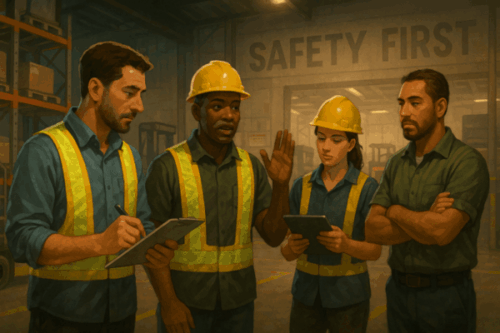
What OSHA Requires Isn’t Always What Workers Remember

And that’s where most safety programs quietly fail.

If you walk into most industrial or manufacturing sites across the U.S. and ask the safety manager, “Are you compliant with OSHA training requirements?” the answer is usually an assured yes. There are binders filled with sign-in sheets, digital folders holding certificates of completion, and spreadsheets documenting who took what, when.

But ask that same safety manager a different question—“If something goes wrong, are you confident your workers know what to do?” —and you’ll often get a pause.

That pause is the space where incidents happen.

This article is about that space. The gap exists between documented compliance and actual preparedness. It’s where too many safety programs quietly—and dangerously—fail. This failure is not due to negligence, but rather because the structure of regulatory training requirements often fails to align with the realities of human learning, workplace turnover, and operational pressure.

OSHA mandates training. But OSHA doesn’t test whether your team remembers anything once they leave the classroom. And that’s the real risk.


What OSHA Actually Requires (CFR Snapshot)

The Code of Federal Regulations (CFR) contains over 40 specific OSHA standards that explicitly require employee training. These regulations aim to equip workers with the necessary knowledge and skills to safeguard themselves against recognized workplace hazards.

But most of these rules focus on training delivery, not knowledge retention. You can be 100% compliant by checking the box—but still fail when it matters most.

🔒 Lockout/Tagout (29 CFR 1910.147)

  • Requires training for “authorized,” “affected,” and “other” employees.
  • Retraining is mandated with job/equipment changes.
  • Certification of completion is required.

Case Example: A temp worker was fatally electrocuted in Ohio (2020). The investigation revealed no LOTO training had been provided. [Source: OSHA News Release, 2020]

🧯 Forklift Safety (29 CFR 1910.178)

  • Requires formal, practical training and operator evaluation.
  • A refresher is required every 3 years or after an incident.

Data Point: Forklift-related incidents cause ~85 deaths and 34,900 serious injuries annually in the U.S. [Source: OSHA, 2023]

🧪 HAZWOPER (29 CFR 1910.120)

  • Requires 24–40 hours of training plus annual 8-hour refreshers.
  • Applies to workers at hazardous waste sites or chemical spill responses.

Note: Subcontractors often claim HAZWOPER compliance but lack valid or updated documentation.

🦠 Bloodborne Pathogens (29 CFR 1910.1030)

  • This training is required for workers who are exposed to blood or other potentially infectious materials (OPIM).
  • Annual retraining is mandated.

Observation: Non-clinical roles (e.g., janitors, laundry workers) are often overlooked despite exposure risk.

🚧 Confined Spaces (29 CFR 1910.146)

  • Workers must complete training before being assigned to permit-required confined spaces.
  • Retraining is required for procedural or hazard changes.

Case Example: In 2021, two workers in Texas lost consciousness due to oxygen deprivation in a confined space. Training records were incomplete.
[Source: OSHA Region 6 Case Files]

📌 Bottom Line: OSHA tells you what to train and when. But it doesn’t verify how well the message sticks.

Compliance ≠ Competency

Let’s say a new hire watches a fall protection video, signs a form, and starts work the next day. Three weeks later, they’re standing on a shaky ladder, one hand bracing a beam while reaching for a tool.

Technically trained. Functionally unprepared.

🧠 The Science of Forgetting

  • People forget 50% of information within 1 hour.
  • 70% within 24 hours,
  • 90% in a week without reinforcement.
    [Source: Ebbinghaus Forgetting Curve, Psychonomic Bulletin & Review, 2015]

And it’s worse in safety-critical roles:

  • High turnover
  • ESL barriers
  • Fatigue from long shifts
  • Training delivered in formats workers don’t relate to

For example, after a fall-related fatality in Florida in 2022, half of the job crew admitted that they believed harnesses were optional for short jobs. Training was “complete.” Behavior said otherwise.


The Hidden Costs of the ‘Check-the-Box’ Approach

💥 1. Preventable Incidents

Workplace injuries cost U.S. employers over $58 billion/year in direct costs alone. [Source: Liberty Mutual Workplace Safety Index, 2023]

Even well-intentioned training becomes worthless if workers forget, misinterpret, or never internalize it.

⚖️ 2. Legal Exposure

Signed sheets won’t protect you from legal scrutiny if your documentation is weak or incomplete.

Example: A subcontractor fell through a skylight in California. Training documents were unsigned and lacked detail. The jury awarded $11.3 million.  [Source: CA Civil Court Records, 2021]

🛑 3. Operational Drag

Poor training leads to:

  • Constant supervision
  • Repeat errors
  • Missed productivity goals
  • Lost morale and engagement

😒 4. Culture Breakdown

When workers view training as a formality, they treat safety as a formality. That’s when near misses become normalized.

Example: In one warehouse, workers admitted to clicking through digital modules without watching them. “It’s about checking boxes,” one said. That’s not training—it’s theater.

How Smart Companies Go Beyond the Bare Minimum

🔁 1. Continuous Training

Safety leaders use:

  • Daily toolbox talks
  • Microlearning (3–5 minutes/day)
  • On-the-job mentoring and peer reviews

Practice Highlight: A manufacturer in Indiana saw a 35% drop in safety incidents after launching “safety spotlight” themes embedded into shift meetings.

🤝 2. Supervisor Engagement

Supervisors aren’t just enforcers—they’re coaches:

  • They observe
  • Ask probing questions
  • Reinforce habits daily

🌐 3. Risk-Based Customization

  • High-risk roles require high-frequency refreshers.
  • Training is delivered in the workers’ first language.
  • Materials are adapted based on literacy and comprehension.

Example: A Texas utility contractor switched to bilingual live instruction and saw test scores and jobsite safety behaviors improve immediately.

👀 4. Behavior-Based Observations

Training isn’t assumed. It’s verified in the field:

  • Observations
  • Peer-to-peer feedback
  • “What if…” scenario drills

Data Point: Companies that use behavior-based safety observations see 40–60% fewer injuries. [Source: National Safety Council]

📚 5. Meaningful Documentation

Effective recordkeeping includes:

  • Content taught
  • Delivery method
  • Language of delivery
  • Trainer credentials
  • Pass/fail outcomes

Example: A global manufacturer avoided a six-figure fine by producing a time-stamped training video showing a temp receiving (and ignored) proper instruction.


Redefining What ‘Good Training’ Really Means

OSHA asks, “Did you train your workers?”

But the more important question is:

Did the training work?

Training becomes significant only when it equips workers to react immediately, rather than merely watching a video.

If your safety culture is built on comprehension, accountability, and repetition—not checklists—then you’re not just meeting a standard.

You’re protecting people.

And that’s the only metric that matters.

Why Safety Doesn’t Come Naturally

There’s a hard truth every safety leader eventually comes to grips with: humans are not naturally wired for safety. Not at work. Not at home. Not on the factory floor or at the job site. And certainly not when we’re stressed, tired, or distracted.

We’re wired to survive—but not to anticipate.

We’re wired for efficiency—not caution.

We’re wired to take shortcuts—not follow procedures.

So when an organization says they want to build a culture of safety, they’re not just setting policy—they’re asking people to rewire instinct.


The Science Behind Unsafe Behavior

Neuroscience gives us powerful insights into why safety is so hard to sustain. The prefrontal cortex—responsible for judgment, decision-making, and impulse control—isn’t always in charge when we’re working under pressure. Instead, the limbic system, which governs emotion and habit, often takes over.

That’s why experienced workers sometimes make dangerous mistakes: they’re running on autopilot. The brain favors repetition. If you’ve walked across the shop floor without a hard hat 200 times and nothing happened, your brain stores that as “safe”—even if it’s not.

And that’s just the beginning.

  • Risk normalization kicks in when hazards are frequent and uneventful.
  • Cognitive overload from multitasking reduces attention to detail.
  • Social dynamics like peer pressure, time pressure, or supervisor indifference shape whether people speak up.

Our biology, our psychology, and our workplace cultures all conspire to make safety harder than it should be.

So what can we do?


A Culture of Safety Must Override Instinct

Safety culture isn’t about rules. It’s about overrides.

It’s the behavioral architecture we build to guide people toward safer actions even when their instincts pull the other way. And it takes more than posters, policies, and PPE.

To create a culture that rewires behavior, organizations must blend science, systems, and story. Here’s how.

1. Make Safety Social, Not Just Procedural

Humans are social animals. We do what our peers do, not necessarily what’s written in the manual.

  • Micro-behaviors matter. When a supervisor wears hearing protection consistently, others follow. When they don’t, no sign on the wall will fix it.
  • Mentorship works. Pairing experienced, safety-conscious workers with new hires helps transfer not just skills, but mindsets.
  • Recognition shifts norms. Instead of only flagging violations, organizations should spotlight positive safety behaviors—like speaking up, stopping work, or reporting a near miss.

Culture isn’t what you say. It’s what you celebrate.


2. Create Space for the Brain to Work

Cognitive overload is a real and measurable hazard. When workers are juggling production goals, shifting procedures, and personal distractions, their brains are too taxed to prioritize safety.

  • Simplify decision points. Clear checklists reduce cognitive friction.
  • Design intuitive environments. Color-coded zones, visual cues, and automated reminders help anchor attention.
  • Avoid information dumping. Safety training shouldn’t be a firehose. Spread it out. Make it relevant. Reinforce it over time.

Give the brain room to do the right thing—and it will.


3. Shift from Fear to Trust

Fear-based safety cultures don’t work. They breed silence. They hide problems. And they guarantee that the next incident will be worse than the last.

Instead, high-performing safety cultures cultivate psychological safety:

  • People feel safe to speak up.
  • Supervisors listen, not lecture.
  • Employees can admit mistakes without being punished.

Trust allows information to flow. And information is the fuel of prevention.


4. Turn Near Misses into Gold

A near miss is a gift. It’s your organization’s nervous system firing in time.

But most go unreported—not because people don’t care, but because they don’t believe it matters, or worse, they fear retaliation.

Organizations should:

  • Celebrate near-miss reporting.
  • Treat near misses as learning opportunities—not liabilities.
  • Close the loop. Show what was done with the report. Prove it wasn’t wasted effort.

Near misses are the smoke. Treat them seriously, and you’ll rarely see fire.


5. Train for Behavior, Not Just Knowledge

Too much safety training is passive, generic, and forgettable. But learning science shows we retain more when we:

  • Practice skills in context.
  • Receive feedback immediately.
  • Repeat learning over time.

Effective safety training is:

  • Job-specific
  • Scenario-based
  • Culturally relevant
  • Engaging and interactive

And above all, it respects the worker’s intelligence and experience.


6. Use Tech to Amplify, Not Replace, Human Judgment

Digital tools can help—but they don’t replace culture.

Technology should:

  • Reduce friction in reporting
  • Automate reminders
  • Track trends across sites
  • Provide real-time data to inform decision-making

But the goal is not to “tech away” the human part of safety. The goal is to equip people—to make safety the easy choice, not the hard one.


7. Build Rituals, Not Just Systems

The brain loves ritual. It helps form habits. It provides cues and consistency. The best safety cultures embed ritual into daily operations:

  • Start every meeting with a safety moment
  • End every shift with a quick check-in
  • Ask “What could go wrong?” before beginning a task

These micro-moments stack. They send a signal: safety is always on.


What Gets in the Way? (And What to Do About It)

Even the best safety plans falter without the right conditions. Here are common blockers—and how to move through them.

Resistance from leadership: Frame safety as a performance and liability issue. Show the cost of inaction, not just the moral imperative.

Fatigue and distraction: Rotate shifts. Build in recovery. Don’t punish people for slowing down to stay safe.

Contractor chaos: Standardize onboarding. Share your safety values upfront. Monitor without micromanaging.

Complacency: Refresh training. Change up the message. Rotate roles so people see the risks from new angles.

Safety is a journey. Not a checkbox.


Final Thought: You’re Not Fighting People. You’re Fighting Biology.

The enemy of safety isn’t the worker. It’s the wiring.

It’s the instinct to hurry.

It’s the pressure to please.

It’s the brain’s lazy love for shortcuts.

Your job as a leader is to build a culture that helps people override those instincts—not once, but daily. That’s the only way it becomes habit. That’s the only way it becomes culture.

Safety isn’t about perfection. It’s about persistence. It’s about design. And it’s about believing that everyone—from the CEO to the temp hire—deserves to go home whole.

Let’s build systems that make that belief real.

Every day. Every shift. Every person.

#SafetyCulture #WorkplaceSafety #EHS #HumanFactors #SafetyLeadership #RiskPrevention #IndustrialSafety #ConstructionSafety #BehavioralSafety #SafetyMindset #InjuryPrevention #NearMiss


More Than a Moment: How to Make Safety Culture Part of Everyday Work

Week 2 of National Safety Month – Small Actions. Big Impact.

We’re now into the second week of National Safety Month, and there’s something important we need to talk about.

Sure, many of us have banners up. Some companies have issued challenge coins or done a “Safety Week” giveaway. There are probably a few posters near the lunchroom with stats about slips, trips, and falls. Maybe you’ve even done a big training day or brought in donuts and safety trivia.

All of that is great. But here’s the hard truth:

Culture doesn’t grow in a week. And it doesn’t show up because a poster says it should.

It grows because safety becomes something people do—not something they’re reminded of.

This week, let’s dive deep into how small, daily behaviors—when supported by simple tools and clear expectations—build lasting safety cultures.

Let’s explore how technology, like sam® by secova, plays a role. And let’s acknowledge the reality: embedding safety in everyday work isn’t always easy… but it is always worth it.


Where Culture Lives (and Dies)

Culture doesn’t exist in a binder. It doesn’t live in a PowerPoint deck. It lives in the thousands of tiny decisions people make every day:

  • Do I report that near miss?
  • Do I stop the line because of a guard that looks loose?
  • Do I walk past a wet floor sign… or make sure it’s been properly cleaned up?


What separates strong safety cultures from reactive ones isn’t compliance. It’s consistency.

It’s the repeated, visible, reinforced behaviors that create norms—and it’s those norms that eventually create belief systems.

So how do we get there?

Why the Poster Falls Flat: Common Mistakes in Safety Messaging

Let’s take a moment to look inward. How often does this happen?

  • Safety is treated as an event—not a daily rhythm
  • Teams hear “safety is everyone’s job” without being told what that actually means
  • Trainings are pushed out on timelines, not tied to actual risk exposure
  • Frontline workers don’t get real-time feedback or reinforcement

This creates what we call the “safety drop-off.”

It starts strong with enthusiasm and effort… but within weeks or months, things taper off. Posters fade. Messages blur. Behavior returns to “normal.”

Real culture change can’t rely on enthusiasm alone.

It has to be tied to the work. Tied to behavior. Tied to systems that support and reward consistency.

The Kaizen Connection: Small Actions Build Big Shift

Kaizen, a concept born in Japanese manufacturing, means “continuous improvement.”

Not giant leaps. Not major overhauls.

Tiny, repeatable steps.

In safety culture, Kaizen might look like this:

  • Five-minute daily safety debriefs at the end of shift
  • One worker trained each week in a new safety observation skill
  • Frontline team members empowered to lead toolbox talks, rotating weekly

These micro-interventions work because they do three things well:

  1. They reinforce behavior
  2. They spread ownership
  3. They normalize safety conversations

And they do it without slowing down productivity—or overwhelming managers.

This is what we mean when we say “infusing safety into everyday work.”

It’s not about more rules. It’s about making safety an expectation, not an exception.


Why Simple Tools Drive Deeper Culture

There’s a myth in safety management that in order to be compliant, you have to be complex.

But complexity kills consistency.

If workers can’t report a hazard in under a minute, they won’t do it. If a training platform crashes or requires three logins, people will avoid it. If corrective action requires six signatures and a PDF form, it’s already too late.

What culture needs is clarity—and what clarity needs is simplicity.

Digital tools, when done right, don’t replace human interaction. They amplify it. They reinforce culture by:

  • Making safety visible to leaders and workers alike
  • Providing real-time feedback loops
  • Encouraging reporting without punishment
  • Creating trend data that drives action

When people see that what they report actually gets tracked

—and resolved—

they believe in the process.

That’s culture reinforcement.

How sam® Makes Safety Culture a Daily Practice

At sam® by secova, we didn’t build a safety platform for safety people only. We built it for real-world users—from welders to warehouse managers, forklift drivers to first-year apprentices.

Here’s how sam® supports real cultural integration:

  • Microlearning at the Moment of Need
    • Instead of hour-long sessions, sam® delivers 2-5 minute refreshers tied to actual tasks and hazards. This makes safety part of the job—not a break from it.
  • Easy, Mobile Hazard Reporting
    • See something? Snap it. Tag it. Submit it. Done. Your team doesn’t need a degree to use sam®. They need a phone and a minute.
  • Corrective Actions That Don’t Disappear
    • Every action logged has an owner, a due date, and a follow-up. Nothing gets buried in paper logs or forgotten in inboxes.
  • Engagement Dashboards That Show Progress
    • Want to know which team leads follow through? Which shifts log near misses? Which sites are trending safer? It’s all right there.

This is what “infused” looks like. 

Not one more system. Not one more burden.

Just smart, simple tools that reinforce what your culture is already trying to do.

What You Can Do This Week

If you want to move from participation to integration—this is your playbook:

  1. Identify one routine task that could include a safety behavior. Maybe it’s tagging a worn cord, inspecting a fall harness, or logging a temperature check.
  2. Build a small ritual around it. Can you tie it to a pre-shift meeting? Can a different employee lead it each week?
  3. Remove one barrier to reporting. Digitize your form. Add a QR code. Give someone 15 minutes a week to gather insights.
  4. Recognize one behavior this week publicly. Did someone speak up? Log a near miss? Fix a hazard? Celebrate it—out loud.
  5. Use your system to reinforce, not just record. If you use sam®, lean on dashboards, notifications, and training flows to prompt—not punish.


You don’t need to change everything to change something.

And something small today can shift everything tomorrow.

This Isn’t a Month—It’s a Mindset

Safety Month reminds us to stop and focus. But if all we do is focus and forget—we’ve missed the point.  The goal isn’t participation. It’s permanence.

It’s a workplace where:

  • Safety conversations aren’t scheduled—they’re second nature
  • Reporting isn’t feared—it’s expected
  • Training isn’t a task—it’s a tool

And the truth is, you don’t get there by chance.  You get there by effort. By structure.  And by tools that make it easier to stay the course. That’s what we’re building with sam® by secova.

Because safety culture isn’t a poster.

It’s a practice.

And it’s something we all have the power to shape—one task, one tool, one day at a time.


#SafetyCulture #WorkplaceSafety #EHS #SafetyIntegration #NationalSafetyMonth #ContinuousImprovement #KaizenSafety #FrontlineSafety #SafetyMindset #NearMissReporting #SafetyLeadership #SmartSafety #EmployeeEngagemen,# SafetyTraining #RealTimeReporting #HazardPrevention #DigitalSafetyTools #OperationalSafety #SafetySimplicity #SafetyEveryday #ProactiveSafety #CultureOfCare #RiskReduction #SafetyInManufacturing #WarehouseSafety #ForkliftSafety #SafetySuccess #SimpleSafety #SafetyOwnership #samBysecova